
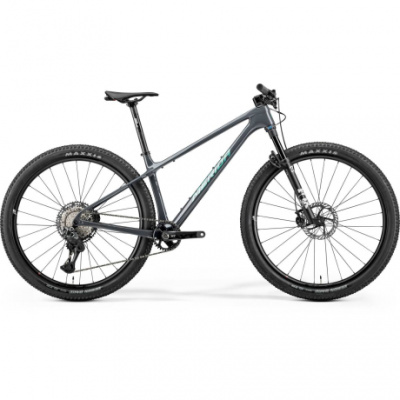
Merida BIG.NINE XT
Race-light carbon hardtail that climbs like it's been stung and shifts wirelessly when every second counts.
- CF3 III carbon frame: race-light, stiff, comfortable
- Shimano XT Di2 wireless: instant, precise shifts
- FSA SCi30 carbon wheels: low weight, 30mm internal
- Fox 32 SC Performance fork: 100mm, remote lockout
- 29×2.4" tyre clearance: versatile rubber choice
- AGILOMETER sizing: confident handling across all sizes
Merida BIG.NINE XT Deals
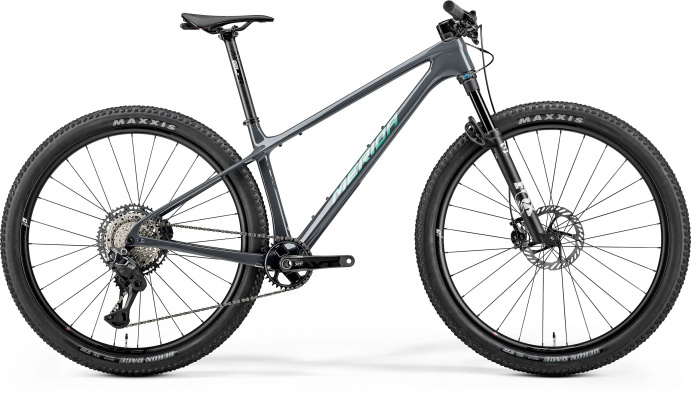

Prices and availability can change quickly. Delivery charges are not always included in listed prices.
Final price, stock status and delivery terms are set by retailer. We may receive a commission on purchases made.
Bikesy's Verdict
The Merida BIG.NINE XT is a hardtail that knows exactly what it's for. It climbs with the urgency of a bike half its price and corners with the poise of something twice as expensive, all while weighing in under ten kilograms. The wireless XT Di2 drivetrain is a genuine performance upgrade - no cables, no fuss, just instant shifts when you need them - and the carbon frame and wheels keep the weight low without resorting to fragile components. If you're racing XC or chasing personal bests on climbs, this bike will reward every watt you put through the pedals.
It's not a bike for riders who want plush, forgiving suspension or all-day comfort on rough trails. But if you know that less suspension often means more speed, and you'd rather shave seconds on the climb than coast through the descent, the BIG.NINE XT delivers exactly what you're after. The AGILOMETER sizing means you'll get confident handling no matter which frame size you choose, and the modern geometry keeps you composed when the trail gets technical. It's a machine that rewards commitment, and if you're serious about going fast, it's hard to fault.
Pros
- Race-light at 9.9 kg with carbon frame, wheels, and cockpit
- Shimano XT Di2 wireless shifting: fast, precise, cable-free
- AGILOMETER sizing keeps handling predictable across all frame sizes
- Fox 32 SC Performance fork with remote lockout balances climb efficiency and trail capability
- 29×2.4" tyre clearance offers versatility for grip or speed
Cons
- Hardtail design is more demanding on rough, prolonged descents than full-suspension alternatives
- High-end spec reflects in pricing if you're on a tighter budget
- Fixed seatpost limits descending confidence if you mix in trail riding beyond pure XC
About the Merida BIG.NINE XT
Merida's CF3 III carbon frame has been honed over countless race weekends and test laps, and the BIG.NINE XT distils that experience into a hardtail that climbs like it's been stung and corners with the poise of something twice the price. You're looking at a bike that weighs in around 9.9 kilograms, rolls on carbon hoops, and shifts wirelessly through Shimano's XT Di2 drivetrain - a spec sheet that reads like a love letter to the stopwatch. The Fox 32 SC Performance fork offers 100 millimetres of travel with a two-position remote lockout, so you can firm it up for the fire-road drag and open it back out when the trail gets choppy.
What sets this machine apart isn't just the headline components. Merida's AGILOMETER sizing philosophy tweaks reach, stack, and chainstay length across the five frame sizes to keep handling predictable whether you're on the small or the XXL. The CF3 carbon layup uses an Anti Wrinkle System to smooth the inside of each tube, boosting strength without adding grams, and the seat and chainstays are shaped to flex just enough that you don't rattle your fillings on washboard climbs. Internal cable routing through the stays and headset keeps things tidy, and there's clearance for 29×2.4" rubber if you want more grip or cushion than the stock Maxxis Rekon Race offers.
This isn't a bike that apologises for being a hardtail. It's built for riders who know that less suspension often means more speed, and who'd rather shave seconds on the climb than coast through the descent. The wireless XT Di2 setup means no cables to snag or stretch, just a thumb-press and a near-silent shift that lands exactly where you want it. The FSA SIC CF one-piece carbon cockpit integrates bar and stem - 60 millimetres on small through large, 80 on extra-large - and keeps the front end stiff enough to track true when you're out of the saddle. It's a package that rewards commitment: the harder you push, the more it gives back.
Merida BIG.NINE XT geometry
Reach grows from 432 millimetres on the small to 512 on the XXL, and stack climbs in step so you're not folded over the bar or sitting bolt upright. The 68-degree head angle is calm enough to inspire confidence on fast, rough descents yet sharp enough that you can flick the bike through tight switchbacks without wrestling the front wheel. Seat angle sits at 75.3 degrees across the range, planting you over the bottom bracket so your weight drives the rear tyre into the ground on technical climbs rather than lifting it skyward.
Chainstays lengthen slightly as frame size increases - 430 millimetres on the small, 442 on the XXL - which keeps the wheelbase proportional and prevents smaller riders from feeling twitchy or larger riders from feeling like they're steering an oil tanker. The result is a bike that feels planted at speed, responsive in tight sections, and predictable when you need to change line mid-corner. Bottom-bracket drop is a consistent 65 millimetres, low enough to keep the centre of gravity grounded but not so deep that you're clipping pedals on off-camber roots.
When you're sprinting out of a hairpin or threading through a rock garden, the geometry translates into a front end that holds its line and a rear that hooks up without feeling nervous. Taller riders get more stack without losing the aggressive posture, and shorter riders aren't left perched on tiptoes at the lights. It's a sizing system that acknowledges real bodies ride real trails, and it shows in the way the bike behaves under pressure.
Component choices & upgrades
The stock build is already dialled. Shimano XT Di2 wireless shifting is as good as it gets before you step up to XTR, and the Fox 32 SC Performance fork offers a remote lockout that's genuinely useful when the gradient kicks up. The FSA SCi30 carbon wheelset brings a 30-millimetre internal width that supports wider tyres without adding weight, and the Shimano XT hydraulic brakes - 180-millimetre rotor up front, 160 at the back - haul you down with two-piston bite that's easy to modulate.
If you're chasing every last gram or racing at a level where marginal gains matter, you could swap the Maxxis Rekon Race tyres for something lighter or faster-rolling, though you'll sacrifice some grip on loose corners. A carbon seatpost is already fitted, so the next step would be a lighter saddle if the Prologo Akero doesn't suit your sit bones. The FSA SL-K post has zero setback, which works well with the steep seat angle, but riders who prefer a more rearward position might want an inline post with a setback option.
For most riders, the smart money is on leaving the drivetrain and brakes alone and spending any upgrade budget on tyres, grips, or a dropper post if you're mixing in trail rides where a bit of saddle drop would help on the descents. The frame will clear a short-travel dropper, and the internal routing makes installation straightforward. But if you're racing pure XC, the fixed post keeps weight down and eliminates one more thing to think about when you're in the red.
Where the Merida BIG.NINE XT excels
This bike is outstanding at cross-country racing. If your weekends involve mass-start sprints, lung-searing climbs, and technical descents where a second's hesitation costs you three places, the BIG.NINE XT delivers the speed and precision you need. The lightweight carbon frame and wireless shifting mean you can attack climbs without waiting for the drivetrain to catch up, and the modern geometry keeps you composed when the course gets rough.
It's also excellent for fast trail rides where efficiency matters more than plush suspension. Long fire-road slogs, flowy singletrack, and moderate technical sections all play to the hardtail's strengths: you get instant power transfer, predictable handling, and a ride quality that's surprisingly comfortable thanks to the shaped carbon stays. The 100-millimetre fork is enough for most XC terrain, and the remote lockout means you're not wasting energy bobbing through the travel on smooth sections.
Where it's not ideal is on prolonged, rough descents or trails littered with square-edged hits. A hardtail will always be more demanding on your body than a full-suspension bike when the trail gets truly gnarly, and while the carbon frame does a decent job of damping vibration, you'll feel more through the saddle and bars than you would on a short-travel trail bike. If your local loops are more enduro than XC, or if you're spending more time descending than climbing, a bike with rear suspension will be kinder to your hands and lower back. But for riders who live for the climb and treat the descent as a victory lap, this machine is hard to beat.
Merida BIG.NINE XT FAQs
What is the weight of the Merida BIG.NINE XT 2026?
The complete bike weighs approximately 9.9 kilograms, which puts it firmly in race-ready territory. That figure includes the carbon frame, carbon wheels, and wireless XT Di2 drivetrain, so you're getting a genuinely light package without resorting to fragile components.
What type of riding is the Merida BIG.NINE XT best suited for?
It's built for cross-country racing and fast trail riding where efficiency and low weight matter more than suspension travel. If you're chasing podiums or personal bests on climbs, this bike will reward your effort. It's less suited to all-day epics on rough, technical terrain where a full-suspension bike would be more forgiving.
Does the Merida BIG.NINE XT have internal cable routing?
Yes, cables and hoses run internally through the stays and headset, which keeps the frame looking clean and protects the lines from trail debris. The wireless Di2 drivetrain means there are no shift cables to route, just brake hoses and the occasional wire for the fork's remote lockout.
What is the maximum tyre clearance on the Merida BIG.NINE XT?
The frame will clear 29×2.4" tyres, which gives you plenty of room to experiment with wider, grippier rubber if the stock Maxxis Rekon Race feels too fast-rolling for your local trails. That clearance also means you won't have mud packing issues in wet conditions.
How does the AGILOMETER sizing work on Merida bikes?
AGILOMETER is Merida's approach to scaling geometry across frame sizes so that handling characteristics remain consistent whether you're on a small or an XXL. Reach, stack, and chainstay length all change proportionally, which means smaller riders get a bike that's nimble without being twitchy, and taller riders get stability without sluggishness. It's a thoughtful system that acknowledges one geometry doesn't fit all.
Is the Merida BIG.NINE XT a good bike for racing?
Absolutely. The lightweight carbon frame, wireless XT Di2 shifting, and modern geometry make it a formidable XC race machine. It climbs efficiently, accelerates sharply, and handles technical sections with confidence. If you're serious about racing and want a hardtail that won't hold you back, this bike delivers.
What are the key upgrades on the 2026 Merida BIG.NINE XT compared to previous models?
The headline change is the introduction of Shimano XT Di2 wireless shifting, which replaces the mechanical or wired electronic drivetrains on earlier models. You also get the FSA SCi30 carbon wheelset and the FSA SIC CF one-piece carbon cockpit, both of which save weight and add stiffness. The Fox 32 SC Performance fork is another upgrade, offering refined damping and a reliable remote lockout.
What bottom bracket standard does the Merida BIG.NINE XT use?
It uses a BSA threaded bottom bracket, which is easy to service, widely compatible, and less prone to creaking than press-fit designs. The Shimano BB-MT-801 unit is a solid choice that pairs well with the XT crankset and should give you years of trouble-free use.
Key Features & Benefits
- CF3 III carbon frame with Anti Wrinkle System: Race-light stiffness with shaped stays that absorb trail chatter, so you climb faster without rattling your fillings on rough sections.
- Shimano XT Di2 wireless drivetrain: Instant, precise shifts at a thumb-press with no cables to stretch or snag, giving you a performance edge in tight racing situations.
- FSA SCi30 carbon wheelset with 30mm internal width: Low rotating weight and wide rim profile support bigger tyres for grip and comfort without adding grams or sacrificing acceleration.
- AGILOMETER sizing philosophy: Proportional geometry across all five sizes means confident, predictable handling whether you're on the small or the XXL frame.
- Fox 32 SC Performance fork with remote lockout: 100mm of travel you can firm up on climbs and open out on descents, so you're never wasting energy or control when it matters.
Merida BIG.NINE XT 2025 and 2024 differences
The 2025 model shared much of the same carbon frame and modern geometry as the 2026 release, but some sources list a RockShox SID SL fork in place of the Fox 32 SC Performance, and the wheelset was often the aluminium MERIDA EXPERT CC rather than the FSA SCi30 carbon hoops. The biggest change for 2026 is the introduction of Shimano XT Di2 wireless shifting, which replaces the mechanical or wired electronic drivetrains on earlier models, and the addition of the FSA SIC CF one-piece carbon cockpit, both of which save weight and add stiffness.
The 2024 model continued with the CF3 carbon frame and a similar spec, though some builds featured the MERIDA EXPERT CC II aluminium rims with a narrower 25-millimetre internal width, and Shimano XT hubs rather than the FSA carbon wheelset. The fork was often a RockShox SID SL, and the drivetrain was typically a mechanical Shimano XT 12-speed setup. The 2026 model's wireless Di2 and carbon wheels represent a clear step up in performance and refinement, though the core ride character - fast, efficient, and confidence-inspiring - remains consistent across recent model years.
Alternatives to Consider
Within Merida's own range, the BIG.NINE XT-EDITION offers a similar spec on an aluminium frame if you want to save some budget without sacrificing too much performance, while the BIG.NINE 10K steps up to Shimano XTR Di2 and even lighter carbon components for riders chasing every marginal gain. If you're after a touch more trail capability, Merida's BIG.NINE TR models lean into the downcountry category with slacker geometry and more forgiving suspension.
Cross-brand, the Specialized Epic HT Expert is a direct rival with a similarly light carbon frame, modern geometry, and wireless SRAM AXS shifting, though it tends to favour a slightly more aggressive race position. The Trek Procaliber 9.7 brings IsoSpeed rear compliance and a similar XT-level build, offering a bit more comfort on rough trails without the weight penalty of full suspension. Scott's Scale 930 delivers sharp handling and a proven carbon platform at a comparable price point, while the Cannondale Scalpel HT Carbon 2 offers a stiffer, more race-focused ride with a one-piece carbon rear end. For riders who want a bit more versatility, the Orbea Alma M30 pairs modern geometry with a slightly more relaxed ride quality that suits fast trail riding as much as pure racing.
Reviews
Longer reach and a calmer front centre bring poise to technical climbs without dulling the bike's eagerness to change direction. The CF3 carbon frame feels alive under power, translating every pedal stroke into forward motion with minimal flex, and the shaped stays do a surprisingly good job of filtering out high-frequency buzz from washboard climbs. When the gradient eases and the trail opens up, the Fox 32 SC Performance fork tracks smoothly through chatter, and the remote lockout is genuinely useful - firm it up for the fire road, crack it open for the descent, and you're never fumbling with a lever mid-sprint.
Shimano's XT Di2 wireless shifting is a revelation. Thumb the paddle and the derailleur snaps into place with a near-silent click, no cable stretch or housing friction to slow things down. Because the system is wireless, there's one less thing to route through the frame and one less thing to go wrong when you're deep into a race. The FSA SCi30 carbon wheels spin up fast and hold speed well, and the 30-millimetre internal width means the Maxxis Rekon Race tyres sit wide and stable, even when you're leaning hard into a loose corner.
Descending on a hardtail always demands more from the rider than a full-suspension bike would, but the BIG.NINE XT's geometry keeps you centred and confident. The 68-degree head angle is slack enough that the front wheel doesn't dart around on rough ground, and the steep seat angle means you're not pitched too far forward when the trail drops away. We found the bike most rewarding on fast, flowy singletrack where you can carry momentum and let the lightweight frame do the work. On prolonged, square-edged descents, you'll feel more through the saddle and bars than you would on a short-travel trail bike, but that's the trade-off for a machine that climbs this well.
Handling is predictable across the size range thanks to AGILOMETER sizing, which scales reach, stack, and chainstay length proportionally. Smaller riders get a bike that's nimble without feeling nervous, and taller riders get stability without the front end wandering. The integrated FSA cockpit is stiff and clean-looking, though riders who like to tinker with stem length or bar width will need to swap the whole unit rather than just one piece. Overall, the BIG.NINE XT feels like a bike that's been refined over countless race laps: it's fast where it needs to be, composed where it counts, and light enough that you'll notice the difference every time the trail points up.
Full Specification
| Spec | Value |
|---|---|
| Frame | CF3 III carbon fibre |
| Frame Construction | Progressive geometry with AGILOMETER sizing |
| Frame Features | Internal cable routing, AWS (Anti Wrinkle System) |
| Tyre Clearance | 29x2.4" |
| Bottom Bracket | BSA threaded, Shimano BB-MT-801 24mm |
| Rear Axle | 148x12mm Boost |
| Fork | Fox 32 SC Performance |
| Fork Travel | 100mm |
| Fork Offset | 44mm |
| Fork Adjustments | Air sprung, 2-position remote lockout, tapered steerer tube |
| Drivetrain | 1x12 speed |
| Shifters | Shimano XT Di2 M8250, wireless |
| Rear Derailleur | Shimano XT Di2 M8250, wireless, SGS |
| Crankset | Shimano XT M8200, 34 teeth |
| Crank Length | 170mm (S/M), 175mm (L/XL/XXL) |
| Cassette | Shimano Deore M8200, 10-51 teeth |
| Brakes | Shimano XT Hydraulic Disc |
| Brake Levers | Shimano XT M8100/M8110 |
| Calipers | Shimano XT M8100/M8110, 2-piston |
| Rotors (Front) | 180mm |
| Rotors (Rear) | 160mm |
| Wheels | FSA SCi30 carbon wheelset |
| Rims (IW) | FSA SCi30, 30mm internal width |
| Hubs (Front) | FSA SCi30, Centerlock, 110x15mm |
| Hubs (Rear) | FSA SCi30, Centerlock, 148x12mm, Shimano Microspline freehub |
| Tyres (Front) | Maxxis Rekon Race, 29x2.4" WT, tubeless ready, 3C MaxxTerra EXO |
| Tyres (Rear) | Maxxis Rekon Race, 29x2.4" WT, tubeless ready, 3C MaxxTerra EXO |
| Cockpit | FSA SIC CF 1-piece, carbon, 760mm width, -7° sweep |
| Stem | Integrated FSA SIC CF, 60mm (S/M/L), 80mm (XL) |
| Headset | Acros ICR MERIDA INTEGRATED, IPS sealing |
| Seatpost | FSA SL-K, carbon, 30.9mm diameter, 0mm setback, 400mm (S/M), 450mm (L/XL/XXL) |
| Saddle | Prologo Akero R PAS, recycled, V-mount |
| Mounts | Two bottle cage mounts on downtube |
| Weight (Approx) | 9.9 kg |