
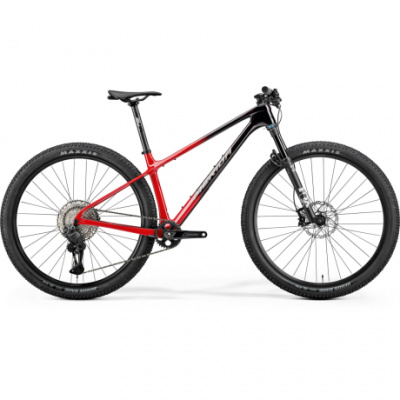
Merida BIG.NINE 7000
Race-sharp XC hardtail that climbs like a whippet and holds its line when the trail gets rowdy.
- CF3 carbon frame: climbs fast, stays stiff
- Shimano XT 1×12: crisp shifts, wide range
- Rock Shox SID SL fork: 100mm XC precision
- DT Swiss X1900 wheels: Boost stiffness, 25mm internal
- Maxxis Rekon Race 2.35": fast-rolling, grippy enough
- Modern XC geometry: stable descents, efficient climbs
Merida BIG.NINE 7000 Deals

Prices and availability can change quickly. Delivery charges are not always included in listed prices.
Final price, stock status and delivery terms are set by retailer. We may receive a commission on purchases made.
Bikesy's Verdict
The Merida BIG.NINE 7000 is a proper XC race machine that doesn't ask you to compromise on descending confidence. The CF3 carbon frame is light and stiff enough to reward every pedal stroke, while the modern geometry means you're not constantly wrestling the front end when the trail gets technical. Shimano XT components and a Rock Shox SID SL fork deliver the sort of precision and reliability you'd expect from a bike aimed squarely at marathon racers and riders who treat every climb as a personal challenge.
It's not trying to be a trail bike or an all-rounder - this is a focused tool for covering ground fast, whether that's racing, training, or simply enjoying spirited XC loops. The spec is generous for the money, and the bike's capability on rough descents is a genuine step forward from older-generation XC hardtails. If your riding is focused on speed, efficiency, and technical XC terrain, the BIG.NINE 7000 is a brilliant choice that punches well above its weight.
Pros
- Lightweight CF3 carbon frame climbs fast and stays stiff under power
- Full Shimano XT drivetrain and brakes offer race-level precision and reliability
- Modern XC geometry balances climbing efficiency with confident descending
- DT Swiss X1900 wheels and Boost spacing add stiffness without excessive weight
- Good tyre clearance (up to 2.4") lets you adapt to varied terrain
Cons
- 100mm fork travel feels limiting on very rough or aggressive descents
- No dropper post as standard - worth adding if you ride technical trails regularly
- Limited mounting options if you want racks or mudguards for adventure use
About the Merida BIG.NINE 7000
The BIG.NINE 7000 sits near the top of Merida's hardtail XC range, and it's built to do one thing exceptionally well: cover ground fast. CF3 carbon keeps the frame light and stiff enough to reward every pedal stroke, while Shimano XT components and a Rock Shox SID SL fork deliver the sort of precision you'd expect from a bike aimed squarely at marathon racers and riders who treat every climb as a personal challenge. It's not trying to be a trail bike with XC pretensions - this is a proper cross-country machine that happens to descend with more composure than older-generation race hardtails.
You'll notice the modern geometry straight away. The head angle is slacker than the steep-and-twitchy XC bikes of a decade ago, and the reach is longer, so you're not perched over the front wheel like a jockey. That translates to stability when the singletrack gets technical or the descent turns loose, yet the steep seat angle keeps your weight forward enough to maintain traction on climbs. It's a balance that works whether you're chasing podiums or simply want a hardtail that won't punish you for pointing it downhill.
Merida's built a reputation for offering serious performance without the boutique price tag, and the 7000 spec reflects that. You're getting a full XT drivetrain, XT brakes, and DT Swiss wheels - components that would cost a small fortune if you pieced them together yourself. The frame itself is no afterthought either: internal routing keeps cables tidy, Boost spacing adds rear-end stiffness, and there's clearance for up to 2.4-inch rubber if you want more cushion or grip. It's a thoughtful package that prioritises the bits that matter most when you're racing the clock or your mates.
Merida BIG.NINE 7000 geometry
Modern XC geometry has moved away from the old race-bike formula of steep angles and short front centres, and the BIG.NINE 7000 reflects that shift. The head angle is relaxed enough to inspire confidence on technical descents, so you're not fighting the bike when the trail pitches down or throws a rock garden at you. At the same time, the seat angle is steep - your hips sit forward over the bottom bracket, which keeps weight on the front tyre during climbs and stops the rear wheel from spinning out on loose or steep pitches.
Reach is generous across the size range, giving you room to move your weight back on descents without feeling cramped, yet the cockpit doesn't feel stretched when you're seated and grinding up a fire road. The longer wheelbase adds stability at speed and smooths out the bike's reaction to trail chatter, but chainstays are kept short enough to maintain the snappy, responsive feel you want from a hardtail. It's a geometry that suits riders who want XC efficiency without sacrificing control when the terrain gets interesting.
If you've ridden older XC hardtails, the difference is immediate. You're not constantly wrestling the front end on descents, and the bike doesn't feel like it's trying to buck you over the bars every time you hit a root. The trade-off is minimal - you might notice a fraction more weight on steep, technical climbs compared to a super-steep race bike, but the payoff in descending confidence and all-day comfort is worth it for most riders.
Component choices & upgrades
The stock build is already well sorted. Shimano XT is the sweet spot in Shimano's range - reliable, precise, and durable enough to handle mud, grit, and the occasional missed shift without complaint. The 10-51T cassette gives you a wide enough range to spin up steep climbs and still have gears left for flat-out fire-road sprints. XT brakes offer plenty of power and modulation, with 180mm front and 160mm rear rotors providing ample stopping force for XC use. The Rock Shox SID SL fork is a proven XC workhorse, with lockout and rebound adjustment to fine-tune the ride, and it's light enough not to blunt the bike's climbing edge.
DT Swiss X1900 wheels are solid performers - 25mm internal width suits modern XC tyres well, and the Boost hubs add stiffness without excessive weight. Maxxis Rekon Race tyres are fast-rolling and grippy enough for most XC conditions, though they're not the burliest option if you're regularly riding loose, rocky trails. The cockpit is Merida's own Expert CC kit: a 760mm flat bar, 50mm stem, and a rigid seatpost. It's functional and light, if not especially plush.
If you're chasing marginal gains or your riding demands more, a dropper post is the first upgrade worth considering. The frame accepts a 30.9mm post, and even a short-travel dropper (80 - 100mm) transforms the bike's capability on technical descents. You'll be able to shift your weight back properly, which makes a hardtail far more forgiving when the trail gets steep or loose. Beyond that, tyres are the next sensible tweak - if you ride rockier or looser terrain, a burlier casing or a more aggressive tread pattern (Maxxis Ardent, Schwalbe Racing Ralph) will add grip and confidence without much weight penalty. Wheels are another area where lighter hoops or a higher-engagement rear hub can sharpen the bike's response, but the stock DT Swiss set is good enough that you'd only notice the difference if you're racing or obsessing over every gram.
Where the Merida BIG.NINE 7000 excels
This bike is outstanding at cross-country racing and fast, flowing singletrack. If your weekends involve timed laps, marathon events, or simply trying to beat your mates up the local climb, the BIG.NINE 7000 is in its element. The lightweight carbon frame and efficient drivetrain reward effort instantly, and the modern geometry means you're not sacrificing control on the descents. It's also excellent for spirited trail rides where the terrain is varied but not overly technical - think groomed XC loops, rolling singletrack, and fire-road connectors.
It does well on rougher gravel byways and bridleways too, thanks to decent tyre clearance and Boost stiffness. The 100mm fork takes the sting out of roots and rocks, and the bike's agility makes it easy to pick lines through technical sections. You're not going to mistake it for a trail bike, but it's more capable on rough descents than older XC hardtails, and that makes it a versatile choice if you mix race-pace riding with more exploratory adventures.
Where it's not ideal: aggressive trail riding or enduro-style descents. The 100mm fork and hardtail platform have limits, and if you're regularly hitting steep, rocky chutes or jump lines, you'll want more travel and rear suspension. It's also not the best choice for bikepacking or long-distance touring - there are no rack or mudguard mounts, and the rigid seatpost and race-focused geometry prioritise speed over all-day comfort. If your riding is purely XC or you occasionally venture onto rougher trails, it's a brilliant tool. If you want one bike to do everything, you'll need to compromise somewhere.
Merida BIG.NINE 7000 FAQs
What is the weight of the Merida BIG.NINE 7000?
Around 10.9 kilograms for a size medium, which is competitive for a carbon XC hardtail at this spec level. The CF3 frame and XT components keep weight in check without resorting to fragile or overly expensive parts.
Is the Merida BIG.NINE 7000 a good trail bike?
It's capable on trails, especially flowing or moderately technical singletrack, but it's primarily an XC race bike. The 100mm fork and hardtail design mean it's not as forgiving as a trail bike on rough, steep descents. If your riding is mostly XC with occasional trail excursions, it'll handle it; if you're chasing gnarly descents regularly, you'll want more travel.
What is the tyre clearance on the Merida BIG.NINE 7000?
Up to around 2.3 or 2.4 inches, depending on rim and tyre combination. That's enough for most XC and trail conditions, and you can fit wider rubber if you want more cushion or grip on rougher terrain.
Can I fit a dropper post to the Merida BIG.NINE 7000?
Yes, the frame accepts a 30.9mm dropper post. It's not included as standard, but fitting one is straightforward and makes a noticeable difference on technical descents, giving you more control and confidence when you need to shift your weight back.
What is the difference between Merida BIG.NINE models?
The BIG.NINE range spans several spec levels, from more affordable aluminium builds to high-end carbon race machines. The 7000 sits near the top, with a CF3 carbon frame, full Shimano XT drivetrain, and quality suspension and wheels. Higher models (like the 8000) typically feature lighter frames, upgraded forks, or carbon wheels, while lower models use aluminium frames and more budget-conscious components.
What type of riding is the Merida BIG.NINE 7000 best suited for?
Cross-country racing, marathon events, and fast trail riding. It's built for efficiency and speed, with enough descending capability to handle technical XC terrain confidently. It's not a trail bike or an all-rounder, but if your riding is focused on covering ground quickly, it's a brilliant choice.
What is the fork travel on the Merida BIG.NINE 7000?
100 millimetres, which is standard for XC hardtails. The Rock Shox SID SL fork is designed for efficiency and precise control, with lockout and rebound adjustment to suit different terrain and rider preferences.
Key Features & Benefits
- CF3 carbon frame with Boost 148 spacing: Lightweight and stiff platform rewards every pedal stroke, while wider rear spacing adds wheel stiffness and tyre clearance for varied terrain
- Shimano XT 1×12 drivetrain with 10-51T cassette: Wide gear range and crisp, reliable shifting let you spin up steep climbs and still have gears left for flat-out sprints
- Rock Shox SID SL Select+ fork, 100mm travel: Lightweight XC fork with lockout and rebound adjustment delivers precise control and efficiency without blunting climbing performance
- Modern XC geometry with slacker head angle and longer reach: Stable and confident on technical descents, yet still efficient and responsive when climbing or sprinting
- DT Swiss X1900 wheels with 25mm internal width: Strong, stiff wheelset suits modern XC tyres and handles rough terrain without excessive weight penalty
Merida BIG.NINE 7000 2024 & 2023 differences
The 2025 model retains the core CF3 carbon frame and modern XC geometry that defined the 2024 and 2023 versions, with only minor component tweaks year-on-year. The 2024 spec was very similar to 2025, typically featuring the same Shimano XT 1×12 drivetrain, XT brakes, and a quality 100mm XC fork (often the Rock Shox SID SL or similar). DT Swiss X1900 wheels were standard across recent years, and tyre choice remained focused on fast-rolling XC rubber like the Maxxis Rekon Race.
The 2023 model continued the same performance-oriented approach, with Shimano XT or SRAM GX-level components depending on regional spec. Frame geometry and Boost spacing have remained consistent, so the ride character and handling are largely unchanged across these model years. Any differences are typically limited to minor component updates - fork damper revisions, slightly different tyre models, or updated cockpit finishing kit - rather than fundamental changes to the bike's design or capability.
Alternatives to Consider
Within Merida's range, the BIG.NINE 8000 offers a step up in spec - typically a lighter frame, upgraded fork, or carbon wheels - if you're chasing every marginal gain. Step down to the BIG.NINE 6000 or 5000 for a more budget-conscious build, often with SRAM NX or Shimano Deore components and an aluminium frame, though you'll sacrifice some weight and refinement. If you want rear suspension, Merida's Ninety-Six range delivers full-suspension XC performance with similar race-focused geometry.
Cross-brand, the Specialized Epic HT is the most direct rival - carbon frame, modern XC geometry, and a similar focus on climbing efficiency and descending control. The Trek Procaliber offers IsoSpeed rear compliance for a slightly smoother ride on rough XC trails, though it's often pricier at equivalent spec. Scott's Scale 940 or 950 models are worth comparing too, with carbon frames and quality components at competitive prices. The Cannondale Scalpel HT brings Lefty fork integration and a distinctive look, though availability and pricing can vary. For a slightly more trail-oriented hardtail with XC speed, the Orbea Alma M30 or Giant XTC Advanced SL blend race efficiency with a touch more descending capability.
Reviews
Acceleration is immediate - the CF3 frame channels every watt into forward motion, and the Shimano XT drivetrain responds with the sort of crisp, predictable shifts that let you focus on the trail rather than the gears. Climbs feel effortless in the way only a light, stiff hardtail can deliver, and the steep seat angle keeps your weight planted over the rear wheel even when the gradient kicks up. When the trail points down, the slacker head angle and longer wheelbase bring a composure that older XC hardtails simply didn't have. You're not fighting the bike through rock gardens or bracing for every root - it holds its line and lets you carry speed with confidence.
Rock Shox's SID SL fork strikes a fine balance between efficiency and control. Lockout firms things up for smooth climbs, and the rebound adjustment lets you tune the fork's reaction to suit the terrain. It's not as plush as a longer-travel trail fork, but that's not the point - this is about keeping the front wheel tracking precisely and minimising energy loss. DT Swiss X1900 wheels feel stiff and responsive, and the 25mm internal width suits the Maxxis Rekon Race tyres well. Those tyres roll fast on hardpack and grip predictably in most conditions, though they're not the burliest option if you're regularly riding loose or rocky trails.
Shimano XT brakes offer plenty of power and modulation, with enough bite to scrub speed quickly on steep descents without feeling grabby or harsh. The 760mm bar and 50mm stem create a cockpit that's roomy enough for confident descending yet still efficient when you're seated and climbing. Because the frame lacks a dropper post, you'll need to manually adjust saddle height for big descents, which is manageable but less convenient than a lever-actuated post. Fit one and the bike's descending capability takes a noticeable step forward - you'll be able to shift your weight back properly, which makes a hardtail far more forgiving when the trail gets steep or loose.
Overall, the BIG.NINE 7000 delivers the sort of performance you'd expect from a bike costing significantly more. It's light, stiff, and responsive, with components that work seamlessly together and geometry that suits modern XC riding. If your focus is on covering ground quickly - whether that's racing, training, or simply enjoying fast, flowing trails - it's a brilliant tool that rewards effort and skill in equal measure.
Full Specification
| Specification | Details |
|---|---|
| Frame Material | CF3 Carbon |
| Frame Design | Modern XC geometry with tapered head tube and internal cable routing |
| Rear Axle Spacing | Boost 148x12mm |
| Bottom Bracket | PF92 (PressFit 92mm) |
| Fork | Rock Shox SID SL Select+ Air, 100mm travel, lockout and rebound adjustment |
| Drivetrain | Shimano XT 1x12 speed |
| Cassette | Shimano XT, 10 - 51T |
| Crankset | Shimano XT |
| Brakes | Shimano XT hydraulic disc, 180mm front / 160mm rear |
| Wheels | DT Swiss X1900 Spline, 29in, Boost 110x15mm front / Boost 148x12mm rear |
| Rims | DT Swiss X1900 Spline, 25mm internal width |
| Tyres | Maxxis Rekon Race, 29x2.35in |
| Approximate Weight | 10.90 kg (size M) |
| Headset | FSA NO.55E |
| Handlebar | Merida Expert CC, 760mm width, flat |
| Stem | Merida Expert CC, 50mm length |
| Seatpost | Merida Expert CC, 30.9mm diameter |