
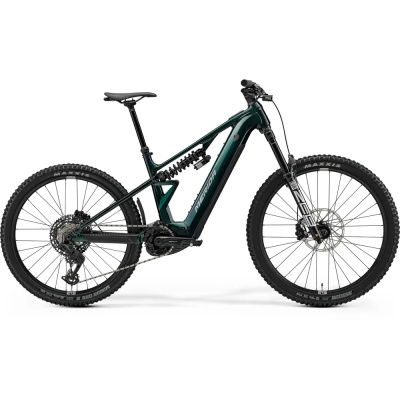
Merida eOne-Eighty FR 800
The Merida eOne-Eighty FR 800 is a 2026 coil-shock, Bosch CX-powered freeride and downhill e-bike built for riders who want serious suspension and braking for repeated hard descents rather than all-round trail use.
- 180 mm coil-sprung suspension (Vivid Coil Ultimate + Zeb Ultimate): Suspension built to stay consistent through repeated hard hits on demanding descents and bike-park laps.
- Bosch Performance Line CX motor with removable 800 Wh battery: Assisted climbs back to the top between runs, with a battery you can take indoors to charge.
- SRAM Maven Base four-piston brakes, 220 mm/200 mm rotors: Strong, controllable stopping power for steep, sustained descents.
- SRAM Eagle 70 Transmission, 10-52t 1x12 gearing: Wide-range gearing to get back up the hill without a second chainring.
- Fitted lights, short mudguard and under-saddle multitool: Ready for early starts, muddy laps and trailside fixes without buying extras.
- Four sizes (Short to XLong) with size-specific rear coil spring rates: Suspension pre-matched to typical rider weight for each frame size.
Merida eOne-Eighty FR 800 Deals
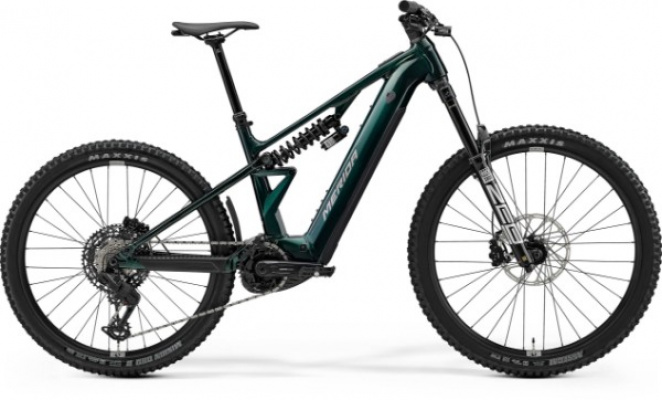
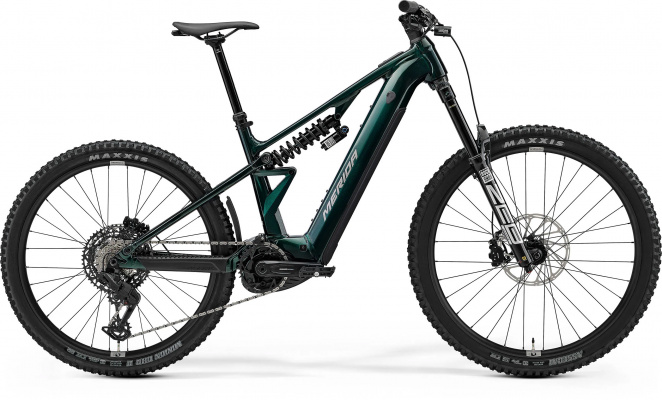

Prices and availability can change quickly. Delivery charges are not always included in listed prices.
Final price, stock status and delivery terms are set by retailer. We may receive a commission on purchases made.
Bikesy's Verdict
The eOne-Eighty FR 800 is a specialist descending e-bike, and it's a genuinely appealing one for riders whose priority is repeated, demanding runs rather than covering ground. Its coil-sprung Vivid Coil Ultimate shock, Zeb Ultimate fork and four-piston Maven Base brakes are exactly the equipment you'd want for sustained, rough descents and bike-park laps, backed by a removable 800 Wh battery for the climbs back up. At a claimed 27.6 kg, though, it's not a bike to consider if you also want something light and playful for varied trail riding; this is a bike built to be shuttled or lift-served and ridden hard, and it does that job with equipment to match. For that specific brief, it's well worth owning.
Pros
- Coil-sprung Vivid Coil Ultimate shock and Zeb Ultimate fork built for repeated, high-speed hits rather than a single long descent
- SRAM Maven Base four-piston brakes on big 220 mm/200 mm rotors give plenty of stopping power for steep, sustained descents
- Removable 800 Wh Bosch battery lets you charge indoors rather than needing the whole bike near a socket
- Fitted lights, mudguard and multitool save buying extra kit for early starts or bike-park days
- Size-specific rear coil spring rates mean the suspension setup is matched to the frame size from the outset
Cons
- At a claimed 27.6 kg (frame size unspecified), it's a genuinely heavy bike to lift onto a car rack or hoist
- Category 5 freeride/downhill focus makes it a specialist descending bike rather than an all-round trail e-bike
- No confirmed real-world range or per-bike torque setting is published, so runtime is something to judge conservatively rather than rely on a quoted figure
The Merida eOne-Eighty FR 800 is aimed at riders who want a full-power e-bike built specifically for pointing down the steepest, roughest tracks and then doing it again straight away. It's the coil-shock, braking-focused build at the descending end of Merida's Bosch-powered eONE-EIGHTY family, running 180 mm of travel front and rear on mixed 29-inch front and 27.5-inch rear wheels, with suspension and brakes chosen for repeated hard hits rather than all-day trail riding.
Built for hard descending, not daily miles
Merida classes the FR 800 as a Category 5 freeride and downhill e-bike, which tells you plainly what it's for: assisted climbs between demanding, sustained descents rather than commuting or general trail riding. Rather than an air shock, the FR 800 comes with a RockShox Vivid Coil Ultimate rear shock paired with a RockShox Zeb Ultimate fork, both delivering the full 180 mm of travel. That coil-shock, Zeb Ultimate combination is the build's headline distinction from lighter-duty eONE-EIGHTY builds fitted with air suspension. It's paired with the manufacturer's total weight limit of 140 kg, which covers the bicycle, rider and any kit you're carrying together, worth bearing in mind if you ride with a loaded pack on shuttle days.
Bosch power and a battery you can take indoors
Power comes from Bosch's Performance Line CX motor and a removable Bosch PowerTube battery holding 800 Wh, a useful capacity for repeated assisted climbs back to the top of a descent. Merida quoted 85 Nm of torque for this system at launch, though that figure reflects a launch-era setting rather than a guarantee of how any individual bike's software is tuned once delivered or updated, so it's worth treating as background information rather than a fixed spec to hold the bike to. No dependable fixed-distance range figure has been published either, which means planning your riding day around battery percentage rather than an assumed mileage. The battery itself removes from the frame, so you can charge it indoors with the supplied 4 A charger without needing the whole bike near a socket, and everyday control runs through a Bosch Purion 400 display and Mini Remote. If you regularly ride further than 800 Wh comfortably covers, Bosch's optional PowerMore 250 range extender is compatible with the platform, though it needs its own mounting hardware and cable and isn't part of the bike as sold.
Stopping power and gearing for the descents
Braking comes from SRAM Maven Base four-piston hydraulic brakes on 220 mm front and 200 mm rear rotors, a genuinely substantial setup for controlling speed on long, steep descents and for coping with the extra mass an e-bike carries. Gearing is SRAM's Eagle 70 Transmission, a 1x12 drivetrain running a 10-52-tooth cassette and 36-tooth chainring on 160 mm cranks across all four frame sizes, giving a wide enough spread to grind back up singletrack between runs without needing a second chainring. If you later want more rear-end cushioning or extra stopping power, the frame's published limits allow fitting up to a 27.5 x 2.6-inch rear tyre and a 220 mm rear rotor, though neither comes fitted as standard.
Choosing your size
The FR 800 is offered in four sizes, Short, Mid, Long and XLong, with published rider-height bands that overlap at the edges, so someone on the boundary between two sizes has a genuine choice based on preferred reach and handling rather than being forced into one frame. Reach grows steadily through the range from Short up to XLong; the geometry table has the exact figure for whichever size you're weighing up. The XLong is the one size without a published upper height limit, simply listed as suiting riders over 187 cm, so very tall riders aren't given an explicit ceiling to work to. Each size also ships with its own rated rear coil spring, scaled up through the range to suit the rider weight typically found on that frame size; if your weight sits well outside what's usual for your height, it's worth checking the fitted spring rate against your own weight rather than assuming it will automatically suit you.
Owning and running an FR 800
Fitted equipment includes front and rear lights, a short rear mudguard and an under-saddle multitool, useful additions if you're doing early starts or late finishes at the bike park without buying them separately; a longer mudguard exists as an optional extra rather than something supplied. The claimed complete-bike weight is around 27.6 kg, though that figure isn't tied to a specific frame size, so it's sensible to plan for lifting and transporting a bike in that region whichever size you choose. Because riding like this puts more strain on suspension and drivetrain than general trail use, Merida calls for suspension servicing at least once a year, more often if you're doing regular bike-park laps, plus an initial dealer inspection within 100-300 km, five to ten riding hours or four to six weeks, and no later than three months after purchase; it's worth budgeting for that early service rather than treating it as optional. The FR 800 carries a stated UK RRP of £6,575, which is Merida's list price rather than a live selling price, and because there's only one FR 800 specification for 2026, a difference in price between retailer listings should reflect their own offer, size availability and stock rather than a hidden change to the coil shock, Zeb Ultimate fork, Eagle 70 Transmission or Maven Base brakes; it's the price, size and what's actually included that are worth comparing. Ridden as intended, on repeated lift- or shuttle-assisted descents, the coil suspension and four-piston brakes are exactly the sort of equipment built to keep working under precisely that kind of repeated hard use.
Key Features & Benefits
- Category 5 rating and 140 kg total weight limit: Clarifies this is a dedicated freeride/downhill machine, with the limit covering bike, rider and kit together, not rider weight alone.
- Optional Bosch PowerMore 250 range extender: A way to add extra range on longer days, though it needs its own mount and cable and isn't fitted as standard.
- Annual suspension servicing plus an early dealer inspection: Budgeting for more frequent care than a typical trail bike, given the repeated hard use this bike is built for.
Geometry
Geometry - FR 800 coil-shock build (aluminium frame)
| Size | Reach (mm) | Stack (mm) | Effective top tube (mm) | Head angle (deg) | Seat angle (deg) | Chainstay (mm) | Wheelbase (mm) | Seat tube (mm) | Head tube (mm) |
|---|---|---|---|---|---|---|---|---|---|
| Short | 435 | 657 | 577 | 64.5 | 78.5 | 435 | 1218 | 410 | 115 |
| Mid | 460 | 661 | 604 | 64.5 | 78.5 | 435 | 1245 | 425 | 120 |
| Long | 485 | 666 | 630 | 64.5 | 78.5 | 435 | 1272 | 445 | 125 |
| XLong | 505 | 670 | 652 | 64.5 | 78.5 | 435 | 1294 | 465 | 130 |
All measurements apply to the 2026 FR 800 standard aluminium frame with 29-inch front/27.5-inch rear wheels. Standover height wasn't published for any size.
Alternatives to Consider
The main point of comparison within Merida's own range is the eOne-Eighty 700, which shares the same Bosch CX aluminium 180 mm platform and 800 Wh battery as the FR 800. Where the two differ is equipment: the reviewed 700 build ran a RockShox Zeb Select fork, Vivid Select air shock, SRAM GX Eagle drivetrain and DB8 brakes, a lighter-duty specification suited to varied trail riding. The FR 800 instead specifies the Zeb Ultimate fork, a coil-sprung Vivid Coil Ultimate shock, SRAM's Eagle 70 Transmission and four-piston Maven Base brakes, all pointed more squarely at sustained, demanding descending and bike-park use. Choosing between them is really a choice between an all-round trail e-bike and a dedicated descending one built on the same underlying platform, rather than a difference in list prices, which can move independently of the build.
Reviews
Independent hands-on impressions of the FR 800 itself haven't been found; the available reviews cover other builds on the same 2025-launched Bosch CX aluminium eONE-EIGHTY platform. Pinkbike's Seb Stott, riding an air-shock eOne-Eighty 900 in an XLong-equivalent size, found the shared frame's short rear centre and tall front end easier to change direction on trail than its weight suggested, though still difficult to lift; that's a frame-handling impression that can reasonably carry over to the FR 800's frame, but not to its coil shock or brakes, which weren't the equipment tested. Separately, E-MOUNTAINBIKE Magazine's Robin Ulbrich, testing a Long-size eOne-Eighty 900, found the platform's Fidlock battery cover straightforward to remove but prone to collecting mud and awkward to operate with gloves on, a general ownership point about the platform's battery design rather than a finding about FR 800 suspension performance.
Full Specification
Frame, suspension and wheels
| Item | Detail |
|---|---|
| Frame | eONE-EIGHTY LITE aluminium, 180 mm rear travel |
| Fork | RockShox Zeb Ultimate eMTB air fork, 180 mm travel |
| Rear shock | RockShox Vivid Coil Ultimate, 180 mm rear-wheel travel (coil spring rate varies by size, see below) |
| Wheels | Mixed: 29-inch front / 27.5-inch rear |
| Rims | Reynolds 309 Enduro Comp, tubeless-ready |
| Tyres | Maxxis Assegai 29x2.5-inch EXO+ MaxxGrip (front); Maxxis Minion DHR II 27.5x2.4-inch DoubleDown MaxxTerra (rear) |
Motor, battery and controls
| Motor | Bosch Performance Line CX |
| Battery | Removable Bosch PowerTube, 800 Wh |
| Charger | Bosch 4 A charger |
| Display/controls | Bosch Purion 400 display, System Controller and Mini Remote |
| Note | 85 Nm was the quoted launch-specification torque figure; individual bikes' software settings aren't confirmed, and no fixed-distance range claim is published. |
Drivetrain and brakes
| Drivetrain | SRAM Eagle 70 Transmission, 1x12 |
| Cassette | 10-52 tooth |
| Chainring | 36 tooth |
| Cranks | SRAM S1000 e-MTB, 160 mm (all sizes) |
| Brakes | SRAM Maven Base, four-piston hydraulic |
| Rotors | 220 mm front, 200 mm rear, CenterLine |
Equipment, weight and use limits
| Dropper post | MERIDA TEAM TR II, adjustable travel, 34.9 mm |
| Fitted extras | Front and rear lights, short rear mudguard, under-saddle multitool |
| Claimed weight | Approximately 27.6 kg (frame size and weighing conditions not specified) |
| Classification | Category 5 freeride/downhill |
| Maximum total weight | 140 kg, covering bicycle, rider and any carried load |
| UK RRP | £6,575 stated list price (not a live selling price) |
Size-specific rear coil spring ratings
| Size | Fitted rear coil spring |
|---|---|
| Short | 300 lbs |
| Mid | 350 lbs |
| Long | 400 lbs |
| XLong | 450 lbs |
Upgrade compatibility
| Extra battery capacity | Optional Bosch PowerMore 250 range extender; requires its own holder and cable, not fitted as standard |
| Rear tyre/rotor limits | Frame accepts up to a 27.5x2.6-inch rear tyre and a 220 mm rear rotor; these are compatibility limits, not fitted equipment |