
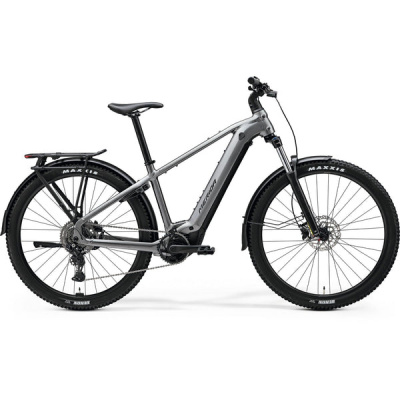
Merida eFloat CC 400
The Merida eFloat CC 400 EQ is a high-step, Bosch CX-powered e-bike fitted with mudguards, lights, a rack and a frame lock, aimed at riders who want one bike for daily commuting and moderate mixed-surface routes rather than technical mountain biking.
- Bosch Performance Line CX motor, stock 85Nm: Confident assistance up steeper hills and on loaded rides, whether commuting or exploring gravel
- Removable 600Wh Bosch PowerTube battery with Purion 200 display: Charge indoors away from the bike and keep track of assistance and charge at a glance
- 120mm SR Suntour XCM34-Boost coil fork and 29 x 2.4in Maxxis Metropass AT tyres: Takes moderate gravel and towpaths in its stride, not just tarmac
- Mudguards, integrated lights, kickstand and Abus frame lock fitted as standard: Ready for commuting and errands without buying separate accessories
- MIK HD rear carrier fitted: Straightforward pannier fitting now, with an upgrade path to an approved child seat later
- Category 2 Cross classification, 150kg total system weight limit: Built for practical load-carrying commuting and mixed-surface rides, not technical trail riding
Merida eFloat CC 400 Deals
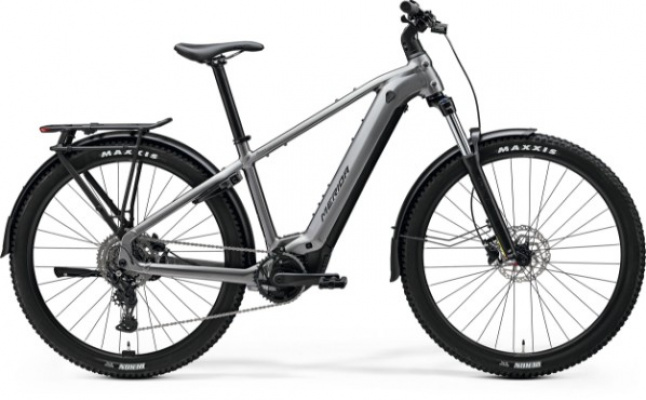

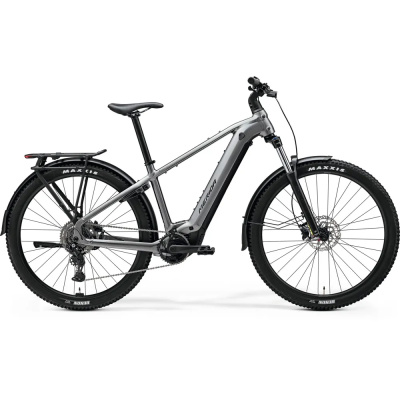

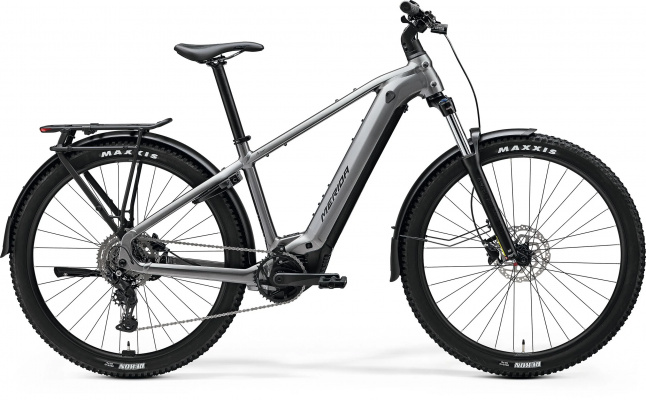
Prices and availability can change quickly. Delivery charges are not always included in listed prices.
Final price, stock status and delivery terms are set by retailer. We may receive a commission on purchases made.
Bikesy's Verdict
The eFloat CC 400 EQ makes most sense for someone commuting daily who also wants real capability for gravel or towpath rides at the weekend, without buying accessories separately or running two bikes. The Bosch CX motor's stock 85Nm, wide Maxxis tyres and 120mm coil fork give it genuine mixed-surface ability that a city-focused e-bike doesn't have, and having mudguards, lights, a rack and a frame lock arrive fitted removes a chunk of setup cost and hassle. The main thing to weigh is the fully rigid seatpost and absent chainguard, which make it less polished for quick stops or keeping trousers clean than some dedicated commuter builds. For a rider prioritising motor strength and terrain range over those small conveniences, it's a strong, sensibly equipped choice.
Pros
- Bosch Performance Line CX motor with a stock 85Nm makes hilly commutes and loaded rides much easier
- Comes ready-equipped with mudguards, integrated lights, kickstand, Abus frame lock and a MIK HD rear carrier already fitted
- Removable 600Wh Bosch PowerTube battery makes indoor charging simple
- Wide 29 x 2.4in tyres and a 120mm coil fork extend it beyond tarmac to gravel and towpaths
- MIK HD rear carrier opens an upgrade path to an approved child seat
Cons
- No chainguard or dropper/suspension seatpost, so trouser protection and quick saddle changes aren't part of the package
- Published height bands overlap with no inseam figures given, so fit needs a bit more thought if you're between sizes
- Rims are tubeless-ready but tyres are fitted wired, with tape and valves not included for a future conversion
The eFloat CC 400 EQ, sold in the UK as a high-step frame, is Merida's case for owning one bike instead of two: a properly equipped commuter that also copes with gravel lanes, towpaths and rougher bridleways without needing a separate off-road bike. It's built around a full-power Bosch motor rather than a lighter city-focused unit, and the frame already carries mudguards, lights, a rack and a lock, so the everyday usefulness is built in rather than added afterwards. Merida places it in what it calls Category 2 Cross use, which is a useful shorthand: capable across mixed surfaces, not a technical mountain bike.
If you're weighing it against a pure city e-bike, the difference is really about ambition. A city bike gets you to work and back reliably; this one is aimed at riders who also want enough motor and tyre underneath them for a gravel loop at the weekend, or a properly hilly commute, without switching bikes to do it.
Power, battery and what the ride numbers actually mean
The motor is a Bosch Performance Line CX, set up from the factory to deliver a stock 85Nm of torque - the kind of output that matters most on loaded rides and steady climbs rather than flat cruising. It draws from a 600Wh Bosch PowerTube battery that removes from the frame, so charging doesn't depend on finding a plug wherever you happen to store the bike. A Bosch Purion 200 display handles picking assistance modes and checking remaining charge, kept deliberately simple rather than packed with ride metrics.
Battery capacity figures are easy to misread as a guaranteed mileage promise, and they're not. The most useful real-world data point available is a single independent test ride: on a 30km off-road route with 500m of climbing, ridden on full assistance throughout, the tester came home with just under a third of the battery left. That's one ride under fairly demanding conditions rather than a claim about what you'll get on your own route, but it's a reasonable pointer that a hilly, off-road-heavy ride at full power will draw the 600Wh pack down noticeably faster than a flatter commute in a lower assistance setting.
Built for daily riding, capable off it too
The 120mm SR Suntour XCM34-Boost coil fork and 29 x 2.4in Maxxis Metropass AT tyres are what let this bike step off tarmac without feeling out of its depth; Merida's stated maximum tyre size with the mudguards fitted is that same 2.4in, so there's no real scope to go wider without losing the guards. Gearing comes from Shimano's CUES range, a nine-speed 1x setup running a 38-tooth chainring against an 11-46-tooth cassette, wide enough that the CX motor makes most hills a non-event rather than a workout. Braking is Shimano MT-200 two-piston hydraulic discs on 180mm rotors front and rear, a sensible spec for a bike that'll often be carrying commuting loads.
Where it's genuinely dressed for daily use is the accessory list: mudguards, integrated front and rear lights, a kickstand and an Abus frame lock all come fitted, alongside a MIK HD rear carrier ready for panniers. What you don't get is a chainguard or a dropper or suspension seatpost - the seatpost fitted is rigid - so trouser protection and quick saddle-height changes at junctions aren't part of the package the way they are on some dedicated commuter bikes.
If an online listing's short bullet points ever describe different parts to these, the detailed specification here, Shimano CUES U4000 running that 11-46 cassette, Maxxis Metropass AT tyres and Shimano MT-200 brakes, is what the UK high-step build is actually specified with; it's worth checking the full spec sheet rather than the headline bullets if something looks off.
Sizing and how much you can load onto it
Merida's published height guide splits into four sizes: S for roughly 155-170cm, M for 161-180cm, L for 171-190cm, and XL for anyone over 185cm with no stated upper limit. These bands overlap deliberately and there's no published inseam figure to narrow things down further, so if your height sits where two bands meet, say around 168cm, it's worth thinking about which size feels more natural rather than assuming the taller option is automatically correct. Stem length shifts with size too: S and M get a 70mm stem, L and XL a longer 90mm stem, which affects reach more than the frame size number alone suggests.
On load, the Category 2 Cross rating carries a 150kg total system weight limit - bike, rider and everything you're carrying, added together, not a rider limit by itself. The rear carrier has its own separate 27kg maximum, which sits inside that total rather than adding to it, so loading the carrier close to its limit with a heavier rider can use up the system allowance faster than it first appears. The MIK HD interface also means an approved, compatible child seat can be fitted as an upgrade - it isn't supplied - so its weight needs factoring into that same 150kg total if that's the plan.
Sorting out which eFloat this actually is
Two labels are worth untangling before you buy. Merida also catalogues a CC L 400 EQ, a low-step version of this frame aimed at riders who want an easier step-through; whether that frame reaches UK retailers isn't established, so everything above describes the high-step bike and shouldn't be assumed to carry over to a low-step listing you might come across elsewhere. You may also see this generation labelled as both a 2025 and a 2026 model - that's Merida's model-year naming for the same 2025/26 platform rather than a sign of two different specifications, so a differing year number on two otherwise identical-looking listings isn't a reason for concern on its own.
Merida's stated UK RRP for the CC 400 EQ is £3,250, though retailer prices move around that figure in both directions, so it's worth treating as a reference point rather than what you'll actually pay today.
One ownership date worth flagging early: eFLOAT's handbook asks for an initial check-up after the earliest of 100-300km, 5-10 riding hours, or four to six weeks, and by three months at the very latest. Given how quickly commuting miles add up on a bike doing double duty as transport and weekend explorer, that first service is likely to come round sooner than the calendar suggests.
Key Features & Benefits
- Stem length varies by size (70mm on S/M, 90mm on L/XL): Reach is tuned per frame size rather than a one-size-fits-all cockpit
- Tubeless-ready rims fitted with wired tyres: Leaves the door open to a tubeless conversion later, though tape and valves aren't included out of the box
- eFLOAT's early service schedule (100-300km, 5-10 hours or 4-6 weeks, whichever comes first, by 3 months at the latest): Booking the first inspection promptly keeps safety and warranty checks on track
Alternatives to Consider
Merida eFloat CC 500 EQ
Shares the same Bosch Performance Line CX motor and mixed-surface concept as the CC 400, but steps up to an 800Wh battery and a Shimano CUES U6000 derailleur. Worth considering if you want more range and drivetrain reach than the CC 400's 600Wh and U4000 setup and don't mind paying more for it.
Merida eFloat City 400 EQ
A different proposition rather than a direct rival: it swaps the CX motor for a lighter Bosch Performance Line unit, carries a 625Wh battery and uses a simpler SR Suntour NEX E25 fork instead of the CC 400's 120mm coil fork. Suits a rider who wants a city e-bike first, with occasional rough surfaces as a bonus, rather than the CC 400's mixed-surface-first setup.
Reviews
Cycling Electric's Michael Vincent tested the high-step eFloat CC 400 EQ on varied Highland tracks and found assured handling on flat ground along with useful climbing ability from the Bosch CX motor. The SR Suntour coil fork took the edge off larger impacts, though the reviewer didn't find it especially plush over rougher ground.
Full Specification
Frame, wheels and tyres
| Spec | Detail |
|---|---|
| Frame | eFLOAT CC LITE II aluminium high-step frame (2026 UK EQ build) |
| Wheels | 29-inch |
| Tyres fitted | 29 x 2.4in Maxxis Metropass AT (wired) |
| Maximum tyre size with mudguards | 29 x 2.4in |
Motor, battery and display
| Spec | Detail |
|---|---|
| Motor | Bosch Performance Line CX, stock setting up to 85Nm |
| Battery | Bosch PowerTube 600, removable, 600Wh |
| Display | Bosch Purion 200 |
Fork
| Spec | Detail |
|---|---|
| Fork | SR Suntour XCM34-Boost coil suspension, 120mm travel |
Drivetrain
| Spec | Detail |
|---|---|
| Rear derailleur | Shimano CUES U4000 |
| Shifter | Shimano CUES U4000-9 |
| Gearing | 1x9, 38-tooth chainring |
| Cassette | Shimano LG400-9, 11-46 tooth |
Brakes
| Spec | Detail |
|---|---|
| Brakes | Shimano MT-200 two-piston hydraulic disc |
| Rotors | Shimano RT10, 180mm front and rear |
Fitted equipment
| Item | Detail |
|---|---|
| Mudguards | Fitted |
| Lights | Integrated front and rear lights fitted |
| Kickstand | Fitted |
| Frame lock | Abus, fitted |
| Rear carrier | MIK HD rear carrier with spring clip, fitted |
| Seatpost | Rigid (no dropper or suspension seatpost fitted) |
Use and load limits
| Spec | Detail |
|---|---|
| Classification | Category 2 Cross |
| Maximum total system weight | 150kg (bike, rider and load combined) |
| Rear carrier maximum load | 27kg (within the 150kg total, not additional to it) |
Size-specific fit
| Size | Fitted stem length |
|---|---|
| S, M | 70mm |
| L, XL | 90mm |
Upgrades and compatibility
| Area | Detail |
|---|---|
| Child seat | An approved child seat compatible with the MIK HD interface can be fitted as an upgrade; not supplied as standard. Factor its weight into the 150kg system limit. |
| Tubeless conversion | Rims are tubeless-ready, but tyres are fitted wired and tape/valves aren't included; a conversion needs those parts bought separately. |
Price
| Item | Detail |
|---|---|
| UK RRP | £3,250 (stated by Merida; not independently confirmed beyond this figure) |