
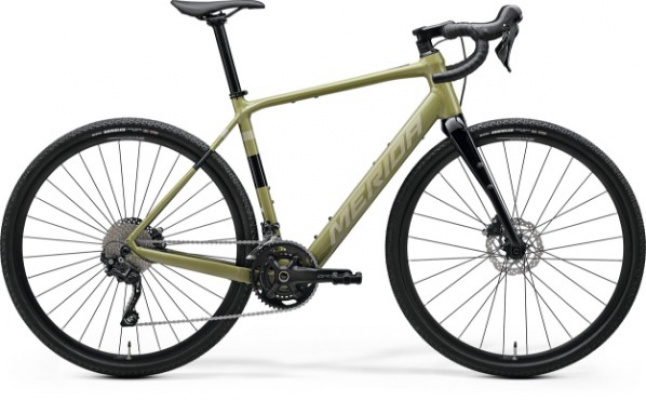
Merida eSILEX 400
Cover ground without the fatigue: natural e-assist, stable handling, and practical mounts for gravel adventures and loaded touring.
- Mahle X30 hub motor: natural assist, minimal drag unpowered
- 250Wh integrated battery keeps the silhouette sleek
- 700×45c tyre clearance for rough lanes and gravel byways
- Shimano GRX 400 2×10: wide range for climbs and flat-out sections
- Rack, mudguard and bottle mounts for bikepacking and commuting
- MTB-inspired geometry: stable and confident on rough surfaces
Merida eSILEX 400 Deals


Prices and availability can change quickly. Delivery charges are not always included in listed prices.
Final price, stock status and delivery terms are set by retailer. We may receive a commission on purchases made.
Bikesy's Verdict
The eSILEX 400 is Merida's answer to riders who want electric range without the bulk or weight penalty that usually tags along. The Mahle X30 hub motor keeps the lines clean and the handling natural - you get assistance up to 25 km/h, then the motor fades into the background with no dragging sensation. It's light enough to hoist onto a train rack, stable enough to handle loaded panniers, and versatile enough to tackle everything from winter commutes to weekend gravel adventures.
The 250Wh battery is modest, so you'll need to manage assist levels on longer rides, and the 40 - 45 Nm of torque won't haul you up Alpine passes like a mid-drive system. But for UK gravel riding, bikepacking, and hilly commutes, the eSILEX 400 hits a sweet spot: natural feel, practical mounts, and a price that doesn't require a second mortgage. It's a bike that invites you to load up and see where the day takes you - and that's exactly what gravel riding should be about.
Pros
- Mahle X30 hub motor feels natural and adds minimal drag when unpowered
- Lightweight for an e-bike at around 13 kg, easy to handle and lift
- Generous mounts for racks, mudguards, and bottles - ideal for bikepacking
- Stable MTB-inspired geometry inspires confidence on rough gravel
- Shimano GRX 400 2×10 drivetrain and 180 mm hydraulic discs offer solid performance
- Wide tyre clearance (up to 700×45c) lets you tune the ride to terrain
Cons
- 250Wh battery offers modest range (50 - 80 km) if you're planning epic unsupported rides
- 40 - 45 Nm torque is gentle compared to mid-drive systems when climbing steep gradients with a load
- Heavier than the non-electric Silex 400 if you prefer simplicity and lower weight
About the Merida eSILEX 400
Gravel bikes have grown up fast, and the eSILEX 400 is Merida's answer to riders who want the freedom of electric range without the bulk or weight penalty that usually tags along. Built around a compact Mahle X30 rear hub motor and a 250Wh battery tucked neatly into the downtube, this aluminium-framed e-gravel machine keeps the lines clean and the handling natural. You get assistance up to the legal 25 km/h limit, then the motor fades into the background - no dragging sensation, no dead weight. It's the sort of setup that lets you ride home from a long day without feeling like you're pedalling a fridge.
The frame itself is triple-butted 6066 aluminium, hydroformed for stiffness where it counts and compliance where you need it. Merida's draped it in mounts: five sets of bottle bosses, rack and mudguard eyelets, even a kickstand tab if you're that way inclined. The carbon fork adds a layer of vibration damping up front, and the whole package tips the scales around 13 kg - light enough to hoist onto a train rack, heavy enough to feel planted when the surface turns to marbles. It's a bike that invites you to load up panniers, point it down a bridleway, and see where the day takes you.
Shimano's GRX 400 2×10 drivetrain brings a sensible spread of gears - 46/30 up front, 11 - 36 out back - and the clutch rear mech keeps the chain quiet over washboard gravel. Hydraulic disc brakes with 180 mm rotors (a welcome bump from the 160 mm rotors on the 2025 model) offer confident stopping power in the wet. Maxxis Rambler tyres in 700×40c come fitted as standard, but the frame clears up to 700×45c (or 27.5×47c if you fancy a volume swap), so you can tune the ride to match your terrain. Whether you're threading singletrack, commuting through winter slop, or stringing together a weekend of fire roads and farm tracks, the eSILEX 400 has the bones to handle it.
Merida eSILEX 400 geometry
Merida's borrowed cues from its mountain bike stable here, and the result is a gravel bike that feels more composed than twitchy. The head angle steepens slightly as you move up the size run - 69.5° on the XS, 71.5° on the XL - but even the slackest end of that range is calmer than a pure road bike, giving you more time to react when a rut grabs the front wheel. Reach grows in 10 mm increments from 375 mm (XS) to 415 mm (XL), so you're stretched out enough for efficient pedalling but not so far that you can't weight the front end when the gradient kicks up.
Stack climbs in step with reach, keeping the cockpit relatively upright across the board. That means less pressure on your wrists during long days and better sightlines when you're picking lines through loose gravel. The 431 mm chainstays are consistent across all sizes, which anchors the rear wheel under you and stops the back end feeling skittish when you're climbing out of the saddle or carrying a loaded pannier. Wheelbase stretches from just over a metre on the XS to 1,068 mm on the XL, so stability improves as frame size grows - bigger riders get a planted feel, smaller riders retain a bit more agility.
Bottom bracket drop sits at 70 mm, a touch lower than some pure road machines but high enough to clear pedal strikes on rutted tracks. The seat angle holds steady at 73.5° across the range, putting you in a position that balances climbing efficiency with all-day comfort. When you add it all up, the geometry delivers a bike that tracks straight on loose surfaces, doesn't punish you for sitting upright, and won't throw a tantrum if you point it down a rocky descent. It's not a race bike, but it's not a touring barge either - it sits in that sweet spot where confidence and fun overlap.
Component choices & upgrades
The stock build on the eSILEX 400 is already well sorted for the money. Shimano's GRX 400 groupset is the entry tier of the gravel-specific range, but it brings the same clutch rear mech and hydraulic disc brakes you'll find further up the ladder. The 2×10 setup gives you a wide enough spread for steep climbs and fast descents, and the 180 mm brake rotors (new for 2026) offer plenty of bite. The Maxxis Rambler tyres are a solid all-rounder - fast on hardpack, grippy enough on loose stuff - and the aluminium cockpit and seatpost keep weight and cost in check without feeling flexy or cheap.
That said, if you're planning to spend serious time on rough tracks or load the bike for multi-day trips, a few tweaks can sharpen the experience. Swapping the Ramblers for something with a more aggressive tread - say, a Panaracer GravelKing SK or a Schwalbe G-One Bite - will give you more confidence on wet roots and muddy lanes. The frame clears up to 700×45c, so you've got room to play. If you're chasing comfort over long distances, a carbon seatpost will take the sting out of washboard surfaces better than the stock aluminium post, and a wider handlebar (the stock bars run 400 - 440 mm depending on frame size) can open up your chest and ease shoulder fatigue on all-day rides.
Pedals are the usual platform affairs, so clipless pedals are an obvious upgrade if you're not already running them. Beyond that, the Mahle iWoc ONE controller is simple but effective - if you want more granular control over assist levels or post-ride data, the Mahle app lets you fine-tune the motor's behaviour and track battery usage. A range extender battery is available as an accessory if the 250Wh capacity feels limiting for your adventures, though it does add weight and bulk. The beauty of the eSILEX 400 is that it works well straight out of the box; upgrades are there if your riding demands them, not because the stock kit is holding you back.
Where the Merida eSILEX 400 excels
This bike is built for riders who want to cover ground without the fatigue that usually comes with long gravel rides or hilly commutes. The Mahle X30 motor is subtle - it doesn't shove you forward like a mid-drive unit, but it smooths out the rough edges of a ride, letting you maintain a steady pace on climbs or into a headwind without emptying the tank. When you switch the assist off (or the battery runs dry), the bike still feels lively; there's no dragging sensation, no dead weight in the rear hub. That makes it a genuine do-it-all machine: you can ride it like a normal gravel bike when you want the workout, then dial in assistance when the terrain or your legs demand it.
It's also outstanding for bikepacking and loaded touring. The frame is festooned with mounts - bottle cages, racks, mudguards - and the stable geometry means the handling doesn't fall apart when you strap on panniers or a frame bag. The carbon fork has cargo mounts too, so you can distribute weight front and rear. The electric assist takes the sting out of climbing with a heavy load, and the wide tyre clearance means you can fit rubber that suits the surface you're riding. Whether you're threading bridleways in the Peaks or stringing together a week-long gravel route, the eSILEX 400 has the practicality and range (with careful battery management) to get you there.
Where it's less ideal is pure speed or technical singletrack. The 250Wh battery is modest by e-bike standards - you'll get 50 - 80 km of range depending on terrain, assist level, and how much you're carrying, but that's not enough for epic unsupported rides without a range extender or power bank. The Mahle X30's 40 - 45 Nm of torque is also on the gentle side; it'll help you up most climbs, but if you're tackling Alpine gradients with a full load, you might find yourself wishing for more grunt. And while the geometry is stable and confidence-inspiring, it's not as nimble as a dedicated mountain bike - tight, twisty singletrack will feel more like hard work than flow. This is a bike for covering distance on mixed surfaces, not for chasing Strava times or sessioning rock gardens.
Merida eSILEX 400 FAQs
What is the range of the Merida eSILEX 400 on a single charge?
Range depends on terrain, assist level, rider weight, and load, but you can expect 50 - 80 km from the 250Wh battery in typical mixed conditions. Eco mode stretches range furthest; Turbo drains it faster. A range extender battery is available if you need more.
Is the Merida eSILEX 400 suitable for bikepacking?
Absolutely. The frame has multiple bottle cage mounts, rack and mudguard eyelets, and the fork has cargo mounts too. The stable geometry handles loaded weight well, and the electric assist takes the edge off climbs when you're carrying panniers or a frame bag.
How heavy is the Merida eSILEX 400?
Around 13 kg. That's light for an e-bike, thanks to the compact Mahle X30 hub motor and integrated 250Wh battery. It's manageable to lift onto a train rack or hoist over a stile.
Can I remove the battery from the Merida eSILEX 400?
Yes, the 250Wh battery is integrated into the downtube but removable for charging or security. The Mahle system is designed to be unobtrusive, so removal and reinstallation are straightforward.
What is the difference between the Merida eSILEX 400 and the non-electric Silex 400?
The eSILEX 400 adds the Mahle X30 rear hub motor and 250Wh battery, plus a slightly heavier frame to accommodate the electrics. The non-electric Silex 400 shares the same aluminium frame platform, geometry, and component spec (Shimano GRX 400 2×10), but weighs less and costs less. Choose the eSILEX if you want electric assist for longer rides or hilly terrain; stick with the Silex if you prefer simplicity and lower weight.
What type of motor does the Merida eSILEX 400 use?
It uses a Mahle X30 rear hub motor, which delivers 40 - 45 Nm of torque and assists up to 25 km/h. The system is known for its natural feel and minimal drag when unpowered, making the bike feel more like a normal gravel bike than a heavy e-bike.
What is the maximum tyre clearance on the Merida eSILEX 400?
The frame clears up to 700×45c (or 27.5×47c if you swap to smaller wheels). That's enough room for proper volume and tread if you're tackling muddy lanes or rough gravel, and you can still fit mudguards with slightly narrower rubber.
Is the Merida eSILEX 400 good for climbing steep hills?
It'll help, but it's not a mountain goat. The Mahle X30's 40 - 45 Nm of torque is moderate - it smooths out climbs and takes the edge off gradients, but it won't haul you up Alpine passes with the same ease as a more powerful mid-drive system. The 2×10 GRX drivetrain gives you a low enough gear for most UK climbs, and the assist makes a noticeable difference, but if you're regularly tackling very steep or long ascents with a heavy load, you might find yourself wishing for more torque.
Key Features & Benefits
- Mahle X30 rear hub motor with 250Wh integrated battery: Natural-feeling assist up to 25 km/h with minimal drag when unpowered, keeping the ride lively and the silhouette sleek
- MTB-inspired geometry with slacker head angle and longer wheelbase: Stable, confident handling on rough gravel and loose surfaces, even when loaded with panniers
- Shimano GRX 400 2×10 drivetrain with clutch rear mech: Wide gear range for climbs and descents, with quiet chain retention over washboard gravel
- 700×45c tyre clearance and multiple frame mounts: Tune the bike to your terrain with wider rubber, and carry racks, mudguards, and bottles for bikepacking or commuting
- Carbon fork and 180 mm hydraulic disc brakes: Vibration damping up front and confident stopping power in all conditions, including wet weather
Merida eSILEX 400 2025 differences
The 2025 eSILEX 400 is largely consistent with the 2026 model in terms of core specifications and technology. Both years feature the Mahle X30 rear hub motor with a 250Wh integrated battery, the Shimano GRX 400 2×10 drivetrain (46/30 crankset, 11 - 36 cassette), and the same triple-butted 6066 aluminium frame with carbon fork. The geometry, tyre clearance (up to 700×45c), and frame mounts for racks, mudguards, and bottles are identical across both model years.
The key difference for 2026 is the upgrade to 180 mm hydraulic disc brake rotors, up from 160 mm on the 2025 model. This brings improved stopping power and heat dissipation, particularly useful for loaded touring or long descents. The 2026 model also benefits from minor aesthetic refinements and updated fork design seen across the wider Silex range, though the eSILEX 400's core ride character and component spec remain unchanged. If you're considering a 2025 model, the smaller rotors are the main trade-off - still adequate for most riding, but the 2026's larger discs offer a noticeable confidence boost in wet or technical conditions.
Alternatives to Consider
Within Merida's own range, the non-electric Silex 400 shares the same aluminium frame, geometry, and Shimano GRX 400 2×10 drivetrain, but sheds the motor and battery for a lighter, simpler package - ideal if you don't need electric assist and want to save weight and cost. If you're after more power or range, the eSILEX+ 400 is occasionally mentioned, though details are scarce; it's worth investigating if you want to stay within the Merida family but need a step up in capability.
Cross-brand, the Specialized Turbo Creo SL EVO is a closer rival in spirit - it uses a lightweight mid-drive motor and offers more torque and range, but at a significantly higher price. The Cannondale Topstone Neo Carbon brings a similar blend of gravel capability and electric assist, with a more powerful motor and longer battery life, though again you'll pay more for the privilege. The Orbea Terra M20-e is another aluminium-framed e-gravel option with a Mahle hub motor, offering comparable weight and natural feel but often with a slightly different component spec. The Scott Solace Gravel eRIDE leans more towards endurance road with gravel capability, featuring a mid-drive motor and a more upright, comfort-focused geometry - it's a good alternative if you prioritise long-distance comfort over off-road confidence. Each of these bikes trades off weight, power, range, or price in different ways; the eSILEX 400's strength is its balance of natural feel, practicality, and approachable cost.
Reviews
Natural assist and minimal fuss define the ride. The Mahle X30 hub motor delivers power smoothly, never shoving or surging, and when you switch it off or the battery runs dry the bike still feels lively - there's no dragging sensation, no sense you're hauling dead weight. That makes it genuinely versatile: you can ride it like a normal gravel bike when you want the workout, then dial in assistance when the terrain or your legs demand it.
Handling inspires confidence on rough surfaces. The slacker head angle and longer wheelbase keep the front end planted when the gravel turns to marbles, and the bike tracks straight through ruts without feeling nervous. When you load it up with panniers or a frame bag, the geometry doesn't fall apart - it just settles into a steady, predictable rhythm. The carbon fork adds a layer of vibration damping up front, and the Maxxis Rambler tyres (or whatever you swap in) soak up the worst of washboard surfaces.
Braking performance is solid. The 180 mm hydraulic discs (a welcome bump from the 160 mm rotors on the 2025 model) offer confident stopping power in the wet, and the Shimano GRX 400 levers have a clean, progressive feel. The 2×10 drivetrain gives you a sensible spread of gears - low enough for steep climbs, tall enough for flat-out sections - and the clutch rear mech keeps the chain quiet over rough ground.
Battery capacity is the main limitation. The 250Wh pack is modest by e-bike standards, and you'll need to manage assist levels carefully on longer rides. Eco mode stretches range to 70 - 80 km in favourable conditions, but Turbo drains it faster - expect closer to 50 km if you're climbing with a load or riding into a headwind. A range extender is available, but it adds weight and bulk. The Mahle X30's 40 - 45 Nm of torque is also on the gentle side; it smooths out climbs and takes the edge off gradients, but it won't haul you up Alpine passes with the same ease as a more powerful mid-drive system. For UK gravel riding and loaded touring, though, it's more than adequate - and the natural feel makes it worth the trade-off.
Full Specification
| Spec | Value |
|---|---|
| Frame Material | Lite II Hydroformed 6066 triple-butted aluminium |
| Frame Features | Mounts for mudguards, rack, and kickstand. Internal cable routing via headset cap. Multiple bottle bosses and cargo mounting points. Internal routing compatibility for dropper posts and dynamo systems. |
| Bottom Bracket | BSA threaded, Shimano RS501 BSA |
| Rear Axle | 9mm QR |
| Fork | Merida SILEX CF2 Carbon |
| Drivetrain | 2x10 speed |
| Shifters | Shimano GRX400 |
| Rear Derailleur | Shimano GRX400 with clutch mechanism |
| Front Derailleur | Shimano GRX400 |
| Crankset | Shimano GRX600, 46-30 teeth |
| Crank Length | 170 mm (XS/S/SM/ML), 175 mm (L/XL) |
| Cassette | Shimano CS-HG50, 11-36 teeth, 10-speed |
| Chain | KMC e10 |
| Brakes | Hydraulic disc |
| Brake Levers | Shimano GRX400 |
| Brake Calipers | Shimano GRX400, 2-piston |
| Rotors (Front) | 180 mm |
| Rotors (Rear) | 180 mm |
| Rims | Merida Comp SL, 17 mm internal width, 22 mm height, aluminium, tubeless ready |
| Spokes | Black stainless |
| Hubs (Front) | Shimano HB-TC500, 100x12 mm, 28 spoke holes, Centerlock |
| Tyres (Front) | Maxxis Rambler, 700Cx40, fold, EXO protection |
| Tyres (Rear) | Maxxis Rambler, 700Cx40, fold, EXO protection |
| Tyre Clearance | 700x45c (without mudguards) or 27.5x47c |
| Handlebar | Merida Expert GRII, aluminium, 400 mm (XS/S), 420 mm (M), 440 mm (L/XL) |
| Stem | Merida Team CC III, aluminium, 31.8 mm diameter, -6° rise, 80 mm length |
| Headset | Merida 8158 |
| Seatpost | Merida Expert, aluminium, 30.9 mm diameter, 0 mm setback |
| Saddle | Merida Comp SL, V-mount |
| Pedals | VP VPE-891 |
| Motor | Mahle X30 rear hub motor, 40-45 Nm torque |
| Battery | Mahle ix250Wh, integrated into downtube |
| Motor Controller | Mahle iWoc ONE |
| Assistance Limit | 25 km/h |
| Weight (Approx) | 13.0 kg |
| Available Sizes | XS, S, M, L, XL |