
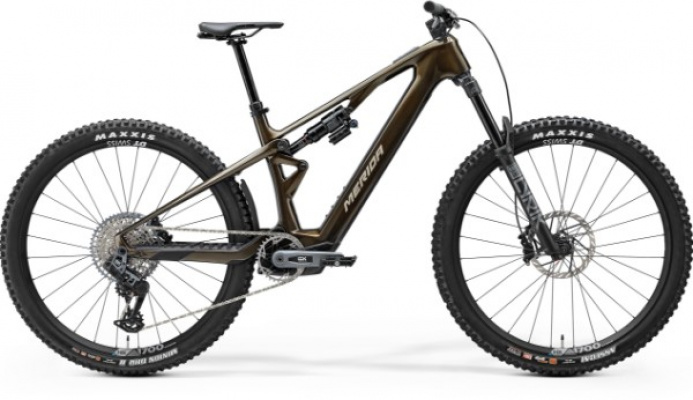
Merida eONE-SIXTY SL 8000
Enduro travel with trail-bike agility and just enough motor to extend your range without the bulk.
- Bosch SX motor: 55Nm torque, natural pedalling feel
- Full CF4 carbon frame with flexstay rear triangle
- 160mm travel front and rear for enduro capability
- SRAM GX Eagle Transmission AXS wireless shifting
- 19.5kg weight: light enough to feel playful
- Mullet flip-chip option for 27.5" rear wheel
Merida eONE-SIXTY SL 8000 Deals

Prices and availability can change quickly. Delivery charges are not always included in listed prices.
Final price, stock status and delivery terms are set by retailer. We may receive a commission on purchases made.
Bikesy's Verdict
The eONE-SIXTY SL 8000 nails the brief for riders who want assistance without the anchor. At 19.5kg it's genuinely light enough to flick through tight sections, yet the 160mm suspension platform and slack geometry mean you're not giving up descending composure. Bosch's SX motor delivers its 55Nm with a naturalness that rewards your own effort rather than drowning it, and the 400Wh battery keeps the centre of gravity tight.
SRAM's wireless GX Transmission and those Maxxis Assegai/DHR II tyres on DT Swiss hoops make this a properly sorted package straight out of the box. Yes, the front can feel a touch low on the steepest chutes, and the motor's got a bit of mechanical chatter, but those are quibbles when the overall ride is this engaging. If you've been eyeing lightweight e-MTBs but worried they'd feel like compromised versions of the real thing, this one proves otherwise.
Pros
- Light 19.5kg weight makes it genuinely playful and easy to manoeuvre
- Bosch SX motor delivers natural, rider-focused assistance without overwhelming your input
- Agile, reactive handling with 160mm travel for enduro capability
- SRAM GX Transmission AXS and quality components ready to ride hard
- Flexstay rear triangle reduces weight and maintenance
- Mullet flip-chip option adds versatility for different riding styles
Cons
- Front end can feel low on very steep descents if you're pushing hard enduro stages
- Bosch SX motor has noticeable mechanical rattle and higher-pitched whine compared to some rivals
- 400Wh battery may require the range extender for longer rides or heavier riders
About the Merida eONE-SIXTY SL 8000
Merida's eONE-SIXTY SL 8000 sits in that sweet spot where enduro ambition meets trail-bike manners. The full carbon CF4 frame wraps around Bosch's Performance Line SX motor - a 55Nm unit that's deliberately dialled back from the full-fat 85Nm bruisers - and the result is a bike that weighs in around 19.5kg, light enough to feel genuinely playful rather than merely manageable. The 'SL' badge isn't marketing fluff; this is a Super Light platform that prioritises agility and rider input over brute-force assistance.
You're looking at 160mm of RockShox suspension front and rear, SRAM's wireless GX Eagle Transmission, and a parts list that doesn't ask for immediate upgrades. The flexstay rear triangle - Merida's take on a bending seatstay rather than a traditional pivot - shaves grams and maintenance while keeping the back end lively. It's a bike that wants to be thrown into corners and popped off lips, not just pointed downhill and held on for dear life.
The Bosch system integrates cleanly, with the 400Wh CompactTube battery tucked into the downtube and a Purion display that doesn't shout about its presence. There's compatibility for a 250Wh range extender if your local loops demand it, and a flip-chip lets you run a mullet setup with a 27.5-inch rear wheel if you're chasing even more pop. This isn't Merida's first rodeo with e-MTBs - the older eONE-SIXTY models ran Shimano motors and tipped the scales closer to 23kg - but the SL iteration represents a clear shift towards rewarding the rider who still wants to work for it.
Merida eONE-SIXTY SL 8000 geometry
Merida's Agilometer sizing system puts reach front and centre, and the eONE-SIXTY SL 8000 spans from a 421mm XShort through to a 512mm XLong. That's a proper spread, letting shorter riders find a confident fit without feeling stretched, and taller pilots dial in stability without resorting to a stem swap. The 64-degree head angle is slack enough to inspire confidence when the trail tilts, but it's not so extreme that you're wrestling the front wheel through tighter sections or feeling vague on mellower gradients.
Stack climbs steadily as you move up the sizes - 601mm on the XShort, 629mm on the XLong - so you're not folding yourself over the bars even when the reach stretches out. The 78.5-degree seat angle is steep enough to keep your weight forward on technical climbs, and combined with those short 450mm chainstays, the bike pivots willingly rather than ploughing. Wheelbase grows predictably with size, from 1141mm to 1278mm, which means the bigger frames feel planted at speed without becoming unwieldy.
Bottom bracket drop varies slightly - 32mm on the XShort, 27.5mm on the rest - but you're always low enough to feel connected through compressions without constantly clipping pedals on rock gardens. The geometry translates to a bike that sits you in a balanced, slightly forward posture: ready to weight the front when you need grip, but not so committed that you can't get back and let the suspension work. It's a setup that rewards active riding rather than passive piloting, and the numbers reflect Merida's intent to keep this feeling like a mountain bike first, an e-bike second.
Component choices & upgrades
The stock build is already well sorted. SRAM's GX Eagle Transmission AXS brings wireless shifting and the brand's robust T-Type derailleur, which hangs tough through impacts and doesn't need constant fettling. The RockShox Lyrik Select+ up front and Super Deluxe Select+ out back offer compression and rebound adjustment, and while they're not Factory-level plush, they're more than capable of handling aggressive trail riding and enduro days. SRAM DB8 brakes with 200mm rotors front and rear deliver strong, consistent power, and the DT Swiss HX 1700 wheels - 30mm internal width - are stout enough to take a beating without adding unnecessary weight.
Maxxis Assegai up front and Minion DHR II out back is a proven pairing: the Assegai's ramped centre knobs roll reasonably well, while the shoulder blocks dig hard when you lean it over, and the DHR II balances predictable cornering with decent braking traction. Both run EXO+ casings, which offer a sensible middle ground between weight and puncture protection. If you're regularly riding sharp rock or pushing harder descents, a Double Down casing on the rear or a beefier insert might be worth considering, but for most riders the stock setup won't leave you wanting.
Upgrade paths exist if your skills or terrain demand more. Fox Factory suspension would bring finer damping control and a touch more suppleness, and if you're chasing every gram, a carbon wheelset with lighter hubs would sharpen acceleration. A longer dropper post might suit taller riders on the bigger frame sizes, and swapping the Proxim saddle for something that suits your sit bones is always a personal call. But the point is this: the 8000 spec doesn't force your hand. You can ride it hard as it arrives and only tweak when you've genuinely outgrown the kit, not because the stock parts are holding you back from day one.
Where the Merida eONE-SIXTY SL 8000 excels
This bike is outstanding at blending enduro capability with trail-bike agility. If your typical ride involves long fire-road climbs followed by technical, rooty descents with plenty of tight corners and sudden gradient changes, the eONE-SIXTY SL 8000 delivers. The Bosch SX motor's 55Nm is enough to flatten out the sting of extended climbs without making you feel like a passenger, and the light overall weight means you can still manual over obstacles, pump transitions, and generally ride with intent rather than just pointing and hoping.
It's also excellent for riders who want e-bike assistance but don't want to sacrifice the playful, reactive feel of a conventional mountain bike. The flexstay rear end and balanced geometry keep the bike lively, and the 160mm travel soaks up square-edged hits and compressions without feeling wallowy or detached. You'll appreciate the way it holds a line through rough sections, and the slack head angle inspires confidence when speed builds on open descents.
Where it's less ideal: pure downhill park days or the absolute gnarliest enduro stages. The front end can feel a touch low on the very steepest chutes, which might have you second-guessing your line choice when the gradient goes properly vertical. The Bosch SX motor, while smooth in its power delivery, does have a mechanical rattle and a higher-pitched whine compared to some rivals - it's not a deal-breaker, but if you're sensitive to drivetrain noise it'll be there in the background. And if you're a heavier rider or regularly tackling all-day epics, the 400Wh battery might leave you eyeing the range extender sooner than you'd like. This isn't a bike for riders who want maximum motor power and don't care about weight; it's for those who value agility and natural feel over brute assistance.
Merida eONE-SIXTY SL 8000 FAQs
What is the range of the Merida eONE-SIXTY SL 8000?
Range depends heavily on terrain, rider weight, assist mode, and how much you're contributing, but the 400Wh Bosch CompactTube battery typically delivers between 30 and 60 kilometres of mixed trail riding. If you're climbing constantly in the highest assist mode, expect the lower end of that range; mellow trails with judicious use of Eco mode will stretch it further. The optional 250Wh range extender adds roughly another 20 - 40km, which is worth considering if your local loops are long or you're planning multi-hour epics.
How heavy is the Merida eONE-SIXTY SL 8000?
The complete bike weighs approximately 19.5kg in the XShort size, with the Mid and Long sizes coming in around 19.7 - 20.3kg depending on build tolerances and component choices. That's genuinely light for a full-suspension e-MTB with 160mm travel, and it's a big part of why the bike feels so agile and responsive compared to heavier, full-power alternatives.
Is the Merida eONE-SIXTY SL 8000 good for climbing?
Yes, it climbs efficiently. The steep 78.5-degree seat angle keeps your weight forward over the front wheel for traction, the short chainstays prevent the front end from wandering, and the Bosch SX motor's 55Nm of torque smooths out the gradient without overwhelming your own pedalling rhythm. The light weight means you're not hauling a boat anchor when the motor's assistance tapers off at higher cadences, and the balanced geometry keeps the bike composed even on technical, rooty climbs where you need to pick lines carefully.
What motor does the Merida eONE-SIXTY SL 8000 use?
It uses the Bosch Performance Line SX, a mid-power unit delivering 55Nm of torque and 600W peak power. It's designed to offer a more natural, less intrusive ride feel compared to Bosch's full-power motors, and it's lighter too. The trade-off is less outright grunt, but the benefit is a bike that still rewards your own effort and feels closer to a conventional mountain bike in its response and handling.
Can I run a mullet setup on the Merida eONE-SIXTY SL 8000?
Yes, the frame includes a flip-chip that allows you to convert to a 29-inch front and 27.5-inch rear wheel setup. Making the switch increases rear travel slightly - from 160mm to 174mm - and can add a touch more pop and manoeuvrability to the back end. It's a useful option if you prefer the snappier feel of a smaller rear wheel or if your local trails favour tight, punchy sections over high-speed flow.
What are the pros and cons of the Merida eONE-SIXTY SL 8000?
Pros include the light weight, natural and playful ride feel, agile handling, well-integrated Bosch system, and a spec that's ready to ride hard without immediate upgrades. The flexstay design keeps maintenance low and weight down. Cons are the slightly low front end on very steep descents, the Bosch SX motor's mechanical rattle and audible whine, and the 400Wh battery capacity, which might feel limiting on longer rides without the range extender. The suspension is capable but not quite as plush as some higher-end competitors.
How does the Merida eONE-SIXTY SL 8000 compare to the Specialized Turbo Levo SL?
Both bikes target the lightweight e-MTB segment and prioritise natural ride feel over maximum motor power. The Levo SL uses Specialized's own SL 1.1 motor, which is similarly restrained in output, and it's also built around a full carbon frame. The Merida tends to offer slightly more aggressive geometry and a touch more travel, making it feel more enduro-focused, while the Levo SL leans slightly more towards trail versatility. Component specs and pricing vary across the ranges, but both deliver that engaging, rider-focused experience that sets them apart from full-power e-MTBs.
What kind of riding is the Merida eONE-SIXTY SL 8000 best suited for?
It's best suited for all-mountain and enduro riding where you want the assistance to extend your range and flatten out climbs, but you still want the bike to feel lively, playful, and responsive. Think long, technical trail rides with varied terrain - rooty climbs, rocky descents, tight switchbacks, and open flow sections. It's ideal for riders who value agility and natural handling over maximum motor power, and who want a bike that rewards active riding rather than just carrying you along.
Key Features & Benefits
- Bosch Performance Line SX motor (55Nm, 600W peak): Delivers smooth, natural assistance that rewards your own effort without feeling intrusive or overpowering
- Full CF4 carbon frame with flexstay rear triangle: Keeps weight down to 19.5kg and reduces pivot maintenance while maintaining a lively, responsive rear end
- 160mm RockShox Lyrik Select+ and Super Deluxe Select+ suspension: Provides enduro-capable travel and adjustability to handle aggressive descents and rough trail sections
- SRAM GX Eagle Transmission AXS wireless drivetrain: Offers reliable, low-maintenance shifting with robust T-Type derailleur that shrugs off impacts
- Agilometer sizing system and mullet flip-chip: Lets you dial in reach for your riding style and convert to 27.5" rear wheel for added pop and manoeuvrability
Merida eONE-SIXTY SL 8000 2025 and previous model differences
The 2025 eONE-SIXTY SL 8000 represents a significant evolution from earlier eONE-SIXTY models. Older iterations - such as the 2020 eONE-SIXTY - featured Shimano motors (e8000 with a 504Wh battery) and weighed considerably more, with test bikes tipping the scales around 23kg. Those bikes ran Shimano XT gears and SLX brakes, and while capable, they felt heavier and less agile than the current SL platform.
The 2025 model introduces the Bosch Performance Line SX motor (55Nm, 600W peak) and a full CF4 carbon frame with flexstay rear triangle, dropping weight to approximately 19.5kg. The switch to SRAM GX Eagle Transmission AXS brings wireless shifting and improved durability, while RockShox Lyrik Select+ and Super Deluxe Select+ suspension replace the older Marzocchi and RockShox setups. The Bosch CompactTube 400Wh battery is more compact and better integrated than the previous Shimano unit, and the overall geometry has been refined for more aggressive, enduro-focused handling. The 'SL' designation and focus on lightweight, natural ride feel mark a clear departure from the heavier, more assistance-focused approach of earlier models.
Alternatives to Consider
Within Merida's own lineup, the eONE-SIXTY SL 6000 steps down with Marzocchi suspension and Shimano Deore shifting, making it a more accessible entry point if you're new to lightweight e-MTBs but still want the Bosch SX motor and carbon frame. At the other end, the eONE-SIXTY SL 10K brings Fox Factory suspension, higher-end SRAM components, and a lighter overall build for riders chasing every performance advantage. If you're considering the older, non-SL eONE-SIXTY models, be aware they run Shimano motors and weigh closer to 23kg - capable bikes, but without the agility and natural feel that defines the SL range.
Cross-brand, the Specialized Turbo Levo SL is the most direct rival, offering a similar lightweight philosophy with Specialized's own SL 1.1 motor and a slightly more trail-focused geometry. The Santa Cruz Heckler SL also competes in this space, pairing a carbon frame with restrained motor output and playful handling. The Orbea Rise has earned praise for its sleek motor integration and balanced ride character, while the YT Decoy SN takes a comparable approach to blending enduro capability with lighter weight. Each of these bikes prioritises rider engagement over brute power, but the Merida's flexstay design, Bosch integration, and aggressive geometry give it a distinct character - especially if you're drawn to enduro-focused handling and don't mind a touch of motor noise in exchange for that natural pedalling feel.
Reviews
Longer reach and a calmer front centre bring poise when the trail tilts, yet the short chainstays and light weight mean the bike pivots willingly through tight sections. Suspension soaks up square-edged hits without feeling detached, and the Bosch SX motor's 55Nm arrives smoothly enough that you're still reading the terrain and adjusting your effort rather than just hanging on. When you weight the front wheel through compressions, the Lyrik holds its line; when you unweight and pump a transition, the flexstay rear end responds with a lively snap that feels closer to a conventional bike than most e-MTBs manage.
Climbing reveals the geometry's intent: the steep seat angle and balanced weight distribution keep traction predictable even on loose, technical ascents, and the motor's assistance feels like a helpful tailwind rather than a shove in the back. Descending, the 160mm travel and slack head angle inspire confidence on open, fast sections, though the slightly low front end can make you think twice on the very steepest chutes. The SRAM GX Transmission shifts cleanly under load, and those Maxxis Assegai and DHR II tyres deliver the grip you'd expect from that pairing.
We do notice the Bosch SX motor's mechanical chatter - there's a rattle at low speeds and a higher-pitched whine under load that's more audible than some rivals. It's not a deal-breaker, but if you're sensitive to drivetrain noise it'll be there in the background. The 400Wh battery is adequate for most trail rides, though longer days or heavier riders will find themselves eyeing the range extender. Overall, the eONE-SIXTY SL 8000 delivers on its brief: it's light enough to feel playful, capable enough to handle serious descents, and natural enough in its assistance that you're still the one doing the riding.
Full Specification
| Spec | Value |
|---|---|
| Frame Material | Full Carbon Fibre (CF4) |
| Frame Design | Lightweight full carbon fibre with flexstay rear triangle |
| Frame Features | Internal cable routing, Supernova mount, mudguard compatible |
| Tyre Clearance | 29x2.4 in |
| Rear Axle | 148x12mm Boost |
| Available Sizes | XShort, Short, Mid, Long, XLong |
| Fork | RockShox Lyrik Select+ eMTB |
| Fork Travel | 160mm |
| Fork Offset | 44mm |
| Rear Shock | RockShox Super Deluxe Select+ |
| Rear Travel | 160mm (29er); 174mm (27.5 rear wheel) |
| Rear Shock Adjustments | Compression and rebound damping |
| Drivetrain | SRAM GX Eagle Transmission 12-speed wireless |
| Shifters | JD GLS Stealth MMX / SRAM AXS Pod Controller |
| Rear Derailleur | SRAM GX Eagle Transmission AXS |
| Crankset | SRAM GX Eagle E-MTB |
| Crank Length | 165mm |
| Cassette | SRAM GX Eagle Transmission |
| Chain | SRAM GX Eagle Transmission |
| Brakes | Hydraulic Disc |
| Brake Calipers | SRAM DB8 Stealth |
| Rotors (Front) | 200mm |
| Rotors (Rear) | 200mm |
| Rims | DT Swiss HX 1700, 30mm internal width |
| Hubs (Front) | DT Swiss HX 1700, 110x15mm |
| Hubs (Rear) | DT Swiss HX 1700, 148x12mm |
| Tyres (Front) | Maxxis Assegai 3C MaxxGrip EXO+ 29x2.5 in |
| Tyres (Rear) | Maxxis Minion DHR II 3C MaxxTerra EXO+ 29x2.4 in |
| Handlebar | Merida EXPERT eTR, 780mm width |
| Stem | Merida EXPERT eTR II |
| Headset | Acros ICR MERIDA INTEGRATED with Blocklock |
| Seatpost | Merida COMP TR III dropper post |
| Saddle | Proxim Nembo Steel |
| Pedals | VP VP-532 |
| Motor | Bosch Performance Line SX, 55Nm, 600W peak |
| Battery | Bosch CompactTube 400Wh integrated |
| Motor Assist Limit | 25 km/h (15.5 mph) |
| Weight (Approx) | 19.5kg (XShort); 20.3kg (Mid); 19.7kg (Long) |