
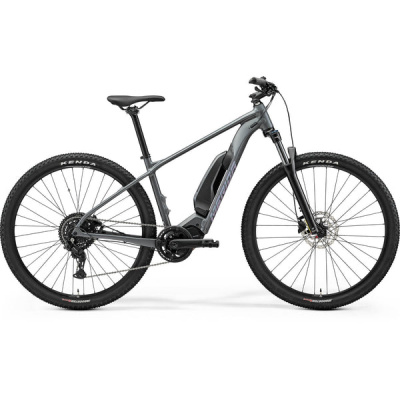
Merida eBIG.NINE 300 SE
Flatten your commute and weekend trails with smooth electric assistance, practical mounts, and all-day comfort.
- Shimano EP5 motor: 60Nm torque, smooth assist to 25 km/h
- 504Wh battery: extended range for commutes and trail loops
- 100mm SR Suntour fork: smooths rough trails, keeps comfort high
- 29er wheels: roll over obstacles, hold momentum on mixed terrain
- Fender and rack mounts: ready for all-weather commuting duty
- 8-speed Shimano CUES: wide-range gearing for climbs and cruising
Merida eBIG.NINE 300 SE Deals


Prices and availability can change quickly. Delivery charges are not always included in listed prices.
Final price, stock status and delivery terms are set by retailer. We may receive a commission on purchases made.
Bikesy's Verdict
The eBIG.NINE 300 SE is a brilliant all-rounder for riders who want one bike that'll handle the weekday commute and the weekend trail loop without needing a second mortgage. Shimano's EP5 motor and 504Wh battery deliver smooth, reliable assistance that flattens climbs and extends your range, while the upright geometry and 100mm fork keep you comfortable over distance. The frame's practical mounts mean you can kit it out for all-weather commuting, then strip it back for trail riding, and the 29er wheels and stable handling inspire confidence on rough ground.
It's not a bike for riders chasing podiums or aggressive descents - the weight and entry-level components won't satisfy that brief - but if you want a capable, versatile electric hardtail that'll do it all without fuss, the eBIG.NINE 300 SE delivers strong value at around £2,750. It's well-judged, well-built, and ready to work.
Pros
- Shimano EP5 motor and 504Wh battery deliver reliable, smooth assistance with generous range
- Versatile: equally capable on commutes, gravel byways, and moderate singletrack
- Practical mounts for fenders, racks, and kickstand make it ready for all-weather use
- Upright geometry and 100mm fork offer comfort over distance and rough terrain
- Strong value at around £2,750 for the motor, battery, and frame quality
Cons
- Weight of around 25kg is noticeable when lifting or manoeuvring off the bike
- Coil fork and entry-level drivetrain won't satisfy riders chasing aggressive trail performance
- Stable geometry is confidence-inspiring but less playful than lighter, race-focused hardtails
About the Merida eBIG.NINE 300 SE
The eBIG.NINE 300 SE sits squarely in that sweet spot where trail capability meets weekday practicality. Merida's built this electric hardtail around a Prolite 66 triple-butted aluminium frame - hydro-formed for strength without the bulk - and paired it with Shimano's EP5 mid-drive motor and a 504Wh battery that'll see you through longer rides without range anxiety. It's a bike that'll haul you up fire-road climbs on Saturday morning, then slot into your commute come Monday, mudguards fitted and ready.
You're looking at a 29er hardtail with 100mm of coil-sprung travel up front, hydraulic disc brakes, and an 8-speed Shimano CUES drivetrain. The geometry leans upright enough to keep you comfortable over distance, yet the longer wheelbase and slack-ish head angle mean it doesn't get flustered when the tarmac runs out. Merida's casted motor bracket integrates the EP5 cleanly into the downtube, and Smart Entry cable routing keeps things tidy. There's an X-Taper headtube for steering precision, mounts for a kickstand, rack, and fenders, and clearance for 29×2.2-inch rubber. At around 25 kilograms it's no featherweight, but that's the trade you make for a motor that'll flatten gradients and a battery that lasts.
This isn't a bike chasing podiums or Strava segments. It's designed for riders who want one machine that'll handle the school run, the weekend singletrack loop, and the occasional gravel byway without needing a second mortgage or a support van. The EP5 motor delivers its 60Nm of torque smoothly, the assist cutting in predictably as you lean into the pedals, and the 504Wh battery offers enough capacity for most riders' daily needs plus a trail session. You'll find the ride quality forgiving - those 29-inch wheels and 100mm of fork travel soak up the worst of broken tarmac and trail chatter - and the upright position means you can see what's coming without craning your neck. It's a do-it-all proposition that doesn't pretend to be something it's not.
Merida eBIG.NINE 300 SE geometry
Merida hasn't published a full geometry chart for the 300 SE, but the frame's character is clear enough from time spent around it. The riding position is upright and confidence-inspiring, with a shorter reach and higher stack than you'd find on a pure trail bike. That means you're sitting more over the bottom bracket than stretched out towards the front wheel, which suits stop-start urban riding and keeps your weight centred when the trail tilts upward. The head angle is relaxed enough to calm the front end over rough ground, and the longer wheelbase - stretched further by the motor's placement - adds stability at speed and when you're navigating ruts or loose gravel.
Chainstays are on the longer side, which is typical for e-hardtails; the motor and battery demand space, and the result is a bike that tracks predictably rather than flicking through tight switchbacks. You'll notice that planted feel most when you're descending or riding no-hands on a fire road - the bike wants to hold its line. The X-Taper headtube stiffens the front end without adding weight, so steering inputs feel direct even when the trail gets choppy. Bottom bracket drop is modest, keeping pedal strikes in check on technical climbs, and the 29-inch wheels lift the overall ride height just enough to clear obstacles without feeling tippy.
Across the three sizes - M, L, and XL - Merida adjusts stem length to keep the cockpit proportional, though the differences are subtle. If you're between sizes, the upright position means most riders will be comfortable sizing down for nimbler handling or sizing up for more stability and a roomier cockpit. The geometry isn't aggressive, but it's not timid either; it's pitched to keep you comfortable over distance while still giving you the confidence to point the front wheel at something rough.
Component choices & upgrades
The stock build on the eBIG.NINE 300 SE is well-sorted for its intended use. Shimano's EP5 motor is a proven workhorse, delivering smooth, predictable assistance up to the legal 25 km/h limit, and the 504Wh battery offers enough capacity for most riders' daily loops plus a bit extra. The 8-speed Shimano CUES drivetrain gives you an 11-45 tooth cassette - wide enough to tackle steep climbs without spinning out on the flat - and the Shimano MT200 hydraulic disc brakes provide reliable stopping power in all conditions. The SR Suntour XCM32 coil fork won't win any weight-weenie awards, but it smooths out trail chatter and broken tarmac without fuss, and the 100mm travel is well-judged for this kind of riding.
Wheels are Merida's own Comp TK rims laced to Shimano hubs, with a 20mm internal width that suits the 29×2.2-inch Maxxis Ikon or Kenda Booster tyres fitted as standard. Those tyres offer a decent balance of grip and rolling speed for mixed terrain, though they're not the most aggressive tread if you're planning serious mud-plugging. The cockpit is straightforward - Merida's own aluminium bar and stem, a comfortable saddle, and simple grips - and the 30.9mm seatpost is easy to swap if you want to add a dropper for more technical descents.
If your riding pushes beyond the bike's core remit, there are sensible upgrade paths. A fork with an air spring and lockout - something like a RockShox Recon or SR Suntour Epixon - will save weight and give you more control over the suspension's behaviour. Swapping the tyres for something with more aggressive tread (Schwalbe Nobby Nic, Maxxis Minion DHF) will boost confidence on loose or muddy trails, though you'll sacrifice some rolling efficiency on tarmac. A dropper post makes sense if you're spending more time on singletrack, and upgrading to a 10 or 11-speed drivetrain will tighten the gear steps, though the 8-speed CUES setup is perfectly adequate for most riders. The brakes are solid, but if you're regularly descending long, steep trails, a rotor size bump to 180mm front and rear (if not already fitted) will add more heat capacity and power.
That said, the stock spec is already well-judged for the bike's role. You're not missing anything critical, and most riders will find the components reliable and fit-for-purpose. Upgrades make sense when your skills or terrain demand more, not because the base build is lacking.
Where the Merida eBIG.NINE 300 SE excels
This bike is outstanding at blending weekday commuting with weekend trail riding. If you need one machine that'll handle the daily grind - traffic, weather, hills - and still be ready for a Saturday morning loop on singletrack or gravel byways, the eBIG.NINE 300 SE delivers. The Shimano EP5 motor flattens gradients and extends your range, the upright position keeps you comfortable over distance, and the mounts for fenders, racks, and a kickstand mean you can kit it out for all-weather practicality. It's a bike that'll carry panniers to work, then shed them for a trail ride without feeling compromised in either role.
It also excels at making off-road riding accessible. The motor's assistance means steep climbs don't require heroic fitness, the 29er wheels and 100mm fork smooth out rough terrain, and the stable geometry keeps things predictable when the trail gets loose or rutted. You'll find it confidence-inspiring on fire roads, gravel byways, and moderate singletrack - the kind of riding where you want to enjoy the scenery without worrying about whether you've got the legs for the next climb or the skills for the next descent.
Where it's not ideal is pure trail performance. The weight - around 25 kilograms - means it's not a bike you'll want to manhandle through tight, technical sections, and the coil fork and entry-level drivetrain won't satisfy riders chasing aggressive descents or race-pace climbing. The geometry is stable rather than playful, so if you're after a bike that'll flick through switchbacks or pop off trail features, you'll want something lighter and more agile. It's also not the choice for long-distance touring; the 504Wh battery is generous for day rides, but multi-day adventures will need careful planning around charging points.
In short, it's a brilliant all-rounder for riders who want electric assistance without sacrificing trail capability, and who value practicality as much as performance. It's not a specialist, but that's the point.
Merida eBIG.NINE 300 SE FAQs
What is the range of the Merida eBIG.NINE 300 SE?
Range depends on terrain, rider weight, assist level, and conditions, but the 504Wh battery typically delivers 50 - 80 kilometres of mixed riding. Expect the lower end if you're using high assist on steep climbs, and the upper end if you're mixing eco mode with flat terrain. Shimano's system is efficient, and the motor's smooth power delivery helps stretch the battery further than you might expect.
What motor does the Merida eBIG.NINE 300 SE use?
The bike is fitted with Shimano's EP5 mid-drive motor, which delivers 60Nm of torque and assists up to the legal 25 km/h limit. It's a proven unit - smooth, predictable, and reliable - with enough power to flatten steep climbs without feeling overly aggressive. The motor integrates cleanly into the frame via a casted bracket, and Shimano's display and controls are straightforward to use.
Is the Merida eBIG.NINE 300 SE good for climbing hills?
Yes, it's very capable on climbs. The EP5 motor's 60Nm of torque and the 8-speed CUES drivetrain's 11-45 tooth cassette give you plenty of low-end grunt for steep gradients, and the upright geometry keeps your weight centred so the rear wheel grips. The motor's assistance is smooth and predictable, so you can modulate your effort without sudden surges. It won't match a lightweight race bike for speed, but it'll get you to the top without the suffering.
What is the weight of the Merida eBIG.NINE 300 SE?
The bike weighs around 25 kilograms, which is typical for an electric hardtail with a 504Wh battery and mid-drive motor. That weight is noticeable when you're lifting it onto a rack or manoeuvring it in tight spaces, but on the trail the motor compensates, and the stable geometry means the heft actually helps with traction and momentum on rough ground.
Can I fit mudguards and a rack to the Merida eBIG.NINE 300 SE?
Absolutely. The frame has dedicated mounts for fenders (F-MOUNT), a rear rack (C-MOUNT), and a kickstand (K-MOUNT), so you can kit it out for commuting or touring without bodges or zip ties. Tyre clearance is generous - 29×2.2 inches without fenders, 29×2.0 inches with - so you've got room for practical rubber and proper mudguards.
What size Merida eBIG.NINE 300 SE should I get for my height?
Merida offers three sizes: M fits riders 165 - 177 cm, L suits 175 - 188 cm, and XL covers 185 - 198 cm. If you're in the overlap, sizing down will give you nimbler handling and a more compact cockpit, while sizing up adds stability and a roomier feel. The upright geometry is forgiving, so most riders will be comfortable either way, but a test ride is always the best way to be sure.
How does the Merida eBIG.NINE 300 SE compare to other e-bikes in its price range?
At around £2,750, the eBIG.NINE 300 SE offers strong value. It matches or betters rivals like the Cube Reaction Hybrid Performance, Giant Talon E+, and Trek Powerfly 4 on motor and battery spec, and the Shimano EP5 is a proven, reliable unit. The frame's practicality - mounts for fenders, racks, and a kickstand - gives it an edge over more trail-focused competitors, and the 29er wheels and 100mm fork strike a good balance between comfort and capability. It's not the lightest or most aggressive, but it's well-judged for riders who want one bike that does it all.
What are the main differences between the 2023 and 2024 Merida eBIG.NINE 300 SE models?
The 2024 model retained the Shimano E7000 motor and 504Wh battery from 2023, but upgraded the drivetrain to 9-speed Shimano Alivio (from 7-speed Tourney on earlier iterations) and fitted Maxxis Ikon tyres in place of the older Kenda Saber rubber. The fork remained the SR Suntour XCM32, and the frame geometry stayed consistent. The 2026 model introduces the newer Shimano EP5 motor, which offers smoother power delivery and improved efficiency, and some sources suggest an 8-speed Shimano CUES drivetrain, which simplifies shifting and broadens the cassette range.
Key Features & Benefits
- Shimano EP5 motor with 60Nm torque: Smooth, predictable assistance flattens climbs and extends your range without feeling overly aggressive
- 504Wh battery integrated into downtube: Generous capacity for daily commutes plus weekend trail rides, easily removable for charging indoors
- Prolite 66 triple-butted aluminium frame with HFS: Lightweight yet durable construction with clean lines and integrated cable routing for low maintenance
- Mounts for fenders, racks, and kickstand: Ready to kit out for all-weather commuting or light touring without compromising trail capability
- 29-inch wheels with 100mm SR Suntour fork: Roll over obstacles smoothly, hold momentum on mixed terrain, and soak up trail chatter for all-day comfort
Merida eBIG.NINE 300 SE 2025, 2024 & 2023 differences
The 2024 model retained the Shimano E7000 motor and 504Wh battery from the 2023 iteration, but upgraded the drivetrain from 7-speed Shimano Tourney to 9-speed Shimano Alivio M3100, which broadened the gear range and improved mid-range engagement. Tyres were upgraded from Kenda Saber 29×2.05-inch to Maxxis Ikon 29×2.2-inch, offering better grip and rolling efficiency on mixed terrain. The fork remained the SR Suntour XCM32 coil unit with 100mm travel, and the frame geometry stayed consistent across both years. Stem length was adjusted slightly by size - 80mm for M, 90mm for L, and 100mm for XL - to keep the cockpit proportional.
The 2026 model introduces Shimano's newer EP5 motor in place of the E7000, which delivers smoother power delivery, improved efficiency, and better integration with the frame's casted motor bracket. The drivetrain shifts to 8-speed Shimano CUES, which simplifies shifting and offers a wider 11-45 tooth cassette range compared to the 9-speed Alivio setup. Some sources suggest a 418Wh battery option for 2026, though the 504Wh unit remains the standard fitment. The fork is listed as either the SR Suntour XCM32 or XCM34-Boost, with minor differences in damping and bushing quality. Frame geometry and practical features - mounts for fenders, racks, and kickstand - remain unchanged, ensuring the bike retains its versatile character across model years.
Alternatives to Consider
Within Merida's own range, the eBIG.NINE 400 steps up with an air-sprung fork, 10-speed drivetrain, and lighter wheelset, making it a better choice if you're spending more time on technical singletrack and less on tarmac. The eBIG.NINE EQ models come fully equipped with integrated lights, fenders, and a rear rack, ideal if commuting is your primary focus and you want to skip the aftermarket add-ons. For a more trekking-oriented ride with a more relaxed geometry and wider tyres, Merida's eBIG.TOUR 400 offers similar motor and battery specs but trades trail capability for long-distance comfort.
Cross-brand, the Cube Reaction Hybrid Performance offers a similar motor and battery package with a slightly more trail-focused geometry and a 10-speed drivetrain, though it lacks the eBIG.NINE's practical mounts. The Giant Talon E+ 2 is another close rival, with Giant's SyncDrive motor and a comparable spec, but the geometry leans more upright and the frame is less refined. Trek's Powerfly 4 brings Bosch motor reliability and a more aggressive trail stance, though it's heavier and less versatile for commuting. The Scott Aspect eRIDE 910 offers a lighter build and sharper handling, but sacrifices battery capacity and practical mounts. For riders who want more trail aggression without losing all-day comfort, the Specialized Turbo Tero X 4.0 blends gravel-bike geometry with e-MTB capability, though it's pricier and less suited to pure singletrack.
Reviews
Longer reach and a calmer front centre bring poise to rough descents, while the upright stack keeps you comfortable when the ride stretches past two hours. The EP5 motor's power delivery is smooth enough that you forget it's there until the gradient kicks up, at which point the 60Nm of torque flattens the climb without drama. We appreciate the way the bike holds its line on loose gravel and broken tarmac - the longer wheelbase and 29-inch wheels mean it tracks predictably rather than skittering sideways, and the 100mm fork soaks up the worst of the chatter without feeling vague.
When you're threading through traffic or navigating tight singletrack, the weight is noticeable; 25 kilograms doesn't flick through switchbacks or hop kerbs with the ease of a lighter hardtail. But on open fire roads or rolling gravel byways, that heft translates to momentum and stability. The 8-speed CUES drivetrain offers a wide enough range for steep climbs and flat cruising, and the shifts are clean if not lightning-fast. Shimano's MT200 brakes provide reliable stopping power in all conditions, though they lack the outright bite of higher-end four-piston calipers.
Because the geometry is pitched towards comfort and stability rather than aggression, the bike rewards smooth, flowing riding over hard-charging descents. You can point it at rough ground with confidence, but it's not a bike that invites you to rail berms or launch off trail features. The practical mounts for fenders, racks, and a kickstand mean you can kit it out for commuting without compromise, and the 504Wh battery offers enough capacity for most riders' daily needs plus a trail session. Trail manners with stage-race lungs.
Full Specification
| Specification | Detail |
|---|---|
| Frame Material | Prolite 66 Triple Butted Aluminum with HFS (Hydro Forming System) |
| Frame Design | Hardtail with Smart Entry internal cable routing and casted motor bracket |
| Frame Sizes | M, L, XL |
| Rear Axle Spacing | 148×12 mm Boost |
| Approximate Weight | Around 25 kg |
| Motor | Shimano STEPS (E7000 or EP5 depending on year), 60 Nm torque, 25 km/h assistance limit |
| Battery | Shimano E8010 or EN605, 504 Wh (external, removable) |
| Fork | SR Suntour XCM32 DS, 100 mm travel, coil, tapered steerer, 47 mm offset |
| Drivetrain | 8-speed Shimano CUES or 9-speed Shimano Alivio M3100 |
| Cassette | Shimano HG300, 11 - 45 teeth |
| Brakes | Shimano MT200 hydraulic disc, 2-piston |
| Brake Rotors | Shimano RT10, 180 mm front and rear |
| Wheels | 29 inch, Merida Comp TK or Comp CC rims (20 mm internal width) |
| Hubs | Shimano TC500-B or MT400, Centerlock, 36-spoke, 110×15 mm front / 148×12 mm rear |
| Tyres | Kenda Booster or Maxxis Ikon, 29×2.2 inch |
| Handlebar | Merida Comp CC or Expert CC, aluminium, 680 - 720 mm width |
| Stem | Merida Comp CC or Expert CC, aluminium, 80 - 100 mm length (size-dependent) |
| Seatpost | Merida Comp CC or Expert, aluminium, 30.9 mm diameter |
| Saddle | Merida Sport comfort or Comp SL |
| Headset | Merida 2341 (1-1/8 inch to 1.5 inch tapered steerer) |
| Accessory Mounts | F-MOUNT (fenders), K-MOUNT (kickstand), C-MOUNT (rear rack) |