
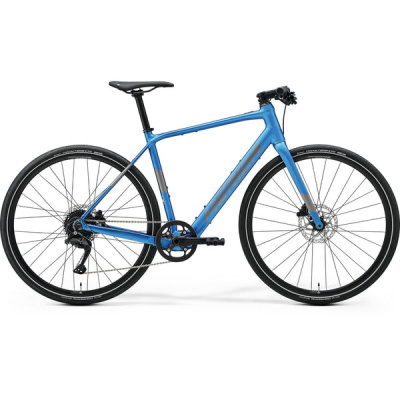
Merida eSPEEDER 200
Smooth Mahle assist and discreet integration make commutes and fitness rides faster without the bulk or stigma.
- Mahle X30 hub motor: discreet, natural-feeling assist
- 250Wh integrated battery keeps the silhouette clean
- 14.6 kg weight: light enough to ride unassisted
- 700×40c tyres balance speed with urban comfort
- Rack, mudguard and kickstand mounts for daily utility
- iWoc button control: simple three-level power selection
Merida eSPEEDER 200 Deals


Prices and availability can change quickly. Delivery charges are not always included in listed prices.
Final price, stock status and delivery terms are set by retailer. We may receive a commission on purchases made.
Bikesy's Verdict
The eSPEEDER 200 nails the brief for riders who want electric assistance without the electric aesthetic or the electric weight penalty. Merida's tucked the Mahle X30 motor and battery so neatly into the frame that you'd struggle to spot it from across the street, and at 14.6 kg it's light enough to ride unassisted or haul up a flight of stairs without cursing. The motor's smooth, natural feel and the bike's stable, upright handling make it a confidence-inspiring choice for urban commutes and fitness rides, and the rack and mudguard mounts mean you can load it up for practical duties without compromise.
The 250Wh battery is the trade-off - it's enough for most daily commutes and shorter leisure rides, but longer tours or hilly terrain will have you watching the charge indicator or planning pit stops. If you're after all-day range or serious climbing torque, you'll want a bigger battery or a mid-drive rival. But if your rides are measured in tens rather than hundreds of kilometres, and you value a bike that looks, feels and handles like a conventional fitness machine, the eSPEEDER 200 delivers exactly that. It's a focused, well-executed tool that does one thing very well: making your commute or weekend loop faster and less sweaty without shouting about it.
Pros
- Discreet Mahle X30 motor and integrated battery maintain a conventional bike aesthetic
- 14.6 kg weight makes it light enough to ride unassisted or carry upstairs
- Upright geometry and stable handling inspire confidence in traffic and on mixed surfaces
- Rack, mudguard and kickstand mounts add practical utility for commuting
- Natural-feeling assist amplifies effort rather than replacing it
Cons
- 250Wh battery offers modest range - 40 - 60 km depending on terrain and assist level
- Heavier and less nimble than a non-electric fitness bike if you're chasing outright speed
- Minimal iWoc button display relies on smartphone app for detailed ride data
About the Merida eSPEEDER 200
The eSPEEDER 200 is Merida's answer to the rider who wants electric assistance without the electric aesthetic. Where many e-bikes announce their presence with bulky mid-drives and slab-sided batteries, this one tucks a Mahle X30 hub motor into the rear wheel and slides a 250Wh cell inside the hydroformed aluminium downtube. The result looks - and more importantly feels - like a conventional fitness bike that happens to have a turbo button. It's aimed squarely at commuters and fitness riders who value a natural pedalling feel and a bike that won't dominate the hallway or draw stares in the bike shed.
Merida's built the eSPEEDER around a triple-butted 6066 aluminium frame with internal cable routing that enters through the headset cap, keeping the cockpit tidy. The geometry leans upright rather than aggressive: you're perched for visibility and comfort, not chasing Strava segments. Flat bars, a short stem progression across the size range, and 700c wheels with generous 40mm Continental Contact Urban rubber give you stable, planted handling whether you're threading through traffic or rolling out a weekend loop. The Mahle system delivers three levels of assist via a simple iWoc button on the top tube - no clunky display, just a discreet LED and the option to dive deeper via the smartphone app if you're that way inclined.
At 14.6 kg the eSPEEDER 200 sits comfortably in the lightweight e-bike bracket, which matters when the battery runs dry or you're hoisting it up a flight of stairs. The Shimano CUES 1×9 drivetrain and hydraulic MT200 disc brakes are sensible, unfussy choices that prioritise reliability over bling. Mounts for mudguards, a rack and a kickstand signal the bike's practical intent, and the frame will clear up to 45mm rubber if you want more cushion or grip. It's not trying to be a gravel racer or a cargo hauler - it's a focused tool for getting from A to B with less sweat and more smile.
Merida eSPEEDER 200 geometry
The eSPEEDER 200's geometry puts you in a relaxed, upright stance that prioritises comfort and control over outright speed. The head angle is calm enough to inspire confidence when you're navigating potholes or glancing over your shoulder in traffic, and the shorter reach across the size range keeps your weight centred rather than stretched out. Stem lengths step from 80 mm on the XS up to 110 mm on the XL, fine-tuning the cockpit without forcing you into a race crouch. The result is a bike that feels stable at low speeds - handy when you're filtering through queues or manoeuvring in tight spaces - but doesn't wallow when you open the taps on a clear stretch of cycle path.
The 700c wheels and moderate wheelbase strike a balance between nimble urban handling and planted stability on longer rides. You're not darting through gaps like a fixed-gear courier, but neither are you piloting a barge. The upright position loads the saddle more than the bars, which is kind on your wrists and shoulders over the course of a commute but can feel less engaging if you're used to a more forward, aggressive posture. The flat bars and short stem mean steering inputs are direct without being twitchy, and the bike tracks predictably through corners even when you're carrying a pannier or two. It's a geometry that rewards smooth, efficient riding rather than heroics, and it suits the bike's electric-assist character perfectly.
Component choices & upgrades
The stock build on the eSPEEDER 200 is already well sorted for its intended role. Shimano's CUES 1×9 drivetrain - comprising the U4000 shifter and U3020 rear mech paired with an 11-36 cassette - covers the range you'll need for urban hills and moderate gradients without fuss. The 42-tooth chainring and Mahle assist mean you're rarely grinding, and the system shifts cleanly enough that most riders won't feel shortchanged. Shimano MT200 hydraulic brakes with 180 mm rotors front and rear offer predictable, progressive stopping power in all weathers; they're not the lightest or most powerful calipers in the catalogue, but they're dependable and easy to service.
If you're planning longer tours or steeper terrain, swapping the Continental Contact Urban tyres for something with a bit more tread - say a Schwalbe Marathon or a WTB Byway - will broaden the bike's repertoire on unpaved surfaces. The frame clears up to 45 mm without mudguards, so you've got headroom to experiment. Riders who log serious miles might consider upgrading the saddle to something with more padding or a pressure-relief channel, though the stock Merida Comp SL is comfortable enough for most. The iWoc button is minimalist by design; if you crave more data at a glance, the Mahle app on your smartphone fills the gap, but there's no retrofit display option that integrates neatly. The grips, pedals and seatpost are all functional rather than fancy - upgrade them if you're chasing grams or specific ergonomics, but the stock kit won't hold you back.
Where the Merida eSPEEDER 200 excels
This bike is outstanding at urban commuting and fitness riding where you want electric assistance without the bulk or the stigma. The Mahle X30 motor delivers smooth, natural-feeling power that amplifies your effort rather than replacing it, and the 250Wh battery is enough for most daily commutes or 40 - 50 km leisure rides depending on terrain and assist level. The lightweight frame and discreet integration mean you can ride it unassisted without feeling like you're dragging an anchor, which is a real advantage if you run out of charge mid-ride or simply fancy the workout. The upright position and stable handling make it confidence-inspiring in traffic, and the rack and mudguard mounts mean you can load it up for shopping runs or wet-weather commutes without compromise.
It also does well on mixed-surface rides - canal towpaths, gravel byways, well-maintained bridleways - where the 40 mm tyres and robust aluminium frame soak up the bumps and keep you rolling. The 1×9 gearing and Mahle assist mean you're not intimidated by hills, and the bike's agility makes it fun rather than laboured on winding routes. Where it's not ideal is on very long tours or hilly terrain that demands more range than the 250Wh battery can deliver; you'll either need to plan charging stops or invest in a Mahle range extender. It's also not a performance road bike - the upright geometry and modest gearing mean you'll be working hard to keep pace with faster club riders on long, flat stretches. And while it handles light gravel capably, it's not a dedicated off-road machine; technical singletrack or loose, steep descents will expose its urban-focused design.
Merida eSPEEDER 200 FAQs
What is the range of the Merida eSPEEDER 200?
Range depends on terrain, rider weight and assist level, but expect 40 - 60 km on a full charge in typical mixed use. Eco mode stretches the battery furthest; Turbo drains it faster but flattens hills. A Mahle range extender can double your distance if you're planning longer tours.
How much does the Merida eSPEEDER 200 weigh?
The 2025 model with the Mahle X30 motor weighs approximately 14.6 kg. That's light for an e-bike and makes it manageable to lift, manoeuvre or ride unassisted when the battery's flat.
Is the Merida eSPEEDER 200 suitable for off-road trails?
It handles well-maintained gravel paths and canal towpaths confidently, but it's not designed for technical singletrack or loose, steep descents. The 700×40c tyres and stable geometry cope with rougher lanes, but the rigid carbon fork and urban-focused build mean it's happiest on tarmac and smooth dirt.
Can I fit wider tyres to the Merida eSPEEDER 200?
Yes - the frame clears up to 700×45c without mudguards and 700×42c with them fitted. That gives you room to experiment with more cushion or tread if you're venturing onto gravel or want extra comfort on rough roads.
What is the battery capacity of the Merida eSPEEDER 200?
The integrated Mahle battery holds 250Wh. It's compact and discreet, which keeps the bike's silhouette clean, but it's modest by e-bike standards - fine for commutes and shorter rides, less so for all-day adventures without a range extender.
How does the Mahle motor on the eSPEEDER 200 perform?
The Mahle X30 hub motor is smooth, quiet and natural-feeling - it amplifies your pedalling rather than taking over. Assistance cuts in gently and fades out just as subtly, and there's minimal drag when you're riding unassisted or above the 25 km/h limit. It's not as powerful as a mid-drive on steep climbs, but it's more than adequate for urban hills and rolling terrain.
What are the key differences between the Merida eSPEEDER 200 and 400 EQ?
The 400 EQ steps up with a higher-spec drivetrain, integrated lighting and mudguards as standard, and often a more refined component package overall. The 200 keeps things simpler and lighter, leaving you to add accessories as needed. Both share the same frame platform and Mahle assist philosophy.
Key Features & Benefits
- Mahle X30 rear hub motor with 250Wh integrated battery: Delivers smooth, natural-feeling assist that keeps the bike looking and handling like a conventional fitness machine, with minimal drag when unassisted.
- Hydroformed 6066 triple-butted aluminium frame with internal cable routing: Combines light weight, durability and a clean cockpit, making the bike easy to live with and pleasant to look at.
- Shimano CUES 1×9 drivetrain with 11-36 cassette: Offers reliable, low-maintenance shifting and enough range for urban hills and moderate climbs without unnecessary complexity.
- 700×40c Continental Contact Urban tyres with clearance for 45 mm rubber: Balances rolling speed with comfort and grip, and gives you room to fit wider tyres for gravel or rougher roads.
- Mounts for rack, mudguards and kickstand: Transforms the bike into a practical commuter or tourer without compromising its sporty character.
Merida eSPEEDER 200 2024 and 2023 differences
The 2024 eSPEEDER 200 featured the Mahle X35+ hub motor rather than the X30 fitted to the 2025 model, paired with the same 250Wh integrated battery. Shimano CUES U4000 shifters and U3020 rear derailleur were already in place, though some sources list Shimano Alivio components for 2024 builds. Continental Contact Urban 700×40c tyres and Shimano MT200 hydraulic brakes carried over unchanged. Reported weight for the 2024 model was marginally lighter at around 13.9 kg, likely due to the X35+ motor's slightly lower mass compared to the X30.
The 2023 model also ran the Mahle X35+ motor and 250Wh battery, with a Shimano Alivio drivetrain and the same Continental Contact Urban rubber. Internal cable routing and the hydroformed aluminium frame remained consistent across both years. The key shift from 2023 to 2025 is the move to Shimano CUES components and the adoption of the X30 motor on the standard 200 model, with the X35+ now reserved for the 200 SE variant. Rack, mudguard and kickstand mounts have been present throughout, though earlier model years - particularly 2021 - shipped without integrated lighting or mudguards as standard, unlike the higher-spec 400 EQ.
Alternatives to Consider
Within Merida's own stable, the eSPEEDER 400 EQ steps up with a more refined component package, integrated lighting and mudguards as standard, making it the natural choice if you want a more polished, ready-to-ride commuter. If you're happy to forgo electric assistance altogether, the non-electric Merida Speeder 200 shares the same frame philosophy and geometry but sheds the motor and battery for a lighter, simpler ride - ideal if your commute is flat or you simply enjoy the workout.
Cross-brand, the Cube Touring Hybrid One 500 offers a larger battery and Bosch mid-drive assistance for longer range and more torque on steep climbs, though it's heavier and less discreet. The Specialized Turbo Vado SL 4.0 uses a similar lightweight hub-motor philosophy with Specialized's own SL 1.1 motor and a 320Wh battery, delivering comparable natural feel with slightly more range and a higher price tag. The Giant Explore E+ 2 pairs a Yamaha mid-drive with a 500Wh battery for serious touring capability, but it's bulkier and more overtly electric in appearance. For a more budget-conscious option, the Trek Verve+ 1 Lowstep offers Bosch Active Line assist and a comfortable, upright stance, though it's heavier and less sporty in character. Finally, the Cannondale Treadwell Neo 2 shares the lightweight, natural-assist ethos with a rear hub motor and clean integration, making it a close rival in the urban-fitness category.
Reviews
Lightweight integration and natural-feeling assist define the eSPEEDER 200's character. The Mahle X30 motor amplifies effort without dominating the ride, and the 250Wh battery tucks neatly into the downtube to preserve the bike's conventional silhouette. When you thumb the iWoc button through its three assist levels, power arrives smoothly and fades out just as subtly - there's none of the on-off jerkiness that plagues cheaper hub motors. The upright geometry and flat bars deliver stable, confidence-inspiring handling in traffic, and the 700×40c Continental tyres soak up potholes and tram tracks without complaint.
Climbs reveal the motor's strengths and limitations. On moderate urban gradients the Mahle system keeps you spinning comfortably, but steeper pitches expose the hub motor's lack of mid-drive torque - you'll be working harder than you would on a Bosch- or Shimano-equipped rival. Descents and flat stretches feel lively thanks to the 14.6 kg weight, and there's minimal drag once you're above the 25 km/h assist limit or riding unassisted. The Shimano CUES 1×9 drivetrain shifts cleanly and covers the range most riders need, though the 11-36 cassette can feel a touch short-legged on very steep ramps if you're not leaning on the motor.
Because the battery is modest, range becomes a consideration on longer rides. Eco mode stretches the 250Wh cell to 50 - 60 km on rolling terrain, but Turbo drains it faster - expect 40 km or less if you're tackling hills or headwinds. The option to add a Mahle range extender exists, but it's an extra purchase and adds weight. Shimano MT200 brakes offer predictable, progressive stopping power in all conditions, and the rack and mudguard mounts make it easy to load the bike up for commuting or light touring. While the iWoc button keeps the cockpit clean, riders who crave detailed ride metrics will need to rely on the smartphone app - there's no retrofit display option that integrates neatly.
Full Specification
| Spec | Value |
|---|---|
| Frame Material | Hydroformed 6066 triple-butted aluminium with integrated battery chamber |
| Frame Design | Sleek normal bike silhouette with integrated battery and internal cable routing |
| Frame Features | Mounts for mudguards, rack, and kickstand |
| Available Sizes | XS, SM, MD, LG, XL |
| Bottom Bracket | BSA, 100mm, threaded |
| Rear Axle | 135x9mm QR |
| Fork | MERIDA Mission CX, carbon, rigid |
| Drivetrain | 1x9 speed |
| Shifters | Shimano CUES U4000 |
| Rear Derailleur | Shimano CUES U3020, SGS |
| Crankset | MERIDA COMP TK, 42 teeth |
| Crank Length | 165mm |
| Cassette | Shimano LG300, 11 - 36 teeth, 9 speed |
| Chain | Shimano LG500 |
| Brakes | Hydraulic disc |
| Brake Calipers | Shimano MT200, 2 piston |
| Rotors (Front) | 180mm |
| Rotors (Rear) | 180mm |
| Rims | MERIDA COMP SL, 17mm internal width, 22mm height, aluminium, tubeless ready |
| Hubs (Front) | Shimano HB-TC500, 100x12mm, 28 spoke holes, Centerlock |
| Spokes | Black stainless |
| Tyres (Front) | Continental Contact Urban, 700Cx40 |
| Tyres (Rear) | Continental Contact Urban, 700Cx40 |
| Tyre Clearance | Up to 700x45C without fenders; 700x42C with fenders |
| Handlebar | MERIDA EXPERT CC, 620mm width, flat |
| Stem | MERIDA EXPERT IR II, 31.8mm diameter, 7° angle; length varies by size (80mm XS, 90mm S, 100mm SM/ML, 110mm L/XL) |
| Headset | MERIDA 8158 |
| Seatpost | MERIDA EXPERT, 30.9mm diameter, 0mm setback |
| Saddle | MERIDA COMP SL, 28% recycled material, V-mount |
| Pedals | VP VPE-891 |
| Motor System | Mahle ebikemotion X30 rear hub motor |
| Battery | Mahle integrated, 250Wh, downtube mounted |
| Motor Assist Limit | 25 km/h (15.5 mph) |
| Weight (Approx) | 14.6 kg |