
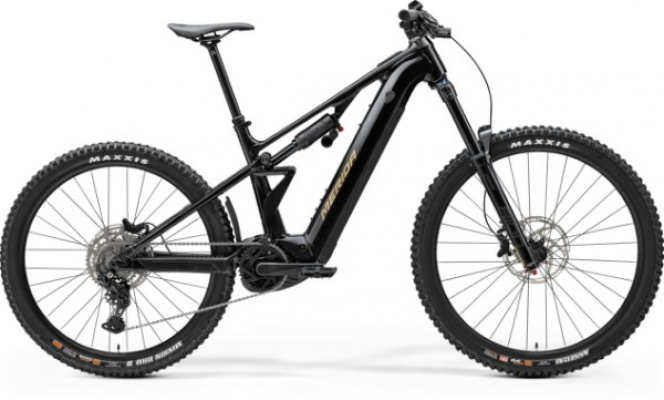
Merida eOne-Eighty 400
The Merida eOne-Eighty 400 is an entry-level, 180mm-travel aluminium e-MTB built to Merida's Category 5 freeride/downhill rating, aimed at riders who want Bosch-assisted climbs between bike-park laps and steep descents rather than long-distance trail riding.
- 180mm-travel aluminium frame, Category 5 rated: Built for repeated bike-park laps and steep, rough descents rather than gentler trail riding.
- Bosch Performance Line CX motor with removable 600Wh battery: Assisted climbs back to the top, with a battery you can pull out to charge indoors.
- SR Suntour Aion 38X fork (180mm) and TRIAIR2 shock: Dedicated freeride-tuned suspension at both ends for hard hits.
- Tektro Gemini M535 four-piston brakes, 203mm rotors: Strong, fade-resistant stopping power on long, steep descents.
- Mixed 29in front / 27.5in rear wheels with Assegai and Minion DHR II tyres: A wheel and tyre combination chosen for grip and control on steep, technical terrain.
- Five sizes with size-specific dropper travel: Easier to match saddle drop and reach to your height for aggressive riding.
Merida eOne-Eighty 400 Deals

Prices and availability can change quickly. Delivery charges are not always included in listed prices.
Final price, stock status and delivery terms are set by retailer. We may receive a commission on purchases made.
Bikesy's Verdict
The eOne-Eighty 400 is Merida's entry point into a genuinely bike-park capable machine, and it earns that billing: 180mm of travel at both ends, a Category 5 freeride rating and Bosch's CX motor for grinding back up between laps. Choosing it means accepting a 600Wh battery and simpler CUES shifting rather than the extra capacity and refinement further up the range, though the fork, shock and four-piston brakes remain properly aggressive. Independent testing of a related build flagged occasional pedal strikes on technical climbs linked to the platform's low bottom bracket, worth knowing if your local trails include tight, rooty sections. For riders who want lift-served descending and steep natural trails over long-range trail riding, it's a sound, honestly specified starting point.
Pros
- 180mm-travel aluminium frame with Merida's Category 5 freeride/downhill rating, built for sustained bike-park riding and steep natural descents.
- Bosch Performance Line CX motor with a removable 600Wh PowerTube battery you can charge off the bike.
- Four-piston Tektro Gemini M535 brakes on 203mm rotors front and rear, sized for repeated hard braking.
- Mixed 29in/27.5in wheels with an Assegai front and Minion DHR II rear tyre, a pairing suited to steep, loose terrain.
- Five sizes with size-specific dropper post travel, giving a wider fit range than a one-size-per-bracket approach.
Cons
- The entry-level 600Wh battery holds less capacity than the 800Wh fitted to the eONE-EIGHTY 500, and no ride-distance figure is published for this build.
- Tubeless-ready rims are fitted without tape or valves, so tubeless setup is an added job and cost.
- Independent testing of a related build on this shared-geometry platform reported occasional pedal or motor-housing strikes on technical climbs, linked to a low bottom bracket.
The Merida eOne-Eighty 400 is the entry point into Merida's dedicated freeride and downhill e-MTB line, built around 180mm of travel front and rear on an aluminium frame that Merida rates for Category 5 use, its most demanding classification, covering repeated bike-park laps and steep, rough natural descents. If you want a motor to do the climbing so you can spend your day chasing lift laps or long fire-road shuttles rather than pedalling gently between features, this is the kind of bike built for that job, and the 400 gets you into the platform at the lowest specified point in the numbered range.
Climbing back up between descents
Power comes from Bosch's Performance Line CX motor, controlled through the simpler Purion 200 display rather than the more detailed unit fitted higher up the range, paired with a removable 600Wh PowerTube battery you can lift out to charge indoors. Merida hasn't published a distance or riding-time figure for this build, so treat the 600Wh capacity as a description of the battery rather than a promise about how many laps you'll get from it; that depends heavily on assist mode, terrain and how much climbing you're doing between descents. It's worth knowing the 400 carries less capacity than the 800Wh battery fitted to the eONE-EIGHTY 500 further up the range, though the frame itself is built around a shared Bosch battery interface that also accepts an 800Wh unit, and Merida's platform manual permits retrofitting a Bosch PowerMore 250 range extender with its own holder and cable. Neither of those is fitted as standard on the 400, so budget for them separately if 600Wh doesn't turn out to be enough for your riding.
The kit that does the descending
Suspension duties go to an SR Suntour Aion 38X air fork with 180mm of travel up front and a TRIAIR2 shock at the rear, a combination built for the sustained hits of bike-park terrain rather than gentle trail riding. Stopping power comes from Tektro Gemini M535 four-piston brakes on 203mm rotors front and rear, sized generously enough to cope with repeated steep descents without fading. Gearing is Shimano's CUES U4000 in a 1x9 arrangement with an 11-46T cassette, a simpler and more robust setup than a wider-range drivetrain, which suits a bike that's more about surviving impacts than spinning up long climbs unassisted. The wheel setup mixes a 29-inch front with a 27.5-inch rear, wearing a Maxxis Assegai up front and a Minion DHR II out back, a tyre pairing generally chosen for grip on steep, loose terrain rather than rolling speed. The Merida Expert TR II rims are tubeless-ready, but they don't come fitted with tape or valves, so setting up tubeless is an extra job and cost rather than something you get straight out of the box.
Getting the size right
The 400 comes in five sizes, XShort through to XLong, with overlapping published height bands rather than one bike per height bracket, so there's some flexibility if you sit near a boundary. Reach runs from 415mm on the smallest frame up to 505mm on the largest, and the cockpit lengthens accordingly across the range. Dropper post travel is matched to frame size too, from 125mm on the XShort up through 150mm and 200mm on the middle sizes; Merida's own UK specification lists 230mm on the XLong but also separately prints 200mm for that same size, so if you're buying an XLong it's worth checking the dropper travel on the specific bike rather than assuming which figure applies.
Living with a bike-park bike
The published 140kg limit covers the whole system, bike, rider and any kit you're carrying, not the rider alone, which matters if you ride with a hydration pack or protective gear that adds noticeable weight. Because this is a bike built for repeated impacts, Merida calls for suspension servicing at least once a year, and more often if you're doing regular bike-park days, which is worth budgeting for alongside the purchase price. UK retailers have listed the 400 at around £4,900, though we haven't seen that figure confirmed on Merida's own price list, so treat it as a starting point for comparison rather than a fixed number. It's also worth keeping this build separate in your head from other numbered eONE-EIGHTY models and from listings dated a year or two either side of this one: the 400's 600Wh battery, CUES shifting and SR Suntour suspension are specific to this build, and a different year printed on a listing for a higher-numbered model doesn't tell you anything about a change to the 400 itself.
Bought with that in mind, the 400 works best as a bike you commit to for lift-served or shuttle-assisted riding: the motor and battery get you back to the top, the frame and brakes are built to survive the sessions in between, and the size range means most riders can find a frame that fits without compromise.
Key Features & Benefits
- Shimano CUES U4000 1x9 drivetrain, 11-46T cassette: Simple, robust gearing suited to shuttle and lift-assisted riding rather than long unassisted climbs.
- Frame's shared Bosch 600Wh/800Wh battery interface and PowerMore 250 compatibility: A documented upgrade route to more range without changing the whole bike, though the extra battery isn't fitted as standard.
- Tubeless-ready Merida Expert TR II rims: Ready for a tubeless conversion when you're prepared to add tape, valves and sealant yourself.
Geometry
Geometry - 600Wh 1x9 build, standard frame (29in front / 27.5in rear)
| Size | Reach (mm) | Stack (mm) | Effective top tube (mm) | Head angle | Seat angle | Chainstay (mm) | Wheelbase (mm) | Seat tube (mm) | Head tube (mm) | BB drop (mm) |
|---|---|---|---|---|---|---|---|---|---|---|
| XShort | 415 | 652 | 556 | 64.5° | 78.5° | 435 | 1195 | 400 | 110 | 12 |
| Short | 435 | 657 | 577 | 64.5° | 78.5° | 435 | 1218 | 410 | 115 | 12 |
| Mid | 460 | 661 | 604 | 64.5° | 78.5° | 435 | 1245 | 425 | 120 | 12 |
| Long | 485 | 666 | 630 | 64.5° | 78.5° | 435 | 1272 | 445 | 125 | 12 |
| XLong | 505 | 670 | 652 | 64.5° | 78.5° | 435 | 1294 | 465 | 130 | 12 |
Reviews
E-MOUNTAINBIKE Magazine's Bene tested the eONE-EIGHTY 900 in a Long frame size on this same Bosch CX platform and reported occasional pedal or motor-housing strikes on technical climbs, which the reviewer linked to the platform's low bottom bracket. The eOne-Eighty 400 shares that published bottom-bracket geometry, so the caution about clearance on tight, rooty climbs is relevant here too, even though this test didn't cover the 400's own SR Suntour suspension or its other fitted components.
Full Specification
eOne-Eighty 400 (600Wh 1x9 build) specification
| Area | Detail |
|---|---|
| Frame and travel | eONE-EIGHTY LITE aluminium; 180mm rear travel |
| Fork | SR Suntour Aion 38X air fork, 180mm |
| Shock | SR Suntour TRIAIR2 |
| Motor | Bosch Performance Line CX |
| Display/control | Bosch Purion 200 |
| Battery | Removable Bosch PowerTube 600Wh; no published ride-distance or riding-time figure |
| Drivetrain | Shimano CUES U4000, 1x9 |
| Cassette | Shimano LG400-9, 11-46T |
| Brakes | Tektro Gemini M535, four-piston hydraulic |
| Rotors | 203mm front and rear |
| Front wheel/tyre | 29-inch; Maxxis Assegai 29x2.5in |
| Rear wheel/tyre | 27.5-inch; Maxxis Minion DHR II 27.5x2.4in |
| Rims | Merida Expert TR II, tubeless-ready (tape and valves not included) |
| Cranks | 165mm, all five sizes |
| Permitted total weight | 140kg maximum, including bike, rider and carried equipment |
| UK RRP | £4,900; UK seller-stated figure, not confirmed on an accessible manufacturer price page |
Size-specific dropper post travel
| Size | Fitted dropper travel |
|---|---|
| XShort | 125mm |
| Short | 150mm |
| Mid | 200mm |
| Long | 200mm |
| XLong | 230mm (Merida's UK specification also separately lists 200mm for this size; check the individual bike) |
Upgrade path and maintenance
The frame's battery mount is built around a shared Bosch interface that also accepts an 800Wh battery, and Merida's platform manual permits retrofitting a Bosch PowerMore 250 range extender with its required holder and cable; neither is fitted as standard on this build, and the mounting position is shared with a bottle mount. Merida specifies suspension servicing at least once a year, with more frequent checks recommended for regular bike-park use.