
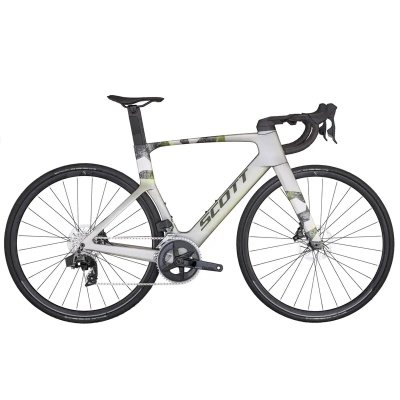
Scott Foil RC 30
Race-ready aero speed with enough comfort and stability to keep you fresh through long, fast road events.
- HMX carbon frame with F01 Airfoil tube shaping
- SRAM Rival eTap AXS wireless electronic shifting
- Duncan SL Aero seatpost adds compliance without drag
- Hydraulic disc brakes: confident stopping in all weather
- Clearance for 28mm tyres smooths rough tarmac
- 8.4 kg complete weight keeps climbs sharp
Scott Foil RC 30 Deals

Prices and availability can change quickly. Delivery charges are not always included in listed prices.
Final price, stock status and delivery terms are set by retailer. We may receive a commission on purchases made.
Bikesy's Verdict
The Foil RC 30 is a bike that rewards commitment. It's fast, efficient, and composed - a machine built for racing and high-tempo riding that doesn't punish you for putting in the miles. The aero frame and stiff HMX carbon chassis deliver tangible speed gains on flat to rolling terrain, while the compliance-tuned seatpost and wider tyre clearance mean rough tarmac won't beat you up. At 8.4 kg it's impressively light for an aero platform, and the SRAM Rival eTap AXS groupset is reliable, crisp, and clutter-free.
It's not the most playful or exciting bike you'll ever ride - the stable geometry and composed character prioritise confidence over outright aggression - but if you're after a bike that's fast, predictable, and versatile enough to handle everything from criteriums to long sportives, the Foil RC 30 is a compelling choice. It's a bike that asks you to ride hard, and it'll reward you when you do.
Pros
- Impressive 8.4 kg weight for an aero platform keeps climbs sharp
- SRAM Rival eTap AXS wireless shifting is crisp and reliable
- Stable, predictable handling inspires confidence at race pace
- Duncan SL Aero seatpost adds compliance without sacrificing stiffness
- Clearance for 28mm (or wider) tyres smooths rough tarmac
Cons
- No integrated power meter if you train with watts
- Saddle clamp can be fiddly when adjusting position
- Composed character may feel less exciting if you prefer snappy, playful handling
About the Scott Foil RC 30
The Foil RC 30 sits at the sharp end of Scott's aero road range, built around the same HMX carbon frame and F01 Airfoil tube profiles that define the entire Foil family. It's a bike designed to win - whether that's a town-sign sprint, a breakaway on a rolling road race, or simply the bragging rights on your club's fast loop. At 8.4 kg it's impressively light for an aero platform, and the frame's dropped seatstays and compliance-tuned Duncan SL Aero seatpost mean you're not trading comfort for speed. SRAM's Rival eTap AXS wireless shifting brings crisp, reliable electronic gear changes without the cable clutter, and hydraulic disc brakes deliver confident stopping power in all conditions.
This is the sort of bike that rewards commitment. You'll feel the frame's stiffness when you stamp on the pedals out of a corner, and the aerodynamic advantage becomes tangible when you're holding a high tempo into a headwind or chasing down a wheel. Yet it's not a one-trick pony: the geometry is stable enough to inspire confidence on fast descents, and the ability to fit 28mm tyres (with clearance hinting at 30mm or more on certain rubber) means rough tarmac and chipseal won't rattle your fillings loose. It's a bike that asks you to ride hard, but it won't punish you for doing so.
Scott positions the Foil RC 30 as an all-rounder within the aero category - a machine that's equally at home in a criterium, a road race, or a fast sportive. The spec is well judged: Syncros RP2.0 Disc wheels are light and stiff, Schwalbe ONE tyres offer a good balance of grip and rolling speed, and the Syncros Creston 2.0 Aero bar and Foil 1.5 Aero stem keep the front end slippery. It's a cohesive package that doesn't demand immediate upgrades, though there's headroom if you want to chase marginal gains.
Scott Foil RC 30 geometry
The Foil RC's geometry is race-focused but not overly aggressive. Reach figures are moderate - 389mm on a medium, for instance - so you're stretched out enough to get low and aero without feeling like you're doing yoga on the bike. Stack grows steadily through the size range, giving taller riders the front-end height they need without resorting to a tower of spacers. The head angle steepens as you go up in size (from 70.5° on XXS to 73.3° on XXL), which keeps the handling sharp and responsive across the board. You'll notice the steering is precise rather than twitchy; it's the sort of bike that holds a line beautifully through a fast corner but doesn't dart around nervously when you're out of the saddle.
Chainstays are a consistent 412mm across all sizes, which keeps the rear end snappy and responsive. Combined with a relatively low bottom bracket (66mm drop), the bike feels planted and stable at speed, especially when you're leaning into a descent or carving through a technical section. The wheelbase grows with frame size - from 972mm on XXS to 1012mm on XXL - so larger riders get the stability they need without sacrificing agility. The seat tube angle sits around 73 - 74.5° depending on size, which puts you in a powerful, forward position for climbing and time-trialling without feeling too extreme for all-day comfort.
In practice, this geometry translates to a bike that feels composed and predictable. It's not the most playful machine you'll ever ride - some might miss a bit of that nervous, flickable energy - but when you're holding 40 km/h on a rolling road or threading through a bunch at race pace, you'll appreciate the stability and confidence it offers. The slightly longer wheelbase and calmer head angle mean it's less likely to surprise you, which is exactly what you want when the speed's high and the margins are tight.
Component choices & upgrades
The stock build on the Foil RC 30 is already well sorted. SRAM Rival eTap AXS is a proper electronic groupset - wireless, reliable, and with a 48/35T chainring pairing and 10-30T cassette that covers most road riding without leaving you spinning out or grinding. The hydraulic disc brakes (160mm rotors front and rear) offer excellent modulation and power, and the Syncros RP2.0 Disc wheels are light enough to keep the bike feeling lively without being fragile. Schwalbe ONE tyres are a solid choice for fast road riding, offering good grip and durability with Race-Guard puncture protection.
That said, if you're chasing performance gains or tailoring the bike to specific demands, there are sensible upgrade paths. Wheels are the obvious first target: a set of deeper-section carbon hoops will sharpen the aero advantage and add a touch of stiffness, though you'll pay a weight penalty if you go too deep. If you're racing crits or flat road races, 50 - 60mm rims make sense; for hillier events, stick with something shallower and lighter. Tyres are another easy win - swapping to a faster-rolling tubeless setup (25mm front, 28mm rear, or even 30mm if clearance allows) can improve comfort and reduce rolling resistance, especially if you're willing to experiment with lower pressures.
The Syncros cockpit is functional and aero, but if you're after a more tailored fit or prefer a specific bar shape, there's no shortage of aftermarket options. The Duncan SL Aero seatpost is a clever bit of kit - it's designed to flex vertically for compliance while staying stiff laterally - but the saddle clamp can be fiddly to adjust, so if you're swapping saddles regularly, be prepared for a bit of patience. Power meter users will note there's no integrated option here, so you'll need to add a crank- or pedal-based unit if you're training with watts. Beyond that, the bike doesn't demand much - it's a cohesive, well-thought-out package that works straight out of the box.
Where the Scott Foil RC 30 excels
This is a bike built for fast road racing and high-tempo riding. If your weekends involve criteriums, road races, or aggressive club rides where the pace rarely dips below 30 km/h, the Foil RC 30 is in its element. The aerodynamic frame and cockpit save you watts when you're holding a steady effort, and the stiff HMX carbon chassis means every bit of power you put down translates into forward motion. It's the sort of bike that feels fast even when you're not trying, and when you do commit - out of a corner, in a sprint, chasing a break - it responds with a satisfying surge.
It's also surprisingly capable on longer, mixed-terrain rides. The compliance from the seatpost and the ability to run wider tyres mean rough tarmac and chipseal don't beat you up as much as you'd expect from an aero race bike. Climbs are handled with efficiency rather than fireworks - the low weight and stiff frame keep you moving, but it's not quite as lively or playful as a dedicated climbing bike like the Addict RC. Descents are where the stable geometry really shines: the bike tracks beautifully, holds a line through fast corners, and doesn't get unsettled by rough patches or crosswinds.
Where it's less ideal is for riders seeking maximum comfort or versatility. The race geometry and firm ride quality won't suit everyone, especially if you're after a more relaxed, endurance-oriented position. It's also not a gravel bike - while it can handle light gravel or rough lanes, the clearance and geometry aren't designed for proper off-road adventures. And if you're a rider who values that last bit of snappy, aggressive handling - the kind of bike that feels alive under you - the Foil RC's composed, stable character might feel a touch too refined. It's a bike that prioritises speed, efficiency, and confidence over outright excitement, and that's a trade-off some riders will love and others might find a bit too sensible.
Scott Foil RC 30 FAQs
What is the weight of the Scott Foil RC 30?
The complete bike weighs approximately 8.4 kg, which is impressively light for an aero road bike. That figure includes the SRAM Rival eTap AXS groupset, Syncros wheels, and all finishing kit, though pedals aren't supplied.
Is the Scott Foil RC 30 good for climbing?
Yes, it climbs efficiently thanks to its low weight and stiff frame, though it's not quite as lively or playful as a dedicated climbing bike like the Scott Addict RC. The 48/35T chainring and 10-30T cassette offer a good range for most gradients, and the stable geometry keeps you composed on technical ascents.
What is the tyre clearance on the Scott Foil RC 30?
Official clearance is listed as 25mm front and 28mm rear, though some sources suggest the frame can accommodate up to 30mm or even 32mm depending on the tyre and rim combination. That's enough to smooth out rough tarmac without compromising the bike's aero performance.
What is the difference between the Scott Foil RC 30 and the Addict RC?
The Foil RC 30 is an aero race bike with F01 Airfoil tube shaping, optimised for speed and efficiency on flat to rolling terrain. The Addict RC is a lightweight climbing bike with a more traditional round-tube frame, designed for maximum responsiveness and agility on steep gradients. The Foil is heavier but faster on the flat; the Addict is lighter and more playful on climbs.
What type of bottom bracket does the Scott Foil RC 30 use?
It uses a SRAM DUB PF Road 86.5 PressFit bottom bracket, which is a standard modern road BB shell designed for SRAM's DUB cranksets. It's a reliable system, though PressFit designs can occasionally develop creaks if not installed and maintained correctly.
Can I fit wider tyres on the Scott Foil RC 30?
The official spec lists clearance for 25mm front and 28mm rear, but real-world testing suggests you can likely fit 30mm tyres, and possibly 32mm depending on the tyre model and rim width. Wider tyres will improve comfort and grip on rough surfaces, though you may sacrifice a small amount of aerodynamic efficiency.
What is the intended use for the Scott Foil RC 30?
It's designed for racing and high-performance road cycling - criteriums, road races, fast sportives, and aggressive club rides. The aero frame, stiff chassis, and race geometry make it ideal for riders who prioritise speed and efficiency, though it's versatile enough to handle longer, mixed-terrain rides with confidence.
Key Features & Benefits
- HMX carbon frame with F01 Airfoil tube shaping: Cuts through the air efficiently, saving watts on long efforts and high-speed riding without adding weight
- SRAM Rival eTap AXS wireless electronic shifting: Delivers fast, precise gear changes with no cables to snag or maintain, keeping the cockpit clean and reliable
- Syncros Duncan SL Aero CFT seatpost: Flexes vertically to absorb road buzz while staying laterally stiff, so you stay comfortable without losing power transfer
- Hydraulic disc brakes with 160mm rotors: Offers confident, controlled stopping power in all weather, with excellent modulation for technical descents and tight corners
- Clearance for up to 28mm (or wider) tyres: Lets you run more volume for comfort and grip on rough tarmac without compromising the bike's aero performance
Scott Foil RC 30 2024 and 2023 differences
The 2025 model represents a significant groupset shift: it's specced with SRAM Rival eTap AXS wireless electronic shifting, replacing the Shimano 105 Di2 12-speed setup found on 2024 and 2023 versions. That change brings wireless convenience and a slightly different shift feel, though both systems are reliable and well-regarded. The 2025 model also features Syncros RP2.0 Disc wheels, an upgrade from the RR2.0 Disc wheels on earlier years, offering a touch more stiffness and refinement.
Tyre spec remains similar - Schwalbe ONE Race-Guard rubber in 25mm front and 28mm rear - though the 2024 model was listed with 25mm front and rear on some sources. Frame geometry and construction appear unchanged across these model years, with the same HMX carbon layup, F01 Airfoil tube shaping, and Duncan SL Aero seatpost. Hydraulic disc brakes remain consistent, with 160mm rotors front and rear (some 2023 models may have used 140mm rear). Overall, the 2025 update is primarily a component refresh rather than a fundamental redesign, with the SRAM groupset being the headline change.
Alternatives to Consider
Within Scott's own range, the Addict RC 30 is the obvious counterpoint - lighter, more playful, and built for climbing rather than outright aero speed. If you're racing in the hills or prefer a bike that feels lively and responsive under you, the Addict's traditional round-tube frame and lower weight will suit better. Step up to the Foil RC Pro and you'll gain a higher-spec groupset (SRAM Force or Red eTap AXS) and lighter wheels, though the frame and geometry remain the same; it's a marginal-gains upgrade for riders chasing every watt.
Cross-brand, the Specialized Tarmac SL7 is a natural rival - it's an all-rounder that blends aero efficiency with climbing prowess, and it's available in a wide range of builds to suit different budgets. The Trek Madone SL 6 offers similar aero performance with Trek's IsoFlow seat tube for added compliance, though it's slightly heavier and more comfort-focused. The Cervélo S5 is a more aggressive aero option, with sharper handling and a stiffer ride quality; it's faster on flat, fast courses but less forgiving on rough roads. For a lighter, more versatile option, the Giant TCR Advanced Pro 2 delivers excellent climbing and handling with a more traditional frame design, though it sacrifices some aero advantage. Finally, the Bianchi Oltre RC sits in a similar space - aero-focused but with enough compliance and stability to handle long, mixed-terrain rides - and it's worth considering if you value Italian style and a slightly more relaxed geometry.
Reviews
Aerodynamics and low weight rarely coexist this comfortably. The HMX carbon frame feels stiff when you're out of the saddle, yet the Duncan SL Aero seatpost and wider tyre clearance mean rough tarmac doesn't rattle your teeth loose. When you're holding a high tempo into a headwind or chasing down a wheel, the aero advantage is tangible - you're working less hard to maintain the same speed, and that efficiency compounds over long efforts.
Handling is stable and predictable rather than nervous or playful. The slightly longer wheelbase and calmer head angle mean the bike tracks beautifully through fast corners and doesn't get unsettled by crosswinds or rough patches. Some riders might miss a bit of that flickable, aggressive energy, but when you're threading through a bunch at race pace or descending at 60 km/h, the composed character inspires confidence. Climbs are handled with efficiency - the low weight and stiff frame keep you moving - but it's not quite as lively as a dedicated climbing bike.
SRAM Rival eTap AXS is a proper electronic groupset, and the wireless setup keeps the cockpit clean and reliable. Shifts are crisp, the 48/35T chainring pairing covers most road riding without leaving you spinning out or grinding, and the hydraulic disc brakes offer excellent modulation and power. We found the Syncros RP2.0 Disc wheels light and stiff enough to keep the bike feeling responsive, and the Schwalbe ONE tyres strike a good balance between grip and rolling speed. The saddle clamp can be fiddly to adjust, and there's no integrated power meter, but those are minor niggles in an otherwise well-judged package.
Full Specification
| Spec | Value |
|---|---|
| Frame | FOIL RC Disc HMX Carbon |
| Frame Material | HMX Carbon |
| Frame Construction | Road Race geometry with F01 Airfoil Technology |
| Frame Features | Internal cable routing, dropped seatstays |
| Tyre Clearance | 700x28C rear, 700x25C front (up to 30 - 32mm with specific tyres) |
| Bottom Bracket | SRAM DUB PF ROAD 86.5 PressFit |
| Fork | FOIL Disc HMX, 1" Excentric Carbon steerer |
| Drivetrain | 2x12 Speed Electronic |
| Shifters | SRAM RIVAL eTap AXS |
| Rear Derailleur | SRAM RIVAL eTap AXS |
| Front Derailleur | SRAM RIVAL eTap AXS |
| Crankset | SRAM RIVAL, 48/35T |
| Cassette | SRAM RIVAL XG1250, 10 - 30T |
| Chain | SRAM RIVAL |
| Brakes | Hydraulic Disc |
| Brake Levers | SRAM RIVAL eTap AXS HRD |
| Brake Calipers | SRAM RIVAL eTap AXS HRD |
| Rotors (Front) | SRAM Paceline, 160mm |
| Rotors (Rear) | SRAM Paceline, 160mm |
| Rims | Syncros RP2.0 Disc |
| Hubs (Front) | Syncros RP2.0 Disc |
| Hubs (Rear) | Syncros RP2.0 Disc |
| Tyres (Front) | Schwalbe ONE Race-Guard Fold, 700x25C |
| Tyres (Rear) | Schwalbe ONE Race-Guard Fold, 700x28C |
| Handlebar | Syncros Creston 2.0 Aero, 38cm width |
| Stem | Syncros Foil 1.5 Aero |
| Headset | Acros AIF-1138 |
| Seatpost | Syncros Duncan SL Aero CFT |
| Saddle | Syncros Belcarra V2.0 NEO Cut Out |
| Weight (Approx) | 8.4 kg |