
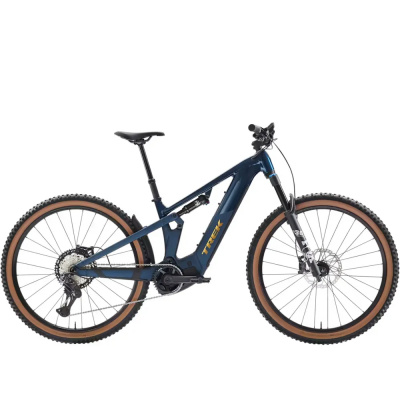
Trek Powerfly FS+ 8
A full-power, 800 Wh Bosch e-MTB with 120 mm rear suspension, electronic shifting and the range to turn a big day out into a realistic plan.
- 800 Wh removable battery: More scope for long rides, with convenient off-bike charging
- 85 Nm Bosch CX motor: Strong assistance for sustained climbs and heavy bikes-and-kit days
- Electronic 12-speed shifting: Choose Shimano XT Di2 or SRAM GX AXS T-Type control
- 120 mm rear suspension: Takes the sting out of rough tracks while staying responsive
- Size-specific wheel setup: 27.5-inch S and 29-inch M-XL formats support proportionate handling
- Accessory-ready frame: Add compatible luggage, mudguards or PowerMore for practical adventures
Trek Powerfly FS+ 8 Deals
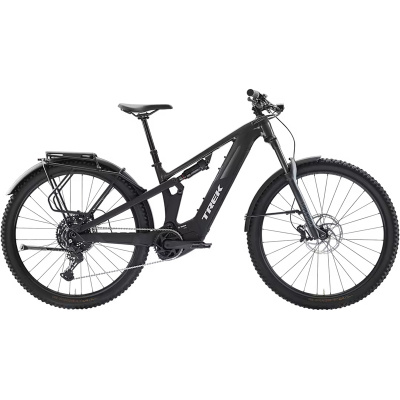
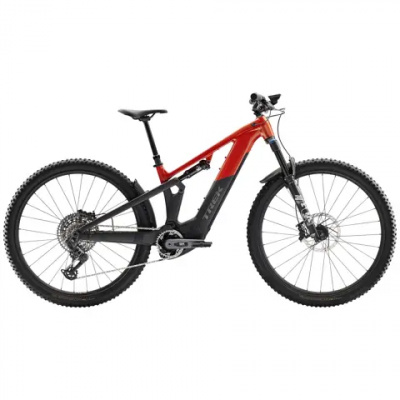
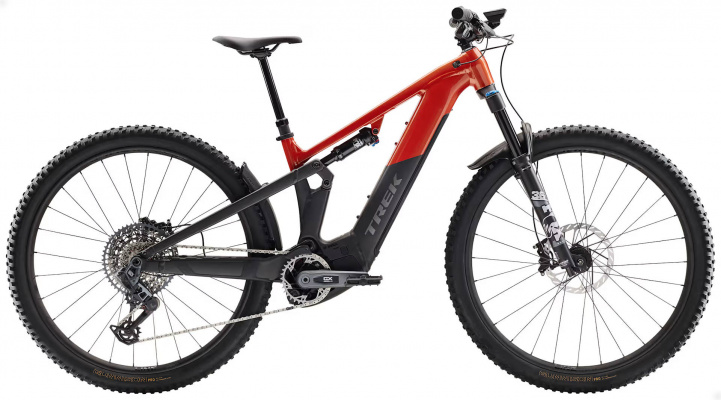
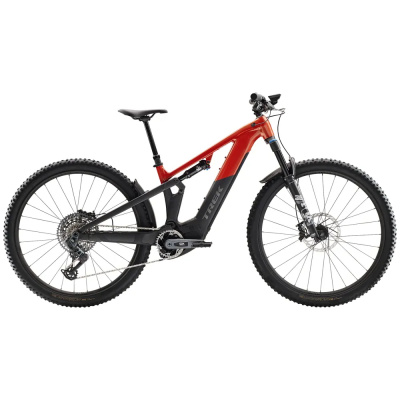
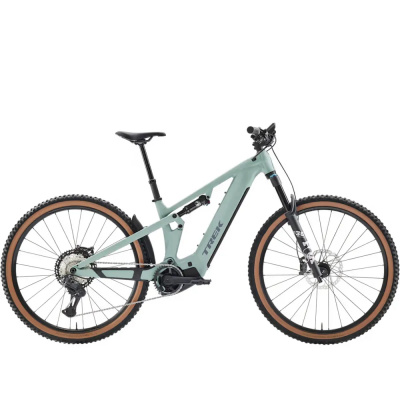
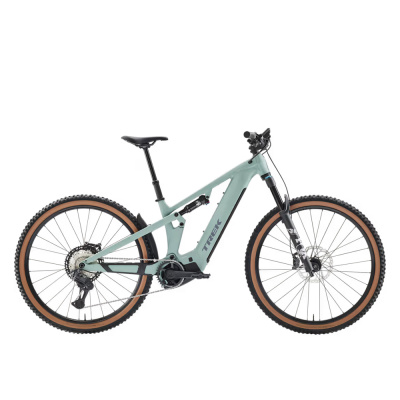
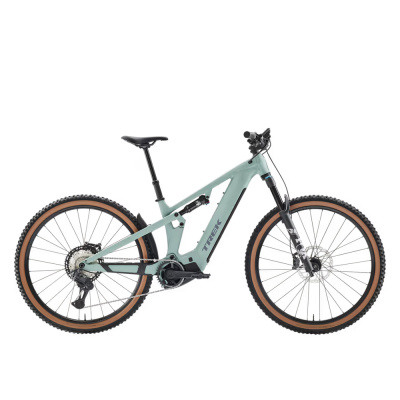

Prices and availability can change quickly. Delivery charges are not always included in listed prices.
Final price, stock status and delivery terms are set by retailer. We may receive a commission on purchases made.
Bikesy's Verdict
The Trek Powerfly FS+ 8 is a cracking choice for riders who want one powerful e-MTB to make long trail-centre days, woodland exploration and repeat-climb rides feel much more achievable. Its removable 800 Wh battery, 85 Nm Bosch CX system, electronic shifting and useful accessory provision give it a genuinely broad brief, rather than a single-minded race focus. The size-specific wheel and dropper arrangement is another thoughtful touch. It is not a lightweight bike, and its 120 mm rear platform is happier on flowing moderate trails than repeated steep, broken descents, but that is a sensible compromise for the rider who values range, agility and practical versatility.
Pros
- Removable 800 Wh battery suits genuinely long rides and off-bike charging
- Bosch Performance Line CX assistance makes repeated climbing far less daunting
- Both current builds include electronic 12-speed shifting
- 120 mm rear suspension balances comfort with a lively, moderate-travel feel
- Rack, mudguard, bottle and PowerMore compatibility add useful versatility
Cons
- Claimed size-M weights of 24.48 kg or 24.88 kg make stairs and transport more demanding
- The 120 mm rear platform has less composure on steep, broken descents than longer-travel e-MTBs
- Bosch electronics, full suspension and electronic shifting bring higher servicing complexity than a basic hardtail
The Trek Powerfly FS+ 8 is the full-power e-MTB for rides that start with a big climb, wander through miles of forest tracks and still leave plenty in the tank for a favourite trail-centre loop. Its Bosch Performance Line CX smart system supplies 85 Nm of assistance, while the removable 800 Wh Bosch PowerTube battery makes long days and off-bike charging far more practical. With 120 mm of rear suspension, it is aimed at covering distance and enjoying moderate singletrack rather than impersonating a downhill bike.
Compare live UK Trek Powerfly FS+ 8 prices
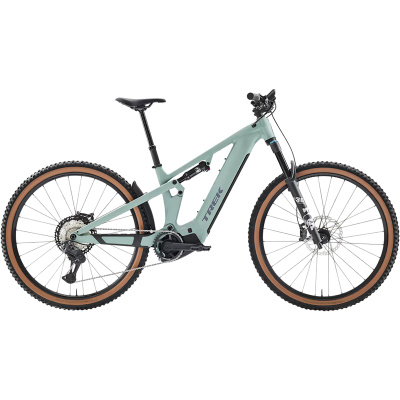
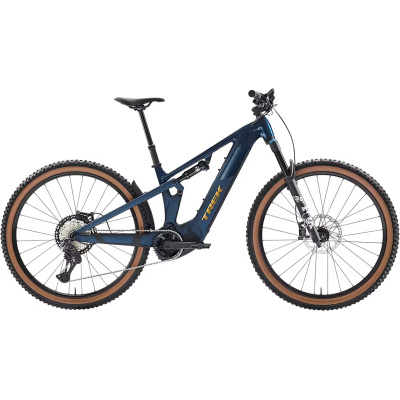
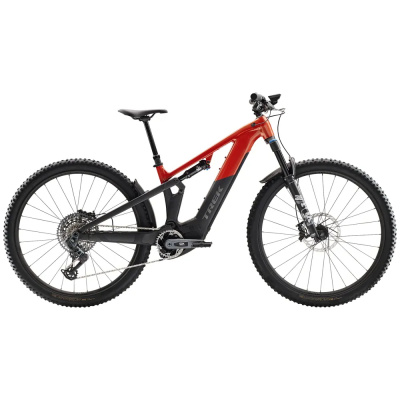
There are two current electronic-shifting packages under the same Powerfly FS+ 8 name, both with an official UK RRP of £5,250. Choose by the drivetrain and brake package shown on the offer, rather than the name alone: one uses Shimano XT Di2 and Shimano XT four-piston brakes, while the other has SRAM GX Eagle AXS T-Type shifting and SRAM DB8 four-piston brakes. Gloss Lava/Matte Dark Web normally identifies the SRAM build, while Blue Sage/Catalina Fog identifies the Shimano version. Mulsanne has appeared across more than one catalogue period, so the drivetrain is the more reliable clue.
What is the latest Trek Powerfly FS+ 8 generation?
Trek calls the current platform the Powerfly+ FS 8 Gen 4. It keeps an aluminium frame, Trek's removable RIB 2.0 battery integration and practical mounting points, then combines them with full Bosch power and electronic 12-speed shifting. The result makes sense for riders who want an assisted mountain bike that can handle a long countryside outing, repeated climbs and a sensible amount of day-to-day utility with compatible luggage or mudguard kit fitted.
Gen 4 frame, sizing and likely ride character
The Gen 4 frame uses 120 mm of rear travel, an ABP suspension arrangement and a Fox Float Rhythm shock. That is enough suspension to smooth out roots, braking bumps and rough tracks while keeping the bike's character more responsive than a long-travel e-MTB. The SRAM GX AXS build has a confirmed 130 mm Fox Rhythm 36 fork. Fork travel on the current Shimano XT Di2 build needs confirming against the exact offered bike and size, particularly for size S, so a generic 150 mm claim should not be treated as settled.
Wheel format follows frame size rather than personal preference. Size S uses 27.5-inch wheels and a 100 mm dropper post, helping smaller riders get a proportionate setup. Sizes M, L and XL move to 29-inch wheels with a 170 mm dropper, bringing more rollover on longer routes. The frame is not designed to swap between wheel diameters or create a mixed-wheel arrangement.
On flowing trails and linking tracks, the Powerfly's moderate travel, Bosch assistance and upright-enough climbing position should make it an easy bike to place and keep moving. It has the capacity for blue and red trail-centre routes within your skill level, repeated climbs and all-day exploration. Steep, broken descents ask more of its 120 mm rear platform than they do of a longer-travel machine, so riders whose weekends revolve around aggressive descending will benefit from a more descent-led design.
Shimano XT Di2 vs SRAM GX AXS builds
Current Shimano XT Di2 build: This package combines Shimano XT Di2 electronic shifting with a Shimano 10-51-tooth cassette, Shimano XT four-piston brakes and 200 mm rotors front and rear. It uses Bontrager Line TLR 30 wheels with a Rapid Drive 108 rear hub. Trek claims a 24.88 kg weight for a size M with tubeless sealant and no inner tubes.
SRAM GX AXS build: The alternative uses SRAM GX Eagle AXS T-Type electronic shifting and a 10-52-tooth cassette, paired with SRAM DB8 four-piston brakes. It has Bontrager Line Comp 30 wheels and the confirmed 130 mm Fox Rhythm 36 fork. Its claimed size-M weight is 24.48 kg. Both packages retain the same 800 Wh battery, 120 mm rear travel and size-specific wheel arrangement, so the choice is chiefly about the drivetrain, braking and wheel specification you prefer.
UK maintenance, battery care and practical ownership
The 800 Wh battery can be removed for charging or storage, which is handy when the bike lives in a shed, garage or vehicle. UK motor assistance cuts out at 25 km/h, so the bike's mass becomes more noticeable on faster tarmac links or whenever you are pedalling without assistance. At roughly 25 kg complete, it is also a substantial lift for stairs and vehicle racks. If you transport it by car, use a carrier whose individual-bike rating comfortably exceeds 24.88 kg and follow any battery-removal instructions for that rack.
PowerMore range extension is compatible for unusually long days, but it is an aftermarket addition requiring the PowerMore battery, a 100 mm reversed cable and mounting hardware. Compatible racks and full mudguards are also optional rather than supplied equipment. A compatible 600 Wh battery can create a lighter setup for shorter rides, provided the correct RIB 2.0 hardware is used where needed.
Like any full-suspension e-MTB, this is happiest with regular attention rather than a winter of neglect. Wet, gritty riding calls for frequent drivetrain cleaning plus periodic checks of brake pads, suspension pivots and the battery interface. Factor in Bosch-system support and fork and shock servicing as part of ownership, particularly if the bike will see plenty of muddy miles.
Key Features & Benefits
- RIB 2.0 battery integration: The Bosch PowerTube 800 Wh battery is fitted neatly in the frame but can be removed for charging, storage or easier transport.
- Bosch Performance Line CX smart system: The 85 Nm system is central to the bike's climbing ability, with adjustable assistance settings and over-the-air updates available through the smart system.
- ABP-equipped 120 mm rear suspension: The moderate-travel layout is designed to maintain traction and comfort over roots and rough trail surfaces without the slower feel of a long-travel e-MTB.
- Two premium electronic build options: Shimano XT Di2 brings XT four-piston braking and 10-51 gearing, while SRAM GX AXS T-Type pairs a 10-52 cassette with DB8 four-piston brakes and a confirmed 130 mm fork.
- Useful ownership flexibility: Rack, mudguard and bottle mounts broaden everyday use, while compatible PowerMore and alternative-capacity batteries offer ways to tailor the bike for longer or shorter days.
Geometry
Gen 4 geometry - 130 mm-fork reference configuration
These measurements apply to the Gen 4 130 mm-fork reference configuration. They should not be used to predict the exact handling of a Shimano XT Di2 build whose fitted fork travel has not been confirmed.
| Size | Wheel size | Reach | Stack | Effective top tube | Head angle | Seat angle | Chainstay | Wheelbase | Standover |
|---|---|---|---|---|---|---|---|---|---|
| S | 27.5 inches | 425 mm | 597 mm | 563 mm | 65 degrees | 77 degrees | 458 mm | 1201 mm | 756 mm |
| M | 29 inches | 450 mm | 629 mm | 595 mm | 66 degrees | 77 degrees | 461 mm | 1223 mm | 780 mm |
| L | 29 inches | 475 mm | 647 mm | 630 mm | 66 degrees | 77 degrees | 461 mm | 1257 mm | 775 mm |
| XL | 29 inches | 500 mm | 666 mm | 654 mm | 66 degrees | 77 degrees | 461 mm | 1290 mm | 778 mm |
| Size | Seat tube | Head tube | Bottom bracket drop | Bottom bracket height | Front centre | Fork rake |
|---|---|---|---|---|---|---|
| S | 380 mm | 130 mm | 30 mm | 330 mm | 745 mm | 49 mm |
| M | 400 mm | 110 mm | 45 mm | 335 mm | 766 mm | 50 mm |
| L | 420 mm | 130 mm | 45 mm | 335 mm | 799 mm | 50 mm |
| XL | 450 mm | 150 mm | 45 mm | 335 mm | 832 mm | 50 mm |
Alternatives to the Trek Powerfly FS+ 8
The Cube Stereo Hybrid ONE44 HPC Race 800 matches the Trek's 800 Wh battery capacity but uses a carbon front triangle, 150 mm front travel and 140 mm rear travel. It also has a slightly lower published weight. That makes the Cube the stronger on-paper proposition for riders prioritising more suspension travel and headline value, while the Powerfly FS+ 8 leans into its two electronic-shifting options, removable RIB 2.0 battery integration and Powerfly-specific utility features.
The Trek Rail+ 8 Gen 5 is Trek's more descending-focused full-power alternative. It shares an 800 Wh battery capacity but uses a 160 mm-travel platform, giving it more reserve for rougher, steeper descents. The Powerfly FS+ 8 is the more natural fit when long exploration, moderate-travel agility and practical accessory compatibility matter as much as trail riding.
Independent ride feedback
Solo Bici tested the Gen 4 SRAM GX AXS build with its 130 mm fork. Reviewer Xavi Roca praised its agile cornering, effective climbing and ability to cover long rides, while noting that the ABP suspension stayed active under braking.
The same test found the bike reached its limits sooner on steep, broken descents than a longer-travel e-MTB. It also judged the standard tyre casing light for rocky e-MTB use, so riders who regularly encounter sharp rocks may prefer a tougher compatible casing when the original tyres wear out.
Full Specification
Shared current Gen 4 platform
| Specification | Details |
|---|---|
| Generation | Powerfly+ Full Suspension Gen 4 |
| Frame | Alpha Platinum Aluminium with RIB 2.0 battery integration, Motor Armor, Mino Link, angle-adjust headset compatibility, adjustable leverage rate, ABP, UDH and Boost 148 rear spacing |
| Rear suspension | 120 mm rear travel with Fox Float Rhythm shock, 210 x 50 mm |
| Axles, chainline and routing | Boost 110 front and Boost 148 rear thru-axles, UDH, 55 mm chainline and guided internal routing |
| Mounting provision | Rack, mudguard and accessory mounts; every size accepts at least a 621 ml bottle |
| System weight limit | 136 kg including bicycle, rider and cargo |
Current Shimano XT Di2 build
Fork travel is not stated as a fixed figure here because published claims conflict. The frame's published maximum fork travel is 140 mm for size S and 150 mm for sizes M, L and XL; this does not confirm the fork travel fitted to a particular offered bike.
| Specification | Details |
|---|---|
| Official UK RRP | £5,250 |
| Motor system | Bosch Performance Line CX smart system, supplied at 85 Nm |
| Battery, display and charger | Removable Bosch PowerTube 800 Wh battery, Kiox 300 display, LED Remote and 4 A charger |
| Shifter | Shimano XT Di2 M8250, 12-speed |
| Rear derailleur | Shimano XT Di2 M8260, 12-speed |
| Cassette | Shimano XT M8100, 10-51 teeth, 12-speed |
| Chain | Shimano Deore M6100, 12-speed |
| Crankset | e*thirteen e*spec Plus, 160 mm |
| Brakes | Shimano XT M8220 four-piston hydraulic brakes |
| Rotors | Shimano RT-6B750, six-bolt, 200 mm front and rear |
| Fork | Fox Rhythm 36 with Float EVOL air spring, GRIP damper, 44 mm offset, Boost 110 axle and 15 mm Kabolt; travel must be confirmed |
| Shock | Fox Float Rhythm, two-position damper, 210 x 50 mm |
| Rims | Bontrager Line TLR 30, Tubeless Ready |
| Front hub | Bontrager alloy, sealed bearing, six-bolt, Boost 110, 15 mm thru-axle |
| Rear hub | Bontrager alloy, sealed bearing, six-bolt, Rapid Drive 108, Shimano freehub, Boost 148, 12 mm thru-axle |
| Handlebar | Bontrager Comp alloy, 31.8 mm, 40 mm rise, 780 mm |
| Stem | Bontrager Rhythm Comp, 31.8 mm, 0 degrees, 50 mm |
| Headset | FSA IS-2, 1-1/8-inch upper and 1.5-inch lower |
| Grips | Trek Line Comp lock-on |
| Saddle | Bontrager Verse P3, steel rails |
| Pedals | VP-536 nylon platform |
| Claimed weight | 24.88 kg in size M, with tubeless sealant and no inner tubes |
SRAM GX AXS build
| Specification | Details |
|---|---|
| Official UK RRP | £5,250 |
| Motor system | Bosch Performance Line CX smart system, supplied at 85 Nm |
| Battery, display and charger | Removable Bosch PowerTube 800 Wh battery, Kiox 300 display, LED Remote and 4 A charger |
| Shifter | SRAM AXS Pod |
| Rear derailleur | SRAM GX Eagle AXS T-Type, 12-speed |
| Cassette | SRAM Eagle XS-1275 T-Type, 10-52 teeth, 12-speed |
| Chain | SRAM GX Eagle T-Type, 12-speed |
| Crankset | SRAM GX, 160 mm |
| Brakes | SRAM DB8 four-piston hydraulic brakes |
| Rotors | 200 mm front and rear on the independently reviewed build; all-size fitment is not confirmed |
| Fork | Fox Rhythm 36 with Float EVOL air spring, GRIP damper, 44 mm offset, Boost 110 axle, 15 mm Kabolt and 130 mm travel |
| Shock | Fox Float Rhythm, two-position damper, 210 x 50 mm |
| Rims | Bontrager Line Comp 30, Tubeless Ready |
| Front hub | Bontrager Line Comp 30, six-bolt, Boost 110, 15 mm thru-axle |
| Rear hub | Bontrager Line Comp 30, Rapid Drive 108, six-bolt, Boost 148, 12 mm thru-axle |
| Handlebar | Bontrager Comp alloy, 31.8 mm, 40 mm rise, 780 mm |
| Stem | Bontrager Comp, 31.8 mm, Blendr compatible, 7 degrees, 50 mm |
| Headset | FSA IS-2, 1-1/8-inch upper and 1.5-inch lower |
| Grips | Bontrager XR Trail Comp lock-on |
| Saddle | Bontrager Verse P3, steel rails |
| Pedals | VP-536 nylon platform |
| Claimed weight | 24.48 kg in size M |
Size-specific current-build configuration
| Build | Size or sizes | Wheel size | Tyres | Dropper post | Seatpost length | Seatstay assembly |
|---|---|---|---|---|---|---|
| Current Shimano XT Di2 build | S | 27.5 inches front and rear | 27.5 x 2.40 inches | 100 mm travel | 310 mm | Size-specific seatstay assembly |
| Current Shimano XT Di2 build | M, L and XL | 29 inches front and rear | 29 x 2.40 inches | 170 mm travel | 450 mm | Shared M-XL seatstay assembly |
| SRAM GX AXS build | S | 27.5 inches front and rear | 27.5 x 2.40 inches | 100 mm travel | 310 mm | Size-specific seatstay assembly |
| SRAM GX AXS build | M, L and XL | 29 inches front and rear | 29 x 2.40 inches | 170 mm travel | 450 mm | Shared M-XL seatstay assembly |