
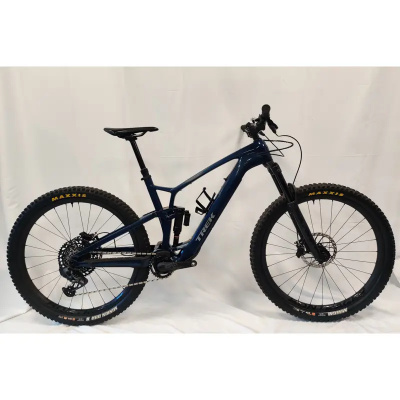
Trek Fuel EXe 9.8
The Trek Fuel EXe 9.8 is a carbon 29-inch light-assist trail e-MTB with 50 Nm TQ power, 150/140 mm suspension and a removable 360 Wh battery.
- 50 Nm TQ-HPR50 motor: Adds climbing support while retaining an active trail-bike feel.
- 360 Wh removable battery: Keeps downtube bulk down and can be removed for charging.
- 150/140 mm suspension: Brings confident control to demanding singletrack and repeated trail laps.
- OCLV Mountain Carbon frame: Helps keep the bike comparatively light for a full-suspension e-MTB.
- 29-inch wheels throughout: Roll smoothly and predictably across every stock frame size.
- Published M weights from 18.1 kg: Easier to manoeuvre than many heavier full-power e-MTBs.
Trek Fuel EXe 9.8 Deals

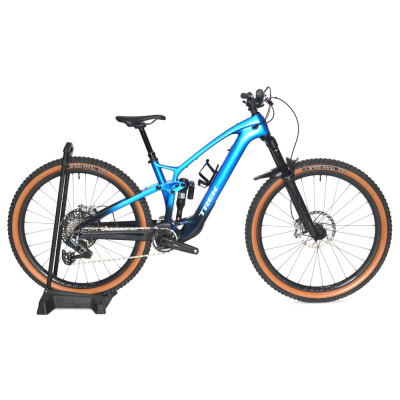
Prices and availability can change quickly. Delivery charges are not always included in listed prices.
Final price, stock status and delivery terms are set by retailer. We may receive a commission on purchases made.
Bikesy's Verdict
The Trek Fuel EXe 9.8 is a thoroughly appealing choice for an intermediate or experienced trail rider who wants more climbing opportunities without losing the physical, responsive side of mountain biking. Its carbon frame, well-judged 150/140 mm suspension package and compact 50 Nm TQ system make it especially good for technical loops where agility matters as much as assistance. The removable 360 Wh battery and compatible range extender add useful flexibility, while the XT, GX AXS and GX AXS T-Type versions give you meaningful choices in weight, shifting and cockpit layout. Buy the exact example rather than the badge alone: legacy bikes can differ significantly in wheels, rear shock, condition and service history.
Pros
- Natural-feeling 50 Nm TQ assistance keeps the ride active
- Carbon chassis and 150/140 mm suspension suit technical trail riding
- Removable 360 Wh battery plus compatible 160 Wh range extender
- 29-inch stock wheels with a supported mixed-wheel option
- Latest GX AXS T-Type build has strong four-piston braking and a Charger 3.1 RC fork
Cons
- 50 Nm assistance demands more rider input than a full-power e-MTB
- The range extender takes the bottle-cage position and adds about 900 g
- No rack, mudguard or kickstand mounts for utility use
A light-assist e-MTB that keeps you involved
The Trek Fuel EXe 9.8 is a carbon full-suspension e-MTB for riders who want extra laps and easier repeat climbs without trading the lively feel of a trail bike for the heft of a full-power machine. Its TQ-HPR50 motor delivers 50 Nm, so it gives a useful helping hand rather than doing all the work for you. That suits experienced riders who enjoy picking lines, moving around the bike and arriving at the top with something left in the legs.
There is 150 mm of fork travel and 140 mm at the rear, which is a capable package for technical singletrack, rocky trail-centre descents and rough natural loops. It is not intended as a substitute for a longer-travel, full-power e-MTB used repeatedly on uplift-style days. On the right ride, though, the lower mass and more active pedalling feel are a big part of the appeal.
The newest Fuel EXe 9.8 build and older examples
The newest Fuel EXe 9.8 specification is the latest UK GX AXS T-Type build, but the 9.8 is now a legacy model rather than part of Trek's current UK Fuel EXe catalogue. That means many examples will be new old stock, ex-demo or pre-owned, and the exact build matters more than the name printed on the frame.
The latest GX AXS T-Type version combines SRAM's 12-speed GX Eagle AXS Transmission with Code Bronze four-piston brakes and a RockShox Lyrik Select+ fork using the Charger 3.1 RC damper. It has a separate 780 mm carbon handlebar and stem rather than the one-piece cockpit used on the earliest 9.8s. Its wheelset and rear shock need a closer look on each bike: later listings describe either Line Comp 30 or Line Elite 30 wheels, and either a Super Deluxe Select+ or Super Deluxe Ultimate AirWiz rear shock.
Earlier 9.8 choices remain distinct. The original GX AXS build has the earlier wireless SRAM GX Eagle drivetrain, Code R brakes, carbon wheels and an integrated 820 mm carbon cockpit. The original Shimano XT version uses mechanical 12-speed shifting and XT four-piston brakes. Mechanical XT avoids the charging routine of an electronic derailleur, while the GX AXS versions give you wireless controls; T-Type adds shifting designed to work under load. Freehub standards differ between XT, GX AXS and GX AXS T-Type bikes, so wheels are not automatically interchangeable between them.
Published size-M weights also vary by build. The original XT is the lightest published 9.8 at 18.1 kg, while the original GX AXS and later GX AXS T-Type records are approximately 18.98 kg. The difference is worth knowing if you want the easiest bike to muscle through tight turns, lift over a gate or pedal beyond the assistance limit.
Carbon chassis, 29-inch wheels and a lively trail stance
Every Fuel EXe 9.8 uses the first-generation OCLV Mountain Carbon chassis with Active Braking Pivot, a Mino Link and 29-inch wheels in every stock size. In the Low Mino Link position, the 65-degree head angle, 77-degree effective seat angle and 440 mm chainstay point towards a stable but responsive ride. The steep seated position should help on sustained climbs, while the modest rear-centre and comparatively low e-MTB weight should make the bike easier to place through turns than a heavier full-power alternative.
A low bottom bracket can help the bike feel settled in corners, but it also rewards tidy pedal timing on roots and rocks. The 150 mm Lyrik fork and 140 mm rear travel bring welcome control and traction when the trail gets rough, without turning the Fuel EXe into a long-travel plough.
The stock layout is 29 inches front and rear, with clearance for tyres up to 29 x 2.5 inches. A 27.5-inch rear wheel is compatible when the Mino Link is set to High, creating a mixed-wheel setup with more rear clearance and a more agile feel. It is an aftermarket change rather than supplied equipment, requires a compatible Boost148 rear wheel and cassette or freehub, and reduces the effective assistance cut-off by roughly 1 km/h with a 27.5 x 2.5-inch rear tyre.
Battery, assistance and longer days out
The removable 360 Wh battery helps the Fuel EXe keep its slim, trail-bike-like silhouette. Trek gives a broad planning duration of 2-5 hours, but steep climbs, winter temperatures, mud, rider weight and assistance mode can shift that figure substantially. UK assistance stops at 15.5 mph, so the bike remains a lighter proposition when you are rolling faster on road links or flatter trails.
For longer loops, the compatible 160 Wh TQ range extender adds approximately 40% more range. It costs about 900 g and occupies the bottle-cage position, so a hydration pack or hip pack makes sense on those big days. The internal battery cannot be replaced with a larger one.
Looking after a legacy light e-MTB
The carbon frame has a bottle position on every size, although size S is limited to a 20 oz bottle. There are no rack, mudguard or kickstand mounts, so this is happiest as a focused trail bike rather than a luggage-carrying commuter. Integrated lights are compatible as a retailer-installed addition, but they are not supplied with the bike.
After wet rides, clean the charge-port and battery-cover area and avoid directing high-pressure water at bearings or electrical seals. For longer storage, keep the battery above 30% charge rather than leaving it fully depleted. On an ex-demo or pre-owned example, battery health, charger inclusion, suspension servicing and pivot service history are far more important than a shiny frame.
There is scope to tune the bike rather than replace it. The frame accepts up to a 160 mm fork within its 567 mm axle-to-crown limit, and compatible air or coil rear shocks can be fitted with the correct mounting hardware. A retailer-installed TQ HPR60 conversion is technically possible and may add 10 Nm, although the Fuel EXe firmware still caps peak mechanical power at 300 W and non-warranty motor availability may be limited.
Key Features & Benefits
- Moderate, progressive assistance: The compact TQ-HPR50 system offers 50 Nm and 300 W peak mechanical power, helping you tackle repeated climbs without removing the need to pedal hard and choose a good line.
- Range you can adapt: The 360 Wh internal battery has a broad 2-5-hour planning duration. Add the compatible 160 Wh range extender for approximately 40% more range when a long loop matters more than carrying a bottle on the frame.
- Mino Link and wheel-format flexibility: The supplied bike runs 29-inch wheels front and rear, while the High Mino Link setting supports a 27.5-inch rear-wheel conversion for riders who value added clearance and a more agile rear end.
- Builds with genuinely different characters: The original XT offers mechanical Shimano shifting and the lowest published size-M weight, while GX AXS models bring wireless controls. The newest T-Type version adds shifting intended to work under load, a 780 mm separate carbon cockpit and Charger 3.1 fork damping.
- Trail-focused frame details: Active Braking Pivot, internal cable routing, UDH and Boost axle standards support a clean setup and practical replacement-wheel or derailleur-hanger options.
Geometry
Geometry in Mino Link Low
These measurements apply to the first-generation carbon Fuel EXe platform with 29-inch wheels.
| Size | Reach | Stack | Effective top tube | Head angle | Seat angle | Chainstay | Wheelbase | Standover | Seat tube | Head tube | Bottom bracket height |
|---|---|---|---|---|---|---|---|---|---|---|---|
| S | 430 mm | 618 mm | 573 mm | 65 degrees | 77 degrees | 440 mm | 1186 mm | 740 mm | 380 mm | 100 mm | 342 mm |
| M | 455 mm | 627 mm | 600 mm | 65 degrees | 77 degrees | 440 mm | 1215 mm | 740 mm | 410 mm | 110 mm | 342 mm |
| L | 485 mm | 627 mm | 630 mm | 65 degrees | 77 degrees | 440 mm | 1245 mm | 740 mm | 435 mm | 110 mm | 342 mm |
| XL | 510 mm | 636 mm | 657 mm | 65 degrees | 77 degrees | 440 mm | 1275 mm | 760 mm | 470 mm | 120 mm | 342 mm |
Alternatives to Consider
The Specialized Turbo Levo SL Expert Carbon is a close light-assist alternative if you want the same published 50 Nm of torque. Its 320 Wh battery is 40 Wh smaller than the Fuel EXe 9.8's 360 Wh unit, while its published motor power is 320 W against the Trek's 300 W peak mechanical power.
The Orbea Rise SL M10 offers more assistance and stored energy on paper, with a 420 Wh battery and 60 Nm in its standard RS mode. It is also a carbon 140 mm-travel alternative, whereas the Fuel EXe 9.8 pairs 140 mm rear travel with a 150 mm fork. The Trek makes more sense when the lower-output, active-pedalling character is the priority; the Orbea has the stronger published motor-and-battery figures for longer or steeper assisted rides.
What BikeRadar found on the first-generation platform
Alex Evans's BikeRadar first ride was aboard the higher-spec Fuel EXe 9.9 XX1 AXS, but it used the same first-generation carbon platform. He found that the bike delivered useful climbing assistance while retaining a trail-bike-like handling character, and reported that High mode could keep pace with full-power e-MTB riders in some circumstances. The review also highlighted the low bottom bracket and integrated cockpit as practical points to bear in mind. The former can aid cornering confidence but asks for more care with pedal timing, while the one-piece cockpit fitted to earlier 9.8 builds offers less straightforward fit adjustment than the separate bar and stem on the latest GX AXS T-Type version.
Full Specification
First-generation carbon Fuel EXe 9.8 platform
| Specification | Details |
|---|---|
| Frame | OCLV Mountain Carbon full-suspension frame with removable battery, alloy rocker link, Active Braking Pivot, Mino Link, UDH, Boost148 rear end and internal routing |
| Intended use | Light-assist trail riding rather than full-power shuttle-style e-MTB use |
| Suspension travel | 150 mm fork and 140 mm rear travel |
| Rear-shock format | 205 mm x 60 mm |
| Maximum fork | 160 mm travel within a 567 mm axle-to-crown limit |
| Stock wheel format | 29-inch front and rear on every size |
| Maximum published tyre size | 29 x 2.5 inches |
| Mixed-wheel compatibility | 27.5-inch rear wheel compatible with Mino Link in High |
| Axle and drivetrain interfaces | Boost110 front, Boost148 rear, UDH, 55 mm chainline and ISIS e-bike crank interface |
| Bottle and accessory mounts | Bottle position on every size; size S is limited to a 20 oz bottle. No rack, mudguard or kickstand mounts. |
| System weight limit | 136 kg including bicycle, rider and cargo |
Latest UK Fuel EXe 9.8 GX AXS T-Type build
| Specification | Details |
|---|---|
| Original UK RRP | £8,250 |
| Motor and battery | TQ-HPR50, 50 Nm, 250 W maximum continuous rated power, 300 W peak mechanical power and 360 Wh removable battery |
| Drivetrain | SRAM GX Eagle AXS T-Type, 12-speed |
| Shifter | SRAM AXS Pod |
| Rear derailleur | SRAM GX Eagle AXS, T-Type |
| Crankset and chainring | SRAM S1000, 165 mm, with 32T T-Type chainring |
| Cassette | SRAM Eagle XS-1275, 10-52T, 12-speed |
| Chain | SRAM GX Eagle T-Type, 12-speed |
| Brakes | SRAM Code Bronze four-piston |
| Rotors | 200 mm front and rear |
| Fork | RockShox Lyrik Select+, DebonAir, Charger 3.1 RC, 44 mm offset, 150 mm travel |
| Rear shock | Offer-dependent Super Deluxe Select+ or Super Deluxe Ultimate AirWiz, 205 mm x 60 mm platform format |
| Wheelset | Offer-dependent Line Comp 30 or Line Elite 30 specification |
| Hubs | Boost110 front complete-wheel assembly; Boost148 Rapid Drive 108 rear complete-wheel assembly |
| Tyres | Bontrager SE5 Team Issue, 29 x 2.50 inches |
| Handlebar | Bontrager Line Pro OCLV Carbon, 780 mm |
| Stem | Bontrager Line Pro, 35 mm or 45 mm |
| Dropper post | Internally routed Bontrager Line dropper |
| Saddle | Bontrager Verse Short Comp, 145 mm |
| Pedals | Not supplied |
| Published weight | 18.98 kg for a published size-M configuration |