
Ere Saddles
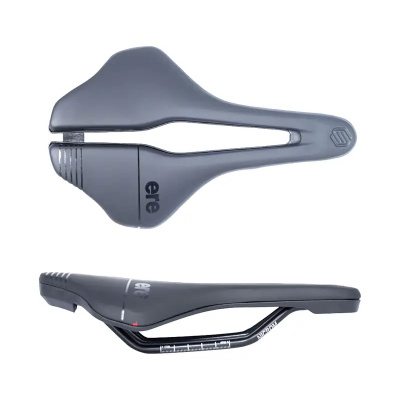
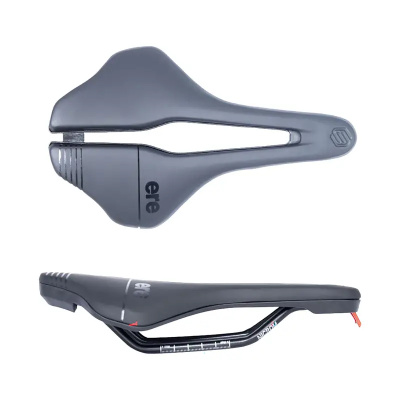
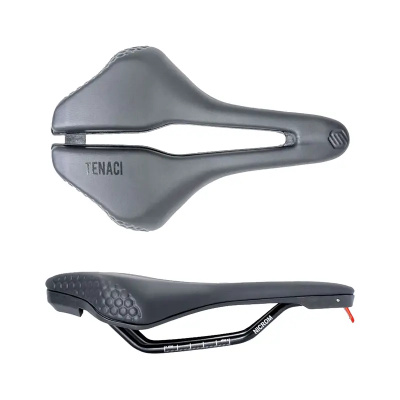
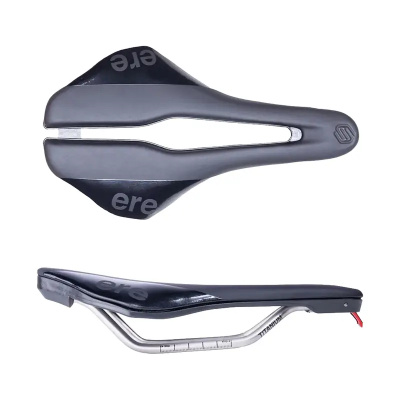
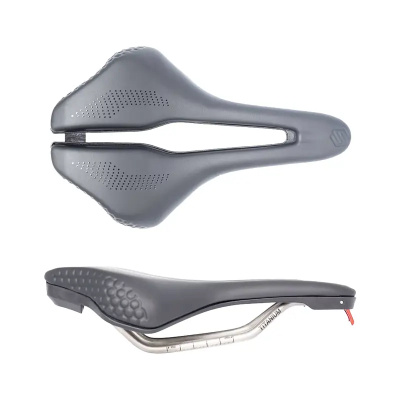
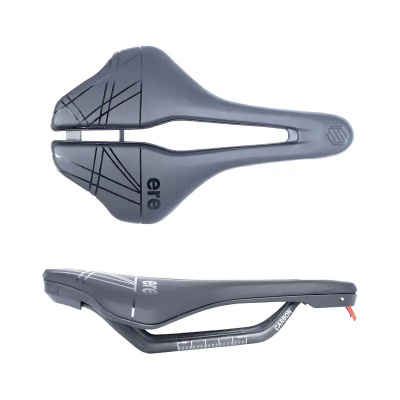
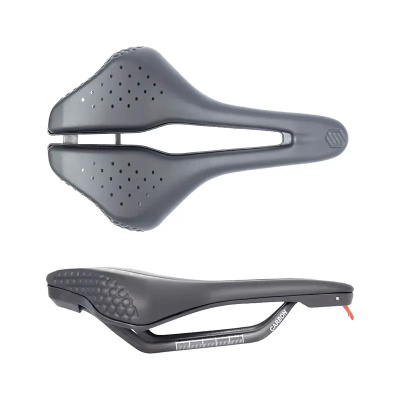
Ere Research Saddles bring something genuinely different to the contact point conversation: on-the-fly adjustability that lets you dial shell stiffness without stopping. Founded by Piet van der Velde, the brand's built its reputation around the patented Comfort Trigger, a red lever at the nose that toggles between three flex settings with a 10nm variance. It's a neat trick when you're climbing out of the saddle one minute and settling into a long valley road the next. The range splits into two families. Genus - Pro and Team variants - targets flat-backed racing positions, while Omnia caters to endurance and gravel riders who spend more time upright. Both lines come in three widths: 133mm (Narrow), 143mm (Standard), and 157mm (Wide). Matching your sit bone width to the right platform matters here, because even the cleverest tech won't save you if you're perched on the wrong footprint. Rail options run from carbon fiber for the gram counters to nickel-chromoly for those who prefer durability over the scales.
Prices and availability can change quickly. Delivery charges are not always included in listed prices.
Final price, stock status and delivery terms are set by retailer. We may receive a commission on purchases made.
How the Comfort Trigger Mechanism Works
The Comfort Trigger sits at the saddle nose, a small red lever that adjusts tension on the shell via an internal cable system. Flick it forward for Comfort mode - maximum flex to absorb chatter on broken tarmac or gravel washboard. Middle position gives you Normal, a balanced setting for steady-state riding. Click it back to Responsive and the shell firms up, ideal for out-of-the-saddle efforts or sprint finishes where you want every watt going through the pedals, not into shell deflection. The 10nm variance is noticeable without being dramatic; you're not transforming the saddle, just tuning it. It's particularly handy on mixed rides - think a loop that starts with smooth A-roads, dips into rutted lanes around the Surrey Hills, then finishes with a punchy climb. You can adapt without carrying a multi-tool or pulling over. The mechanism itself uses a Dynamic Torsion Bar to maintain structural integrity while allowing controlled flex, so the shell doesn't sag or lose shape over time. Microfiber cover keeps things grippy without the break-in period of traditional leather.
Genus or Omnia: Which Line Suits Your Riding
Genus saddles - Pro and Team models - feature a flat profile that suits aggressive, nose-down positions. If you're racing crits, chasing club runs, or spending long stretches in the drops, the Genus keeps pressure distributed evenly across the sit bones without the curved tail pushing you forward. It's a no-nonsense shape. Carbon rails shave weight on the Pro; the Team uses nickel-chromoly for a bit more forgiveness and a lower price point. Omnia models, by contrast, add a subtle curve to the profile, which works better for endurance riders and gravel setups where your hips rotate slightly more upright. The Omnia line also includes All-Road variants with extra padding under the microfiber, useful when you're bouncing over Peak District bridleways or linking singletrack in the Welsh valleys. Both families share the Comfort Trigger, but the Omnia's slightly softer baseline flex makes the Comfort setting more plush, while the Genus holds firmer even in its softest mode. Width choice matters more than the model split for most riders - measure your sit bones or borrow a demo before committing. If you're curious how Ere stacks up against other performance-focused brands, Fizik saddles and Enve saddles offer similarly minimalist approaches, though neither gives you mid-ride adjustability.
Rails, Bars, and Material Choices
Ere uses two rail materials. Carbon fiber rails drop weight to around 150g for the lightest Genus Pro models, and they're stiff enough that you won't feel flex under hard efforts. Trade-off: they're less forgiving if you clip a kerb or drop the bike. Nickel-chromoly rails add roughly 40g but absorb more road buzz and cost less to replace if you damage them. Both clamp into standard 7mm round or oval rail seat posts without fuss. The shell itself is a composite layup reinforced by the Dynamic Torsion Bar, a longitudinal spine that prevents the saddle from collapsing inward over thousands of kilometres. It's a clever bit of engineering - most saddles either go too stiff (and beat you up) or too soft (and waste power). The Comfort Bar, a secondary structural element, ties the nose to the tail and keeps the microfiber cover taut. You won't see it, but you'll notice the difference after a year of wet Scottish winters when cheaper saddles start to dimple and sag. If you're building a full Ere setup, their road tyres and gravel tyres share the same design philosophy: light, durable, and tuned for European conditions.
Swiss Engineering Meets Dutch Design
Ere Research was born from a collaboration between Swiss precision manufacturing and Dutch rider-focused design. Piet van der Velde, the founder, spent years prototyping saddles that could adapt to changing conditions without requiring a workshop. The result is a brand that prioritises user-centric design over heritage storytelling - there's no decades-long backstory here, just a focused effort to solve a specific problem. The Comfort Trigger patent is the headline, but the attention to detail runs deeper: every saddle ships with a torque guide for rail clamps, the microfiber is treated to resist water without going plasticky, and the width sizing is based on actual pressure mapping rather than guesswork. It's a small catalogue compared to Fabric saddles or Cadex saddles, but that's deliberate. Ere would rather refine two platforms than scatter across a dozen shapes. For UK riders who spend time on everything from winter training loops to summer sportives, that focus pays off - you're not wading through endless options, just picking a width and a rail spec. The adjustability means one saddle can cover more scenarios than a fixed-shell design, which is handy if you're swapping between a race bike and a gravel rig and don't fancy buying two saddles. More details on the full Ere Research saddles range are worth a look if you're still weighing up models.