
Ere Research Saddles
ERE Research saddles sit in a small category of genuinely innovative perches - not just reshuffled shapes with a fresh colourway, but saddles built around a patented mechanical idea that actually changes how the thing behaves under you. The headline feature is the Comfort Trigger, a lever under the saddle nose that lets you dial in three distinct levels of base stiffness. Stiffer for a long climb where every watt counts, more compliant when you hit the rough chip-seal that makes up a depressing amount of British A-road. That kind of adjustability is rare, and on UK roads it's more than a novelty.
The range splits broadly into two camps. The Genus is the race-focused line: carbon base, carbon rails, minimal padding, and a weight that makes you check the scales twice. The Omnia is the endurance-minded counterpart - slightly more cushioning, alloy rails, and a friendlier price point. Both use Dynamic Torsion geometry, which allows the base to flex slightly with your pedal stroke rather than fighting your hips on longer efforts.
Sit bone width matters here just as much as it does anywhere. ERE offers widths across 133mm, 145mm, and 157mm, so there's a fit for most anatomies. To round out your cockpit, ERE Research bar tape pairs neatly with these saddles for consistent vibration management front and back.
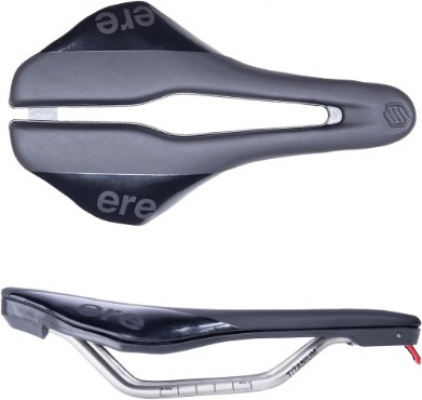
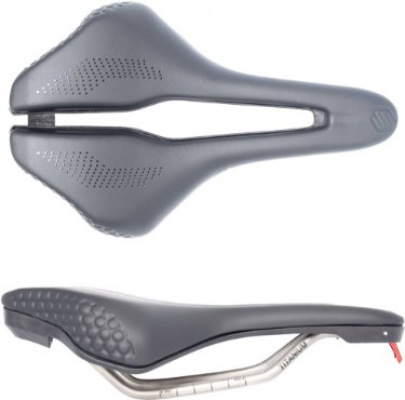
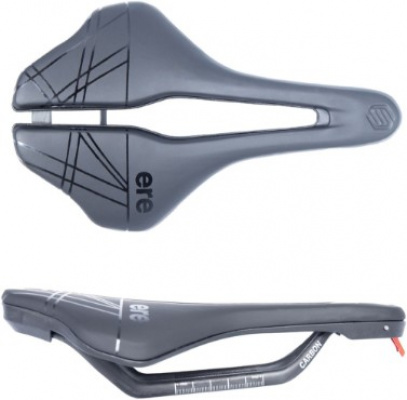
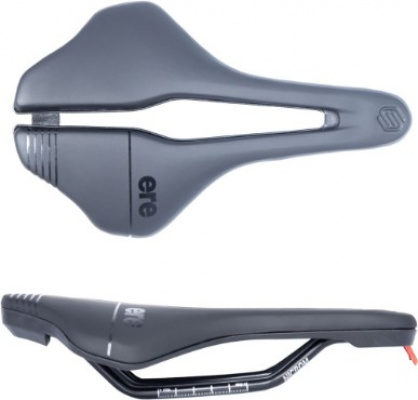
Prices and availability can change quickly. Delivery charges are not always included in listed prices.
Final price, stock status and delivery terms are set by retailer. We may receive a commission on purchases made.
Will an ERE Saddle Fit Your Seatpost?
This is worth sorting before you get excited about anything else. ERE's top-tier carbon saddles - the Genus range - use 7x9mm oval rails. That oval profile is not a gimmick; it reduces weight while maintaining longitudinal stiffness. But it demands a seatpost clamp that works with a top-to-bottom clamping action. If your post uses a side-clamping jaw designed for standard 7x7mm round rails, do not force it. The clamp will concentrate load on the edge of the oval rail and you risk a stress fracture in the carbon. That's a warranty void and a safety issue in one.
Most quality road seatposts from the last few years - including the common two-bolt designs from mainstream brands - will handle oval rails without drama, but check your post's documentation if you're in any doubt. ERE's alloy and chromoly models, which appear in the Omnia line, run standard 7x7mm round rails and will drop straight into virtually any clamp on the market. No adapter, no faff.
If you're currently running a saddle from Fizik or Fabric on a standard alloy post, the Omnia swap is straightforward. Moving to the Genus carbon version just means a quick check of your clamp design first.
Genus vs. Omnia: What You Actually Get for the Money
The Genus is ERE's pro and race-oriented line. Carbon base, carbon rails, a microfiber cover that resists road spray without soaking it up, and padding that's purposefully thin - this isn't a saddle you'd choose for a leisurely sportive. It's built for riders who want direct power transfer, minimal weight, and the Comfort Trigger system to manage the edge cases when the road turns rough. The base stiffness across all three Comfort Trigger settings is still firmer than most endurance saddles even on the loosest setting, so bear that in mind if you're sensitive to road buzz.
The Dynamic Torsion design runs through both lines. Rather than a completely rigid base, ERE engineer a controlled amount of torsional flex into the shell - the saddle can rotate very slightly with the natural twist of your hips during the pedal stroke. On a four-hour ride in the Cotswolds or a long day in the Peak District, that translates to less lower back tension building up over time. It's a subtle thing, not a transformation, but it's measurable on longer efforts.
The Omnia uses the same shell geometry and the same microfiber surface, but swaps carbon rails for alloy, adds a few more grams of padding, and loses the Comfort Trigger. That last point is the real differentiator. You get the Dynamic Torsion flex and the durable cover at a lower price, but base stiffness is fixed. For most non-racers, that's a perfectly sensible trade. The Omnia is the saddle to look at if you want ERE's ergonomic thinking without committing to the full carbon spec. Riders who've previously sat on something like an Ergon for all-day comfort will find the Omnia a sharper, more road-biased alternative without going full race-hard.
The perineal relief channel runs through the centre of both models, cutting pressure on soft tissue during longer rides. Width options across 133mm, 145mm, and 157mm mean you're not forced into a compromise if your sit bone measurement falls between the usual 143mm and 155mm that most brands offer.
Keeping ERE Saddles Working on British Roads
UK riding is hard on kit. Wet lanes, gritty spray off the back wheel of the rider in front, and road surfaces that look like they've been repaired with a blindfold - it all adds up. ERE's microfiber cover handles this well. It doesn't absorb water the way some leather-look covers do, and grit tends to rinse off rather than embed. A quick wipe with a damp cloth after a mucky ride is all it needs. Worth doing, though - dried road salt is mildly abrasive and will dull the surface over time if you leave it.
If you're running a Genus with carbon rails, use a torque wrench. ERE's spec is typically in the 7 - 9Nm range depending on the model - check the saddle's documentation for the exact figure. Carbon rails can develop micro-fractures from overtightening, and the failure mode is not gradual. Torque wrench, correct spec, job done. If you're unsure, most bike shops will clamp a saddle for you in minutes.
The Comfort Trigger mechanism is mechanical, which means it can accumulate grit around the lever pivot after repeated wet rides. A drop of light lubricant on the pivot and a wipe-down every few weeks keeps it moving freely. If the lever starts feeling stiff or notchy, clean it out before forcing it - the internal spring is small and not designed for brute persuasion. Pair the saddle with ERE Research grips and their bar tape for a cockpit that's consistent in how it handles vibration, front to back.
Compared to something like a Brooks, which rewards patience and long break-in periods, an ERE saddle is usable from day one - no conditioning, no proofide, no waiting. Different philosophy entirely, and worth knowing if you're switching between those worlds.
Ere Research Saddles FAQs
How do I use the ERE Research Comfort Trigger?
The Comfort Trigger is a small lever underneath the nose of select Genus saddles. Flick it while riding - or stationary - to move between three base stiffness settings. Firmer settings suit climbing or sprinting where you want direct power transfer; the softer setting takes the edge off rough road surfaces without making the saddle feel wallowy.
Will an ERE carbon rail saddle fit my seatpost?
ERE carbon saddles use 7x9mm oval rails, which need a seatpost clamp that grips from top to bottom. A side-clamping jaw designed for standard 7x7mm round rails will load the edge of the oval rail and can crush or fracture the carbon. Check your post's clamp design before fitting - most modern two-bolt road posts are fine, but verify first.
How do I choose the right ERE saddle width?
Measure the distance between your sit bones - most bike shops can do this with a pressure mat in a few minutes - then add 20 - 25mm to account for your riding position and how much you roll onto the saddle. ERE offers 133mm, 145mm, and 157mm widths. If your sit bone measurement is around 120mm, go 145mm; around 132mm, go 157mm.