
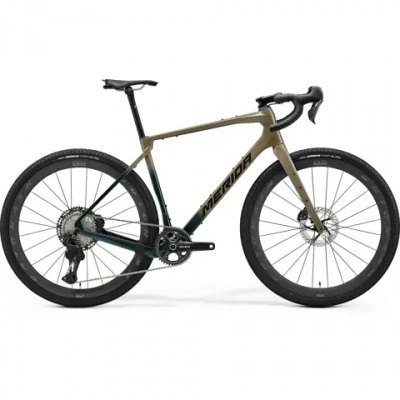
Merida SILEX 9000
Charge through technical gravel and multi-day adventures with MTB stability, Di2 precision, and genuine all-road capability.
- Shimano GRX Di2: electronic precision across 12 speeds
- Reynolds carbon wheels: fast rolling, 25mm internal width
- 45mm Maxxis Ramblers: grip and cushion for rough terrain
- MTB-inspired geometry: stable, confident off-road handling
- Five bottle bosses plus cargo mounts for multi-day trips
- Disc Cooler fins: lower brake temps on long descents
Merida SILEX 9000 Deals
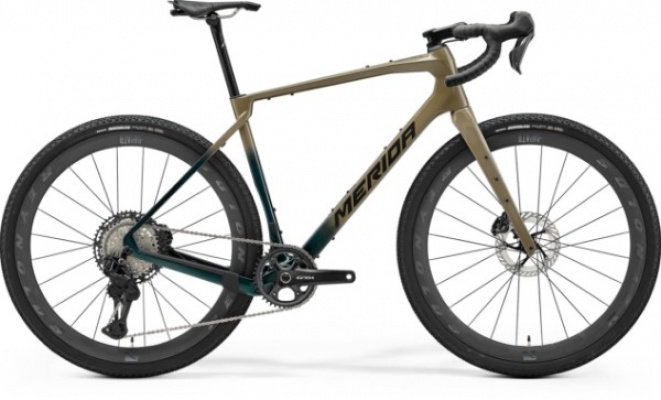
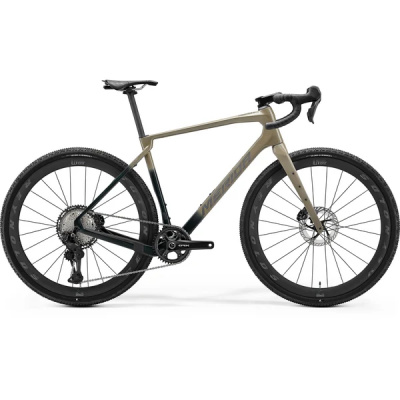


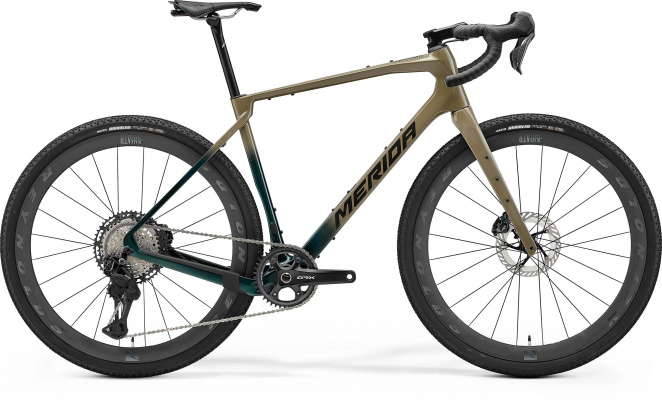
Prices and availability can change quickly. Delivery charges are not always included in listed prices.
Final price, stock status and delivery terms are set by retailer. We may receive a commission on purchases made.
Bikesy's Verdict
The Merida SILEX 9000 is the gravel bike you want when the route stops being polite and starts getting real. MTB-inspired geometry, generous tyre clearance, and a full-carbon frame that's both light and tough mean you can charge through terrain that would have racier machines backing off, and the Shimano GRX Di2 drivetrain keeps you in the right gear no matter how grim conditions get. It's a bike that won the Gravel World Championships, and that pedigree shows in every detail - from the Disc Cooler fins that keep your brakes working on long descents to the five bottle bosses and cargo mounts that let you disappear for a week without worrying about resupply.
It's not the nimblest gravel bike on tarmac, and if your rides are all smooth fire roads and canal paths you'd be carrying capability you don't need. But if your idea of a good day involves mud, ruts, rocky descents, and the occasional 'is this even rideable?' moment, the SILEX 9000 is built for exactly that. It's stable, confident, and fast where it counts, with the comfort and versatility to handle everything from a loaded bikepacking trip to a fast mixed-surface sportive. You'll pay for the privilege, but you're getting a machine that doesn't compromise.
Pros
- Exceptional stability and control on rough, technical gravel and mixed terrain
- Shimano GRX Di2 electronic shifting: reliable, precise, low-maintenance
- Generous tyre clearance (up to 45mm) and abundant mounts for bikepacking and adventure
- Lightweight carbon frame with MTB-inspired geometry for confident off-road handling
- Disc Cooler system keeps brakes effective on long, demanding descents
Cons
- Less nimble in tight corners or rapid direction changes compared to shorter-wheelbase race gravel bikes
- Heavier and less snappy on smooth tarmac if you're chasing pure road speed or KOMs
- Stock Maxxis Ramblers may need swapping for deeper mud or very aggressive off-road use
About the Merida SILEX 9000
Merida's flagship gravel machine doesn't tiptoe around the rough stuff - it charges straight through. Built on a full-carbon frame that borrows heavily from mountain bike thinking, the SILEX 9000 pairs a slacker head angle and longer top tube with a short stem to deliver the kind of composure that lets you hold speed over washboard and ruts without white-knuckling the bars. Shimano's GRX Di2 drivetrain brings electronic shifting to the dirt, and Reynolds carbon hoops keep the weight down while those 45mm Maxxis Ramblers soak up the chatter. It's a bike that won the 2023 Gravel World Championships, and that pedigree shows in every detail - from the dropped chainstay that clears big rubber to the internal WIRE PORT routing that keeps cables out of your handlebar bag's way.
This isn't a gravel bike that apologises for wanting to go fast on tarmac or slow down for a multi-day bivvy trip. Five bottle bosses, fork cargo mounts, and dynamo routing mean you can load it for a week in the wilderness, yet the stiff carbon layup and 1x12 gearing (10-51T cassette) mean you'll still chase down mates on the fire-road climbs. The Disc Cooler system - CNC-machined aluminium fins on the brake calipers - drops operating temperatures by up to 35 per cent, so you're not fading the stoppers halfway down a long Alpine descent. It's a bike that asks 'why choose?' and then proves you don't have to.
You'll find the SILEX 9000 most at home when the surface turns to gravel, hardpack, or broken tarmac - anywhere that rewards stability and traction over outright nimbleness. It's less about crit-race flick and more about all-day confidence, the kind that lets you point it down a rocky chute or across a rutted farm track without second-guessing your line. If your idea of a good ride involves mud on the downtube and a sunset you didn't plan for, this is the tool.
Merida SILEX 9000 geometry
Merida's drawn the SILEX 9000 with numbers that feel more trail bike than traditional drop-bar tourer. That longer top tube and stubby 80mm stem put your weight further forward, centring you over the front wheel for better traction on loose climbs and more control when the descent gets rowdy. The slacker head angle - compared to a pure road endurance frame - adds a dose of calm at speed, letting the front wheel track over obstacles rather than deflecting off them. You're not hunched into an aero tuck here; the taller head tube lifts your hands just enough to keep your neck happy on six-hour epics, and the steep seat angle keeps your hips engaged when you're grinding up a fire road in the saddle.
On fast gravel and hardpack the bike feels planted, almost gravity-fed, as if it's being pulled into the ground rather than skittering across it. That dropped chainstay design - necessary for the generous tyre clearance - also lowers the centre of mass slightly, which you'll notice when you're leaning into a loose switchback or threading through a rock garden. The trade-off? It's not as snappy out of tight corners as a shorter-wheelbase race gravel rig, and you won't flick it through a chicane with one hand. But when the surface turns to marbles or the ruts get deep, you'll appreciate the extra stability far more than you'll miss the last degree of agility.
Sizing spans XXS to XL, and the proportional tweaks - shorter cranks and narrower bars on the smaller frames, longer arms and wider cockpits up top - mean riders at either end of the spectrum get a balanced fit. The frame's designed to take a 30.9mm dropper post if you want to add descending confidence on technical sections, though the stock rigid post keeps things simple and light for most gravel adventures.
Component choices & upgrades
Shimano's GRX Di2 groupset is the headline act here, and it's a smart one. Electronic shifting means crisp, reliable changes even when your hands are numb or the cables would otherwise be clogged with grit, and the 1x12 setup (42T up front, 10-51T out back) covers everything from steep pinches to flat-out fire roads without the faff of a front mech. The GRX825 levers and calipers deliver powerful, progressive braking, and those 180mm rotors front and rear give you plenty of surface area to scrub speed on long descents. The Disc Cooler fins are a thoughtful touch - aluminium heat sinks that keep the calipers from cooking when you're dragging the brakes down a mountain pass.
Reynolds BL ATR carbon wheels are light, stiff, and tubeless-ready, with a 25mm internal width that supports the 45mm Maxxis Ramblers nicely. Those tyres are a sweet spot for mixed-surface riding: fast-rolling centre tread, enough side knobs for loose corners, and EXO casing for a bit of puncture insurance. If you're spending more time in deep mud or on singletrack, you might swap to something with taller knobs - Schwalbe G-One Bites or WTB Resolutes - but for all-round gravel the Ramblers are hard to fault. The Easton EC90 AX carbon bar is wide (400 - 440mm depending on frame size) and shaped to give you multiple hand positions without excessive flare, though if you prefer more wrist rotation you could try a bar with a bit more outward sweep.
The Prologo Scratch saddle and MERIDA carbon seatpost are comfortable enough for most riders, but saddles are personal - if you're planning big days or bikepacking miles, don't hesitate to swap in your favourite perch. The stock build is already well sorted, so upgrades are really about tailoring the bike to your specific terrain or ambitions rather than fixing weak links. If you're chasing every gram you could look at lighter tyres or a carbon cage, but you'd be shaving ounces off a package that's already impressively light for a bike this capable.
Where the Merida SILEX 9000 excels
This bike is outstanding on rough, technical gravel - the kind of riding where stability and traction matter more than outright acceleration. Long fire roads with washboard sections, rocky farm tracks, singletrack detours, and multi-surface adventure routes are its natural habitat. The MTB-inspired geometry and generous tyre clearance mean you can hold speed over terrain that would have a racier gravel bike chattering and slowing, and the electronic shifting keeps you in the right gear even when conditions get grim. It's also superb for bikepacking: those five bottle bosses, fork mounts, and dynamo routing let you carry everything you need for a week off-grid, and the frame's stiffness means it doesn't wallow under load.
It's very good on tarmac too, especially if that tarmac is cracked, patched, or otherwise less than smooth. The carbon frame damps road buzz effectively, the wide-range gearing covers rolling terrain without drama, and the Reynolds wheels spin up to a respectable pace once you're moving. You won't out-sprint a pure road bike, but you'll be comfortable and efficient on long mixed-surface rides that string together lanes, bridleways, and the odd stretch of A-road.
Where it's less ideal: tight, twisty singletrack that demands rapid direction changes, or pure road rides where you want maximum responsiveness and aero efficiency. The longer wheelbase and slacker angles make it stable rather than nimble, so if you're racing crits or chasing KOMs on smooth tarmac you'd be better served by a lighter, more aggressive machine. It's also overkill if your gravel riding is limited to well-groomed canal paths - you'd be carrying capability you don't need. But if your weekends involve mud, ruts, and the occasional 'is this even a path?' moment, the SILEX 9000 is built for exactly that.
Merida SILEX 9000 FAQs
What is the maximum tyre clearance for the Merida SILEX 9000?
The frame and fork clear 700x45C tyres, or 700x42C if you're running full mudguards. You can also fit 650b wheels with rubber up to 2.2 inches wide, which opens the door to even more cushion and grip if you're tackling proper off-road terrain.
Is the Merida SILEX 9000 suitable for bikepacking?
Absolutely. Five bottle bosses, fork cargo mounts, and internal dynamo routing give you plenty of options for frame bags, bottle cages, and lighting. The stable geometry and robust carbon frame mean it carries a load well without feeling sluggish, and the wide gearing range helps when you're hauling extra weight up a climb.
What are the key differences between the Merida SILEX 9000 and the 8000 model?
The 9000 sits at the top of the range with Shimano GRX Di2 electronic shifting and Reynolds carbon wheels, while the 8000 typically runs mechanical GRX and alloy or lower-spec carbon hoops. Both share the same frame platform and geometry, so the 8000 offers similar handling and capability at a lower price point if you're happy with cables and a bit more weight.
Can I fit a suspension fork to the Merida SILEX 9000?
The frame's designed to accept a suspension fork without compromising the geometry, so if you want to add 30 - 40mm of travel for rougher trails you can do so. You'd need to match the axle-to-crown height of the stock rigid fork to keep the handling consistent, but it's a viable upgrade if you're pushing into proper mountain bike territory.
How does the Merida SILEX 9000 compare to the Specialized Diverge?
Both are capable, adventure-ready gravel bikes, but they take different approaches. The Diverge leans on its Future Shock suspension for compliance and comfort, while the SILEX 9000 uses MTB geometry and bigger tyres to achieve stability and control. The Merida feels more planted and confidence-inspiring on technical terrain, whereas the Specialized offers a bit more on-road refinement and adjustability.
What is the weight of the Merida SILEX 9000?
Around 8.7 kilograms for a medium frame, which is impressively light for a bike with this much capability and tyre clearance. Earlier builds with different components came in slightly lighter, but the current spec balances weight with durability and performance.
Is the Merida SILEX 9000 a good bike for commuting?
It's more bike than most commutes demand, but if your route involves rough roads, bridleways, or you simply want one machine that can handle the daily grind and weekend adventures, it'll do the job brilliantly. The hydraulic discs work in all weathers, the frame has mounts for mudguards and lights, and the robust build shrugs off daily abuse. Just know you're carrying adventure capability you might not use every day.
What kind of riding is the Merida SILEX 9000 best suited for?
Technical gravel, multi-day bikepacking, and mixed-surface adventure rides where the terrain varies from tarmac to hardpack to rocky trails. It thrives when the going gets rough and rewards riders who value stability, comfort, and load-carrying ability over pure speed or race-day agility.
Key Features & Benefits
- MTB-inspired geometry with slacker head angle and longer top tube: Delivers planted, confident handling on rough gravel and technical descents, reducing rider fatigue and increasing control
- Shimano GRX Di2 1x12 electronic drivetrain with 10-51T cassette: Crisp, reliable shifts in all conditions and a wide gear range that covers steep climbs and fast flats without a front mech
- Reynolds BL ATR carbon wheels with 25mm internal width: Light, stiff, and tubeless-ready, supporting wide tyres for speed and compliance without weight penalty
- Disc Cooler heat-dissipation fins on brake calipers: Lowers brake temperatures by up to 35% on long descents, maintaining consistent stopping power when you need it most
- Five bottle bosses, fork cargo mounts, and dynamo routing: Versatile load-carrying options for multi-day bikepacking, commuting, or adventure touring without compromising frame stiffness
Merida SILEX 9000 2025, 2024 & earlier differences
The 2024 model year brought significant geometry and design updates across the entire Silex range, including a revised frame platform with improved tyre clearance, updated cable routing, and refined handling characteristics. The 2025 Silex 8000 (the step-down model) continued this evolution, aiming to blend adventure capability with race ambitions, though specific component changes for the 9000 model between 2025 and 2026 are minimal - the core frame, GRX Di2 drivetrain, and Reynolds carbon wheels remain consistent.
Earlier iterations from 2018 and 2019 ran SRAM Force 1x11 drivetrains and Fulcrum Red Passion 3 wheels, with the 2018 SILEX 9000 notably lighter (around 7.98kg) due to different component choices. Those older models shared the full-carbon frame and generous tyre clearance but lacked the current generation's WIRE PORT internal routing, Disc Cooler system, and refined MTB-inspired geometry. If you're considering a used or previous-year model, the 2024-onwards frames represent a meaningful step forward in handling and practicality, while earlier builds offer similar adventure credentials with slightly older tech and a bit less refinement.
Alternatives to Consider
Within Merida's own stable, the Silex 8000 offers the same frame platform and geometry but swaps electronic shifting for mechanical GRX and carbon wheels for alloy or lower-spec carbon hoops, delivering similar off-road capability at a lower price if you're happy with cables. Step down further and the Silex 6000 brings the adventure-ready frame and generous tyre clearance to an aluminium platform with capable components, ideal if you want the Silex ethos without the carbon price tag.
Cross-brand, the Specialized Diverge Expert Carbon is a natural rival, leaning on Future Shock suspension for compliance and a slightly more road-focused geometry, making it a touch more refined on tarmac but less planted on technical gravel. The Trek Checkpoint SL 6 offers a balanced mix of on-road speed and off-road capability with IsoSpeed decoupler compliance, though it doesn't quite match the Silex's MTB-inspired stability on the roughest stuff. For a more aggressive, race-oriented take, the Santa Cruz Stigmata CC Rival brings sharper handling and a stiffer ride, rewarding riders who prioritise speed over all-day comfort. The Cannondale Topstone Carbon 2 adds Kingpin rear suspension for a plush ride on rough surfaces, though it's a bit heavier and less direct-feeling than the Silex's rigid setup. Finally, the Giant Revolt Advanced 1 delivers similar adventure credentials with a slightly more upright position and excellent value, though its geometry is less aggressive and the component spec a notch below the SILEX 9000's Di2 and Reynolds carbon package.
Reviews
Rough gravel and broken hardpack reveal the bike's true character: composed, unflustered, and faster than you'd expect for something this stable. The longer wheelbase and slacker head angle translate to a front end that tracks through ruts and over rocks without deflecting, and the 45mm Maxxis Ramblers absorb enough chatter that you can hold speed where other bikes force you to ease off. Electronic shifting means you're always in the right gear, even when your hands are cold or covered in grit, and the wide 10-51T cassette range covers everything from steep pinches to flat-out fire roads without drama.
When the terrain turns technical - rocky descents, loose switchbacks, washboard sections - the MTB-inspired geometry earns its keep. You're centred over the bike rather than perched on top of it, and that planted feel lets you commit to lines and lean into corners with confidence. The Disc Cooler system keeps the brakes consistent on long descents, so you're not fading the stoppers halfway down a mountain pass. We appreciate the thoughtful details: WIRE PORT internal routing that keeps cables out of the way of handlebar bags, five bottle bosses for multi-day trips, and a dropped chainstay that clears big rubber without compromising stiffness.
On tarmac the bike is efficient rather than electric. The carbon frame damps road buzz effectively, and the Reynolds wheels spin up to a respectable pace once you're moving, but you won't out-sprint a pure road bike or flick through tight corners with race-bike agility. That's the trade-off for all that off-road composure: a longer wheelbase and slacker angles make it stable rather than nimble. If your rides mix smooth tarmac with rough lanes and gravel byways, the balance works brilliantly. If you're chasing KOMs on pristine asphalt, you'd want something lighter and more responsive.
Load it up for a bikepacking trip and the frame's stiffness shines - no wallowing or flex under a full complement of bags and bottles, just the same planted, confident handling you get unladen. Because the geometry puts you in a comfortable, sustainable position, six-hour days don't leave you with a stiff neck or numb hands. It's a bike that rewards ambition: the more varied and challenging the terrain, the more you'll appreciate what Merida's built here.
Full Specification
| Spec | Value |
|---|---|
| Frame Material | Carbon (SILEX CF2 II) |
| Frame Design | Full carbon gravel adventure frame with mountain bike-inspired geometry, dropped chainstay |
| Frame Features | WIRE PORT internal cable routing, five bottle bosses, cargo mounts, dynamo hub routing, dropper post compatibility (30.9mm) |
| Tyre Clearance | 700x45C (or 42mm with fenders) |
| Available Sizes | XXS, XS, S, M, L, XL |
| Bottom Bracket | BSA BBR (68mm shell) |
| Rear Axle | 142x12mm thru-axle |
| Fork | Merida Silex II CF2 Carbon Fork, rigid with cargo mounts and dynamo hub routing |
| Shifters | Shimano GRX825 Di2 (Electronic) |
| Rear Derailleur | Shimano GRX827-SGS Di2 |
| Crankset | Shimano GRX820-1, 42T chainring, 170mm arms (XXS-S/M), 172.5mm arms (L-XL) |
| Cassette | Shimano CS-M8200, 10-51T, 12-speed |
| Chain | Shimano M6100-12 |
| Gearing | 1x12 speed |
| Brake Type | Hydraulic Disc |
| Brake Levers | Shimano GRX825 |
| Brake Calipers | Shimano GRX825 with CNC-machined aluminum Disc Cooler fins |
| Rotors (Front) | Shimano MT800, 180mm, Centerlock |
| Rotors (Rear) | Shimano MT800, 180mm, Centerlock |
| Rims | Reynolds BL ATR EXPERT CL, 25mm internal width, 42mm height, carbon |
| Hubs (Front) | MERIDA EXPERT TR, 100x12mm |
| Hubs (Rear) | MERIDA EXPERT TR, 142x12mm |
| Tyres (Front) | Maxxis Rambler 700x45C, TR (Tubeless Ready), EXO protection |
| Tyres (Rear) | Maxxis Rambler 700x45C, TR (Tubeless Ready), EXO protection |
| Handlebar | Easton EC90 AX Carbon, 400mm (XXS-S), 420mm (M), 440mm (L-XL) |
| Stem | MERIDA TEAM CC III, aluminium, 31.8mm clamp, -6° angle, 80mm length |
| Grips/Tape | MERIDA ROAD EXPERT |
| Headset | Acros ICR MERIDA external, tapered steerer |
| Seatpost | MERIDA TEAM SL II Carbon, 27.2mm diameter, 0mm setback |
| Saddle | Prologo Scratch M5 AGX with V-mount adapter |
| Weight (Approx) | 8.7 kg (frame size M) |