
Unite Pedals
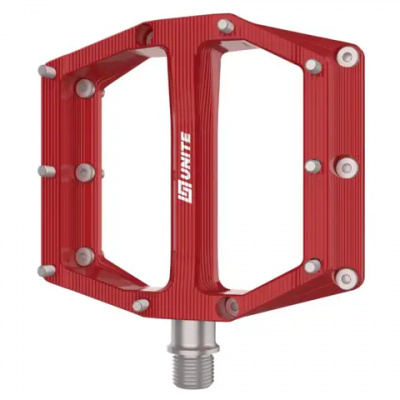
Unite MTB Pedals bring a refreshing dose of British engineering to the flat pedal market, machined in-house in Wales from 6082-T6 aluminium rather than the softer 6061 alloy most rivals rely on. That harder material lets Unite carve deeper concave profiles and thinner body sections without sacrificing strength, which means you get a genuinely planted feel underfoot when you're threading through rock gardens or braking hard into berms. The flagship Unite Instinct Flat Pedals measure a generous 113×102 mm, so there's plenty of real estate for size-ten boots, and the replaceable pins let you dial grip to suit your shoes and the conditions. Available in a spectrum of anodized finishes, these CNC Machined MTB Pedals offer the kind of customisation usually reserved for boutique cockpit components. If you've been running generic platforms and wondering why your feet skate off mid-line, the combination of that deep concave platform and UK-made attention to detail might be exactly what you need. They're not the lightest flats you'll find, but the trade-off is a pedal that'll still spin true after a winter of Welsh trail centre abuse.
Prices and availability can change quickly. Delivery charges are not always included in listed prices.
Final price, stock status and delivery terms are set by retailer. We may receive a commission on purchases made.
Engineering the Instinct: 6082-T6 vs 6061
Most flat pedals are machined from 6061 aluminium because it's cheap, widely available, and easy to work with. Unite Components Instinct V1.1 takes a different route, specifying 6082-T6 instead. That T6 heat treatment bumps tensile strength by around fifteen per cent over standard 6061, which means the CNC mills can carve away more material in critical areas without leaving the pedal body prone to cracking under repeated impacts. You feel the benefit when you case a landing or clip a pedal on a submerged root: the body flexes slightly then springs back rather than denting permanently.
The harder alloy also holds threads better. Pin sockets stay tight longer, and the axle interface resists the micro-wear that eventually leads to creaking or play. It's a detail that matters more over months than minutes, but it's the reason these pedals still feel crisp after a season of Peak District grit and Scottish slop. Weight sits around the mid-400-gram mark per pair, which is heavier than some exotic magnesium options but lighter than cheaper cast platforms. That's the trade-off: you're carrying a few extra grams in exchange for a pedal that won't need replacing halfway through the year.
Platform Dynamics and Grip Architecture
Step onto a pair of Instinct pedals and the first thing you notice is how your foot settles into the concave platform rather than perching on top. Unite machines a pronounced dish into the body, cupping the centre of your sole and guiding your foot into the same position every time you dab or remount mid-descent. That consistency is gold when you're picking lines at speed through Surrey Hills singletrack or committing to a steep chute where misplaced footing isn't an option.
The pin layout uses a mix of heights and spacing to balance initial bite with the ability to reposition your foot without snagging. Shorter pins around the perimeter let you slide into position; taller pins in the centre zones lock you down once you're there. All pins are replaceable, threaded into steel inserts rather than soft aluminium, so you can swap in longer or shorter variants depending on whether you're running stiff-soled enduro shoes or softer, grippier rubber. If you're chasing maximum grip for bike-park days, fit the tallest pins Unite supply. Swap them for mid-length versions when you're riding natural trails where the occasional foot adjustment keeps you balanced through off-camber roots.
The 113×102 mm footprint answers the question many riders with larger feet ask: are Unite Instinct pedals good for large feet? Absolutely. There's enough platform to support a size-eleven boot without your toes or heel hanging off into space, and the concave shape means even mid-sole placements feel stable. Compared to narrower options like Crank Brothers pedals, the Instinct offers noticeably more room to shift weight fore and aft without losing contact.
Axle Durability and Serviceability
Inside each pedal body you'll find an oversize axle running on two Igus bushings and one cartridge bearing. That's a different approach to the twin-bearing setups favoured by brands like Hope pedals or Burgtec pedals, and it's designed specifically for longevity in wet conditions. Igus bushings are self-lubricating polymer sleeves that don't corrode or seize even when water sneaks past the outboard seals, so your pedals keep spinning smoothly through winter commutes and February trail sessions when the weather refuses to cooperate.
The single cartridge bearing sits inboard, shielded from the worst of the muck. When it does eventually need replacing, the axle assembly pulls apart with a basic socket set and a soft mallet - no proprietary tools, no press-fit drama. Unite sell rebuild kits containing fresh bushings and bearings, and the whole service takes about twenty minutes per pedal if you're methodical. That's a big advantage over sealed-for-life designs that force you to bin the entire pedal once the internals go gritty.
Sealing is handled by a combination of O-rings and labyrinth grooves machined into the axle interface. It's not bombproof - nothing is when you're riding through axle-deep puddles in the Peaks - but it keeps the worst of the silt and grime out long enough that you can rinse and regrease rather than replace. How do you service Unite pedals? Unscrew the outboard nut, slide the axle free, wipe everything clean, pack fresh grease into the bushings, and reassemble. Simple, repeatable, and entirely doable in a kitchen if your housemates don't mind a bit of bearing grease on the worktop.
Welsh Precision and Anodized Longevity
Unite machines every pedal in their Welsh facility, which means shorter lead times, tighter quality control, and a smaller carbon footprint than air-freighting components from the Far East. It's not just a feel-good story: in-house CNC work allows Unite to iterate designs quickly and hold tolerances that mass-production runs often miss. The anodized finish is applied locally too, resulting in colours that stay vivid rather than fading to pastel after a few months of trail spray and boot scuffs.
Anodizing also hardens the aluminium surface, adding a thin but tough oxide layer that resists scratches and corrosion. You'll still see cosmetic wear where pins have been swapped or where pedal strikes leave their mark, but the underlying metal stays protected. That longevity matters when you're comparing UK Made Flat Pedals to cheaper alternatives that look great in the box but show their age quickly. The environmental angle is worth noting too: keeping manufacturing close to home reduces shipping emissions and supports local engineering jobs, which is a bonus if you care about where your money goes.
Compared to Nukeproof pedals or DMR pedals, both of which also emphasise UK design, Unite sits in a similar ethos but leans harder into the premium material choice. If you're building a bike where every component reflects a bit of thought and craft, these pedals fit that narrative without feeling like you've overpaid for a badge. They're also a natural pairing with other precision-machined kit - think Hope hubs or 5Dev pedals if you want to keep the British engineering theme running through the whole build.
The V1.1 revision addressed the main weakness of the original Instinct: axle durability under sustained side loads. What is the difference between Unite Instinct V1 and V1.1? The updated version uses a beefier axle diameter and improved sealing around the outboard bushing, changes that came directly from rider feedback after the first batch saw heavy use in Scottish Enduro Racing Series events. The platform shape and pin layout remain identical, so if you liked the feel of the V1 you'll find the V1.1 familiar but longer-lasting. It's a textbook example of iterative design done right, fixing the one area that needed work without reinventing a pedal that already performed well.