
Ohlins Racing Suspension Forks
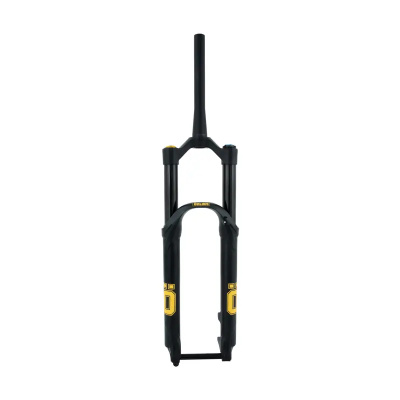
Ohlins suspension forks sit at a different point on the spectrum to most MTB suspension - these are components developed through decades of motorsport racing, translated with surgical precision into mountain biking. Where many forks trade off consistency for cost, Ohlins won't budge on either. The centrepiece is their TTX18 twin-tube damping technology, which keeps oil pressure stable behind the piston throughout the stroke. No cavitation, no fade on a long enduro descent - just damping that behaves the same on the tenth corner as the first.
The range spans downcountry all the way through to World Cup downhill, so whether you're lining up for an enduro race or just determined to get the most from every ride, there's a spec that fits. The three-chamber air spring is another standout - it gives you genuine ramp-up control without rummaging around for volume spacers. For riders who want to know exactly what their fork is doing and why, that kind of granular tuning access matters. These aren't forks you buy and forget. They reward attention, and they give a lot back.
Prices and availability can change quickly. Delivery charges are not always included in listed prices.
Final price, stock status and delivery terms are set by retailer. We may receive a commission on purchases made.
Mapping the Ohlins Fork Family
Ohlins currently run four distinct MTB fork families, and getting the right one starts with being honest about what you actually ride. The RXF34 is the lightweight end of the range - short travel, 34mm stanchions, aimed at downcountry and light trail use where you want suspension compliance without hauling excess weight uphill. Step up to the RXF36 m.2 and you're into genuine all-mountain and enduro territory: 36mm stanchion diameter, travel options from 120mm to 160mm, and the full TTX18 damper package. This is the fork most UK enduro racers and serious trail riders will be looking at.
The RXF38 m.2 runs 38mm stanchions and is built for long-travel enduro, aggressive all-mountain, and e-MTB duties where the added chassis stiffness pays dividends under load or at speed. Then there's the DH38 m.1 - a dedicated downhill race fork with dual-crown geometry and 200mm travel. Not a trail fork that moonlights on race day; a proper DH38 race fork built specifically for lift-served descending. The 'm.1' and 'm.2' suffixes simply denote iteration updates within each platform - think of them as generation markers rather than fundamentally different products. Both the RXF36 and RXF38 are available in air or coil variants: air spring suits riders who want a wider tuning range and lighter weight, while the coil version delivers a more linear, plush feel that some riders prefer on rougher, choppier ground. If you're running an Ohlins rear shock already, pairing it with a matching fork makes suspension tuning across the whole bike considerably more coherent.
How the Ohlins Tech Actually Works
The TTX18 cartridge is what separates Ohlins from most of the competition on paper - and in practice. Twin-tube technology means there are two concentric tubes inside the damper. Oil flows through both circuits simultaneously, which keeps pressure consistent behind the piston regardless of shaft speed. The practical result is that mid-stroke support stays stable even when you're smashing through a rock garden at pace. Conventional single-tube dampers can cavitate - introducing air into the oil circuit - which causes that vague, unpredictable feel mid-stroke. The TTX18 design sidesteps that problem entirely.
The three-chamber air spring deserves equal attention. Most air forks use a positive chamber and a negative chamber, with volume spacers to alter ramp-up. Ohlins add a third, dedicated ramp-up chamber that you pressurise independently with a shock pump. Want a more progressive feel to resist bottom-out? Add pressure to the ramp-up chamber. Want a more linear feel through the mid-stroke? Reduce it. You're tuning the same characteristic that volume spacers address, but without opening the fork. It's a cleaner, faster process - and critically, it's reversible in the car park before a run if the track turns out to be different from what you expected.
The floating axle design is a smaller detail but a meaningful one. Rather than clamping rigidly, the axle is allowed to align the lowers during installation, which reduces stiction and ensures the bushings run true. Less binding means the fork moves more freely at low shaft speeds - exactly where off-the-top sensitivity matters on slow, technical trail features. Compared to the stiff, precise feel of Fox suspension forks or the progressive ramp of RockShox forks, Ohlins occupy a distinct space: highly tunable, motorsport-derived, and built for riders who want to understand and adjust every variable. DVO forks and Cane Creek forks also offer deep damper adjustability, but neither brings quite the same motorsport lineage to the low-speed compression and high-speed compression tuning stack.
Running Ohlins in British Conditions
UK riding throws specific problems at suspension that sunnier markets don't worry about much. Gritty winter mud - the kind you get grinding through the Tweed Valley or on a wet Dyfi session - accelerates wiper seal wear faster than dry-condition riding. Ohlins recommend a lower leg service every 50 hours, and in UK conditions that figure isn't conservative. It's the minimum. Treat it as a fixed point in your riding calendar rather than a guideline, and your stanchions will thank you. The full damper service sits at 100 hours, which for most club-level riders means once a season - more if you're racing regularly.
Steep, rooty enduro tracks demand a fork that's supple off the top - so it tracks the ground through slow, technical features - but has genuine mid-stroke support when the trail opens up and speeds climb. That's a difficult balance, and it's where the ramp-up chamber really earns its place. On a track like the Dyfi's steeper sections, you can run lower main chamber pressure for better small-bump sensitivity, then compensate with ramp-up chamber pressure to prevent bottoming on the bigger compressions. It's a more precise way to reach a setup that volume spacers can only approximate. Low-speed compression adjustment via the LSC dial lets you stiffen the initial stroke slightly for pedalling efficiency on the climbs without affecting the fork's behaviour under impact. High-speed compression tuning, meanwhile, governs how the fork handles sharp, fast hits - roots, square-edged rocks, unexpected compressions at speed. Getting HSC dialled for Scottish chunk is a different conversation from getting it right for Surrey Hills flow, and having both adjusters independently accessible matters.
Need replacement wiper seals, service fluids, or rebuild kits? Head over to our dedicated Ohlins spares and accessories page to keep your fork running properly between full services.
Ohlins Racing Suspension Forks FAQs
Are Ohlins forks better than Fox or RockShox?
It depends what you're optimising for. Ohlins TTX twin-tube damping delivers exceptional mid-stroke consistency and fade resistance on long descents - areas where some riders feel Fox and RockShox are less precise. The real differentiator is the three-chamber air spring, which gives you ramp-up tuning without volume spacers. If granular control matters to you, Ohlins makes a strong case.
How do you set up an Ohlins air fork?
Ohlins air forks use a three-chamber system, so setup order matters. Pressurise the ramp-up chamber first using the dedicated port, then inflate the main positive chamber to your weight-appropriate pressure using the chart printed on the fork leg. Set sag at around 20 - 25%, then use the LSC dial to tune pedalling support and the ramp-up chamber to control bottom-out feel.
What is the service interval for Ohlins MTB forks?
Ohlins specify a lower leg service every 50 riding hours and a full damper rebuild every 100 hours. In wet, gritty UK conditions - think winter mud or trail centre loam - stick firmly to the 50-hour lower leg interval. Letting it slip invites contaminants past the wiper seals and onto the stanchions, which is a far more expensive fix than a routine service.