
Gore Bike Wear Overshoes
Gore Bike Wear overshoes are one of the most dependable answers to the UK's habit of throwing everything at your feet - road spray, biting headwinds, and the kind of rain that finds a way through lesser kit. Gore has spent decades refining the membranes that sit at the heart of this range, and that experience shows in how the overshoes actually perform when temperatures drop and the roads turn filthy.
The two main technologies here pull in slightly different directions. GORE-TEX models - including Active and Paclite variants - give you a guaranteed waterproof barrier for days when rain is relentless and puddle spray is constant. GORE WINDSTOPPER models, often found in Gore's Thermo lines, aren't built for downpours but they're totally windproof, which matters enormously on a freezing descent when numb toes are the real enemy. Both membranes are engineered to breathe, so sweat doesn't turn to ice inside the shoe on a hard climb - a problem that plagues traditional neoprene alternatives.
Whether you're on a wet Sunday club run, grinding through a winter commute, or heading out into conditions where the forecast gave up days ago, there's a Gore model calibrated for what you're facing. Browse the range below to find your fit.
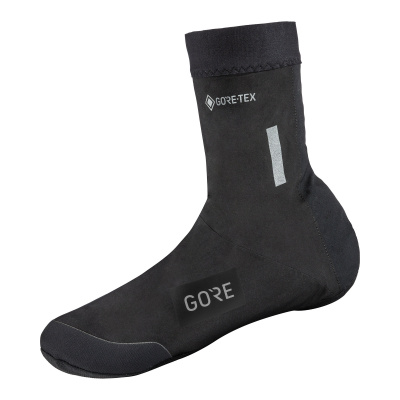
Prices and availability can change quickly. Delivery charges are not always included in listed prices.
Final price, stock status and delivery terms are set by retailer. We may receive a commission on purchases made.
GORE-TEX vs. WINDSTOPPER: Which Fabric Suits Your Ride?
Getting this choice wrong means cold feet - sometimes literally. GORE-TEX Active and Paclite membranes are the ones to reach for when rain is the primary threat. They create a fully waterproof barrier that blocks road spray and sustained rainfall while still allowing moisture vapour to escape outward, so your feet stay dry from both directions. On a soaking Peak District ride where puddles are unavoidable, this is the technology you want doing the work.
GORE WINDSTOPPER operates differently. It's totally windproof and highly water-resistant, but it's not built to handle prolonged heavy rain. What it does brilliantly is block the freezing wind chill that turns a fast descent into a painful experience. If you're riding in dry, sub-zero conditions - the kind of clear, sharp winter days you get across the Scottish Borders or on the North York Moors - a Windstopper model with a thermal fleece lining will keep your feet considerably warmer than a fully waterproof option, because it breathes more freely and retains heat more effectively. The trade-off is straightforward: GORE-TEX for wet days, WINDSTOPPER for cold dry ones. Some riders own both. That's not excessive - it's just honest kit management.
Both constructions use a DWR coating on the outer fabric to bead water on contact, reducing how much moisture the outer shell has to manage. That coating degrades with washing and use, but it's easily revived - more on that below. You'll also find reflective detailing stitched into most models, which adds low-light visibility without adding bulk. Worth having on any winter commute where cars are running with dipped headlights by mid-afternoon.
Fit, Sizing, and Choosing Between Road and MTB Models
Fit matters more with overshoes than most people expect. Too loose and cold air finds its way in; too tight and you're fighting to pull them over the heel every ride. Gore Bike Wear sizes their overshoes to your cycling shoe size, but there's an important nuance here: if your shoes have BOA dials, chunky ratchet buckles, or any significant hardware on the upper, size up. Those dials create a raised bump that a correctly sized overshoe will fight against. It's a faff that's easily avoided.
Road-specific models sit closer to the shoe, with a tighter, more aerodynamic profile and smaller cleat cutouts designed around the compact footprint of a road cleat. They're not intended for walking - the sole construction reflects that. MTB and gravel-oriented models take a different approach: open soles give you full cleat access for clipping in and out on rough ground, and reinforced panels - some using Kevlar or abrasion-resistant materials - protect the toe box during hike-a-bike sections. If you're doing anything technical where you'll be on your feet as much as on the bike, the open-sole design is worth the slight compromise in weather sealing at the bottom.
As a general rule, if you're between sizes, go up rather than down. A slightly larger overshoe is easier to seal at the cuff with Gore bib tights pulled over the top; a slightly small one will split at the heel within a season. It's also worth checking the zip style - rear-zip models are easier to get on over a stiff winter shoe, while those with a hook-and-loop cuff give you a more adjustable seal at the top.
If you're weighing Gore against the competition, Castelli overshoes tend to run more aerodynamically cut for road use, while Endura overshoes offer a broader size range and a more relaxed fit that suits wider feet. GripGrab overshoes are worth considering if you want a neoprene-feel option at a lower weight.
Layering Properly and Keeping the DWR Working
Even the best overshoe is only part of the system. In genuinely cold conditions - anything below about five degrees - pairing your Gore Bike Wear overshoes with a good merino sock makes a meaningful difference. Merino retains warmth when damp and doesn't compress as much as synthetic fibres, which matters because compressed insulation does very little. Check out Gore Bike Wear socks for options that are cut to work with this range specifically.
If you're riding in extreme cold and your shoes have mesh venting panels, tape them before you go out. It takes thirty seconds and stops cold air channelling straight into the shoe underneath the overshoe. Not glamorous advice, but it works.
On washing: this is where a lot of riders accidentally wreck their Gore kit. Machine wash at 40°C using a liquid detergent - no powder, and absolutely no fabric softener, which clogs the membrane and kills breathability. After washing, tumble dry on a low heat setting. The heat is what reactivates the DWR coating, restoring the beading effect on the outer fabric. If your overshoes are soaking up water rather than shedding it, a tumble dry cycle often fixes it without a full wash. Do this regularly and the performance holds up across multiple seasons.
For a complete winter setup, Gore bib tights pulled down over the overshoe cuff close the gap at the ankle effectively. Add a Gore jacket and Gore gloves and you've got a matched system where every seam and cuff is designed to work together - which sounds like marketing, but in practice it means fewer cold spots where layers don't quite overlap.
Gore Bike Wear Overshoes FAQs
Are Gore-Tex overshoes completely waterproof?
Models built with a GORE-TEX membrane are fully waterproof - road spray and sustained rain won't get through the fabric itself. That said, water can still enter from the top of the cuff or through the cleat cutout at the bottom, so pulling your bib tights over the cuff and choosing the right cleat hole size for your shoe type both help close those gaps.
How do I choose the right size overshoes for cycling?
Base your size on your cycling shoe size, but go up a size if your shoes have BOA dials, chunky ratchets, or a wide fit - those add height that a snug overshoe will struggle to clear at the toe. The fit should be firm enough to stay put and retain warmth, but pulling them over the heel shouldn't be a wrestle every time you head out.
What is the difference between Gore-Tex and Windstopper overshoes?
GORE-TEX gives you a fully waterproof membrane - the right call for heavy rain and constant road spray. GORE WINDSTOPPER is totally windproof and highly water-resistant but not rated for prolonged downpours; it trades some wet-weather performance for better breathability and, in thermal versions, a warmer thermal fleece lining. Cold dry days suit Windstopper; wet days suit GORE-TEX.