
Gore Bike Wear Bib Tights
When the temperature drops to single figures and the wind's cutting across an exposed Lancashire lane, Gore Bike Wear Bib Tights are the standard against which everything else gets measured. Standard lycra becomes a liability somewhere around four degrees - it lets the cold straight through on descents, and your knees know about it for days. Gore's answer is GORE-TEX WINDSTOPPER technology: a totally windproof membrane that blocks icy headwinds while staying breathable enough to vent hard-effort heat on the climbs. No clammy, soggy feeling halfway up the hill. The integrated WINDSTOPPER chamois cup extends that same protection where you really don't want cold air hitting - a detail that makes a genuine difference on long, exposed descents. Add a brushed fleece interior and DWR-treated outer, and you've got tights that deal with road spray and biting wind chill in one package. Gore winter cycling tights sit at the serious end of the market, and the build quality justifies the position. If you're riding through milder spells, it's worth comparing our Gore Bike Wear Bib Shorts for shoulder-season miles instead.
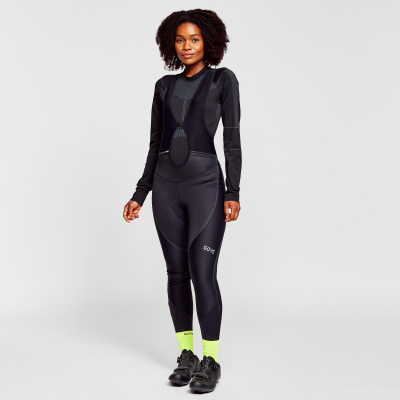
Prices and availability can change quickly. Delivery charges are not always included in listed prices.
Final price, stock status and delivery terms are set by retailer. We may receive a commission on purchases made.
Fabric Tech and Weather Performance: The WINDSTOPPER Advantage
The gap between a thermal tight and a Gore-Tex Infinium bib tight becomes obvious the moment you're descending at 45 mph into a December headwind. Ordinary brushed-fleece tights trap warmth well enough when you're working hard, but they offer no real wind resistance - the cold punches straight through. GORE-TEX WINDSTOPPER changes that equation entirely. The panels are totally windproof, so the chill that would ordinarily stiffen your knees on a long descent simply doesn't get in. Crucially, the membrane remains highly breathable, which matters enormously on a tough winter climb. Overheat in a waterproof that can't breathe and you're soaked from the inside out; WINDSTOPPER lets water vapour escape while refusing to let wind or rain enter.
The brushed fleece interior is the thermal engine behind that performance. It traps a thin layer of dead air against your skin, and that layer is what actually keeps you warm - the fleece itself is the mechanism, not just padding. On wet UK roads, the DWR coating on the outer face handles road spray efficiently, beading water off before it can saturate the fabric. DWR does deplete over time with washing, but it's straightforward to reactivate (more on that below). Reflective detailing runs across Gore garments as standard, which matters when you're finishing a winter loop in the dark somewhere on the North Yorkshire moors.
Making Sense of the Gore Range: C3, C5, and C7
Gore structures its bib tight range around three fit profiles, and getting the right one matters as much as the fabric choice. The C3 sits at the 'Active' end - a slightly more relaxed cut that works well for commuting, gravel days, or anyone who prefers not to be in a race-cut garment on a three-hour mixed-surface ride. It's not baggy; it's just not aero-obsessed. The C5 is Gore's 'Advanced' fit: a tailored, snug profile aimed squarely at regular road riding. It follows the body closely without the compression of a full race cut, which makes it the most versatile pick for the majority of road riders. The C7 is the race-cut option - highly compressive, aero-focused, and made for riders who want maximum performance on the bike, full stop. If you're comparing Gore C5 vs C7 bib tights and you're not racing or doing structured training, the C5 is almost certainly the more comfortable long-term choice.
On sizing: Gore uses a European sizing model, which tends to run closer to the body than UK or US equivalents. If you're between sizes, or if you've got larger thighs from regular riding or gym work, size up. The tights are designed to be snug, and there's no benefit to fighting a pair that's restricting your movement through the hip. When in doubt, err larger - the fit still performs without being baggy. If you're used to the cut of Castelli bib tights or Assos bib tights, Gore's sizing tends to be similar in approach, though the fit profile differs between brands.
The chamois pad also varies across the range. Higher-tier models use Gore's Advanced Brand Core seat insert - a multi-density chamois with a GORE WINDSTOPPER cup built in. That windproof crotch panel isn't a gimmick; on a long, cold descent it's a meaningful layer of protection. Lower-tier tights use a simpler insert, which is perfectly adequate for shorter winter commutes but less suited to four-hour road rides in January. Worth checking the spec before you buy, particularly if saddle comfort is a known issue for you.
Layering and Washing: Getting the Most From Your Investment
Gore windproof cycling tights do a significant amount of the thermal work themselves, but pairing them correctly unlocks the full system. Underneath, a merino or synthetic base layer from the Gore Bike Wear base layer range keeps moisture moving away from your skin efficiently. Above the waist, a Gore Bike Wear jacket with its own WINDSTOPPER or GORE-TEX membrane matches the protection level of the tights - mixing a windproof lower half with a permeable jersey on top defeats the point of the system. Seal the gaps at your feet with Gore Bike Wear overshoes and at your hands with Gore Bike Wear gloves, and you've got a coherent setup that covers exposed skin at every joint.
Washing these tights incorrectly is the fastest way to degrade their performance. Use liquid detergent only - powder residue and fabric softener both clog the breathable membrane and compromise the DWR coating. Fabric softener in particular is the enemy here; even a single wash with it can meaningfully reduce breathability. Wash on a gentle cycle at 30 degrees, then tumble dry on low heat for around 20 minutes. That low-heat tumble is what reactivates the DWR treatment - it's not just about drying the garment, it's part of the maintenance cycle. If you're air-drying, a quick 10-minute run in the dryer afterwards still does the job. Treated correctly, the DWR and membrane will perform consistently across many seasons.
It's also worth comparing what else is available at a similar price point. Endura bib tights and dhb bib tights both offer competitive thermal options, particularly if your budget is tighter - dhb in particular punches well for the price on milder winter days. But for genuinely hostile conditions, Gore's windproof membrane is a different class of protection. The trade-off is cost and the care required to maintain performance; if you're only riding on sheltered routes or in the shoulder season, you may find a simpler thermal tight does enough.
Gore Bike Wear Bib Tights FAQs
Are Gore bib tights true to size?
Gore uses European sizing, which typically runs closer to the body than UK or US sizing. If you're between sizes or have muscular thighs from regular riding, size up. The tights are designed to fit snugly, so there's no performance penalty in going a size larger - you'll just avoid the discomfort of a tight that's fighting your legs.
What is the difference between Gore C3, C5, and C7 bib tights?
C3 is the Active fit - slightly more relaxed, good for commuting and mixed-surface riding. C5 is the Advanced fit - tailored for road cycling, snug without being restrictive. C7 is the Expert fit - a race cut with high compression and an aero focus. Most road riders will find C5 the most practical all-round choice.
Do I need WINDSTOPPER bib tights for winter cycling?
For proper UK winter riding - exposed descents, moorland lanes, temperatures below five degrees - WINDSTOPPER panels make a real difference. They block wind chill at the knees and thighs while remaining breathable enough for hard climbs. On milder days or sheltered urban commutes, a good thermal tight without a windproof membrane will usually suffice.