
Dvo Rear Shocks
DVO rear shocks sit at the obsessive end of suspension engineering - two families, one clear philosophy: feel everything, lose nothing to stiction. The air-sprung Topaz and coil-sprung Jade both ditch the traditional Internal Floating Piston in favour of a bladder system that's genuinely more reactive from the very first millimetre of travel. That's not marketing copy; it's a measurable mechanical difference that matters whether you're picking a line through slick Tweed Valley roots or keeping your rear wheel hooked up on a steep, rutted Welsh enduro stage.
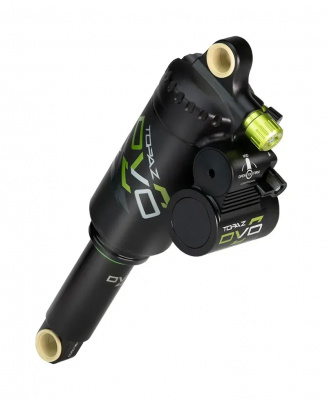
The Topaz handles trail and enduro duty with an adjustable air spring and DVO's T3 compression platform, giving you three distinct damping modes without faffing around mid-ride. The Jade family covers coil territory - the standard Jade for gravity and bike park use, the Jade X for enduro riders who still need to pedal home. Both are tunable at home without specialist tools, which counts for a lot when the riding season runs twelve months and the mud never really stops.
If you're building a fully matched setup, pair either shock with a DVO suspension fork to keep the damping character consistent front to rear. That coherence in feel is harder to put a number on, but you notice it immediately.
Prices and availability can change quickly. Delivery charges are not always included in listed prices.
Final price, stock status and delivery terms are set by retailer. We may receive a commission on purchases made.
Decoding the DVO Rear Shock Lineup
Start with the Topaz. It's the air-sprung workhorse of the range and the shock you'll see spec'd on enduro bikes across Scotland and the Brecon Beacons. The Topaz T3 air shock is the headline model - travel-adjustable, with positive and negative air chambers you can tune independently using volume spacers to tighten or open up the spring curve. That means you can run it supple early in the stroke for small-bump grip, then firm it up before it bottoms out on bigger hits. Gen 3 updates brought refined bladder geometry and improved wiper seals, both worth noting if you're comparing older units.
The Jade family works differently. Coil springs don't need air pressure management, so you swap tuning complexity for raw linearity and zero air-spring progression. The standard Jade is a pure gravity shock - high and low-speed compression dials, a wide shim-stack tuning range, built for riders who spend most of their day pointing downhill. The Jade X shifts the brief toward enduro. Gone are the twin dials; in their place is the T3 lever with Open, Medium, and Firm settings. Open is supple and active for descending, Firm locks it down for fireroad transitions, and Medium sits in between for rough climbs where you still want some support underfoot. So if someone asks about the difference between DVO Jade and Jade X - that T3 lever and the enduro-biased valving is the crux of it.
Frame kinematics matter here too. High-leverage linkages generally suit coil shocks better because the leverage ratio does the work the air spring's progression would otherwise handle. If your frame runs a flatter leverage curve, the Topaz's tuneable positive chamber gives you more room to dial in support. When in doubt, check your frame manufacturer's recommended shock tune - DVO publish spring rate calculators that actually help.
The DVO Tech Philosophy: Bladders over IFPs
Most rear shocks use an Internal Floating Piston to separate the oil from the nitrogen charge. It works, but the IFP's O-ring seals create a small but real breakaway friction - stiction - that the shock has to overcome before it moves at all. On wet roots or square-edged braking bumps, that lag costs you grip. DVO's bladder system replaces the IFP with a flexible membrane that responds instantly, with zero O-ring drag. The result is a shock that tracks the ground rather than waiting to be told it's moving.
On the Topaz, the reservoir is CNC machined with cooling fins along its outer surface. Long descents generate heat, and heat thins the oil, which changes your damping mid-run - not ideal when you're committed to a rutted chute. The cooling fins pull heat away faster, keeping the oil viscosity consistent. It's the kind of detail that doesn't show up on a spec sheet but makes a difference on a long Welsh enduro stage where you're doing four or five hot runs in an afternoon.
The Jade's loader valve is worth understanding if you're mechanically inclined. It allows you to remove and re-shim the compression assembly without bleeding the shock. That means you can change the damping tune at home with basic tools - swap to a softer shim stack for loamy conditions, firm it up for hardpack - without sending the shock away. For UK riders servicing kit through a wet winter, that's a genuinely practical advantage over shocks that demand a full strip and bleed every time you want to adjust the tune. It puts DVO rear shock tuning within reach for any home mechanic with patience and a clean workbench.
Compared to the adjustability on offer from Cane Creek rear shocks, DVO's approach is arguably more accessible for riders who want meaningful tuning without a hydraulics course. RockShox rear shocks and Fox rear shocks dominate OEM spec, but DVO's bladder architecture gives the aftermarket option a genuine technical argument rather than just a premium price tag.
Living with a DVO Shock in the UK
The bladder system's sensitivity is most obvious in the kind of conditions UK trails serve up constantly - off-camber roots slicked by overnight rain, loose-over-hard surfaces where your rear wheel needs to find grip rather than skip. The Topaz in particular responds to tiny ground movements that a stiffer IFP shock would simply transmit as buzz. That translates to more confidence in the corners, not just on the descents.
Maintenance is honest rather than demanding. DVO metric rear shocks use standard wiper seals that cope well with gritty winter mud, but they do need cleaning after muddy rides - a quick wipe down of the shaft before the seals push grit inward is just good practice, the same as any quality shock. The bladder pressure does need occasional checking; it's separate from your main air spring pressure on the Topaz, and it drifts slowly over months of use. Keep a quality shock pump in the garage and check it a few times a season. It's a small habit that keeps the small-bump feel where it should be.
Home serviceability is a real selling point for UK ownership. A lot of riders in the Peak District and the Highlands are doing their own suspension servicing through winter rather than posting shocks away for weeks. DVO's design supports that - service intervals are reasonable, parts availability has improved, and the loader valve on the Jade means compression tuning doesn't require a bleed kit. A set of Öhlins rear shocks might match DVO on outright feel, but the at-home tuning access tilts the practical argument toward DVO for riders who like understanding what their suspension is doing.
One genuine trade-off: bladder systems do require more attention than sealed cartridge designs if you push service intervals. If you're the type to fit a shock and forget it for two seasons, a simpler IFP unit might suit your habits better. But if you're the sort of rider who's already googling shim stacks before you've even bought the shock, DVO is exactly your kind of brand.
Dvo Rear Shocks FAQs
Are DVO rear shocks any good?
They're genuinely well-regarded, particularly for small-bump sensitivity and tunability. The bladder system removes the stiction that holds back IFP-based designs, which makes a real difference on technical, rooty trails. They're also a strong choice for home mechanics - the internals are accessible and the tuning options are meaningful rather than cosmetic.
How do you set up a DVO Topaz rear shock?
Set your sag first - aim for 25 - 30% of travel using the main air valve. Then check your bladder pressure separately; DVO typically recommend 170 - 200 psi, and this controls the shock's initial reactivity. From there, use volume spacers in the positive or negative air chambers to adjust ramp-up and mid-stroke support. The T3 lever handles compression mode on the fly.
What is the difference between DVO Jade and Jade X?
The standard Jade is a gravity-focused coil shock with separate high and low-speed compression dials - built for downhill and bike park riders who want granular damping control. The Jade X swaps those dials for a three-position T3 lever (Open, Medium, Firm), making it faster to adjust on enduro courses where you're transitioning between climbing and descending regularly.