
Bontrager Commuter And Hybrid Tyres
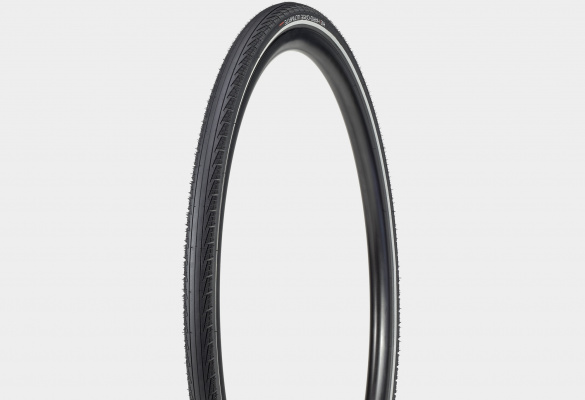
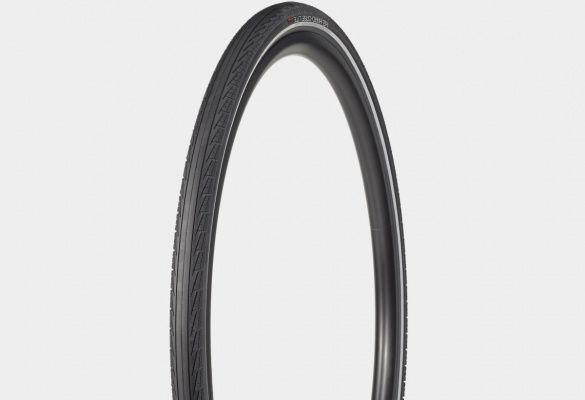
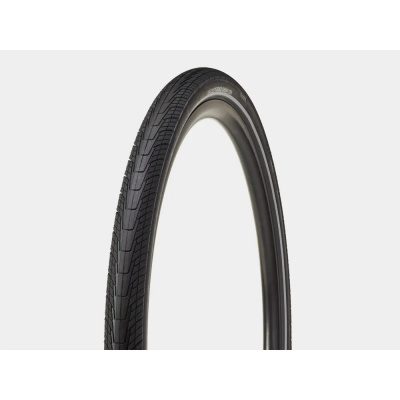
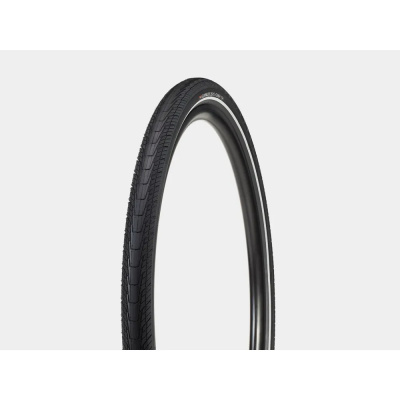
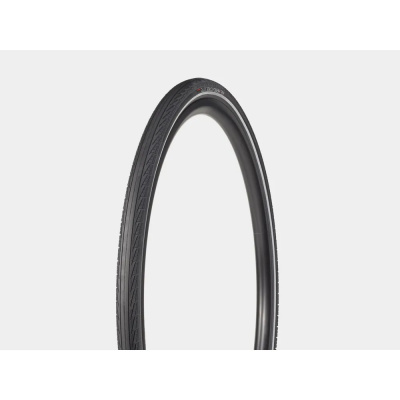
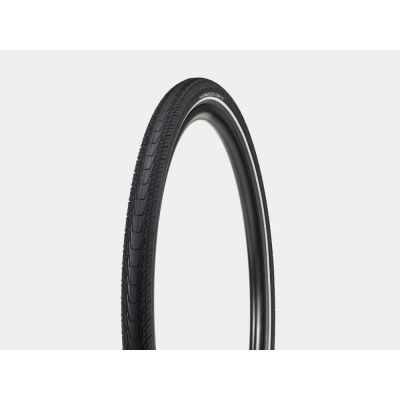
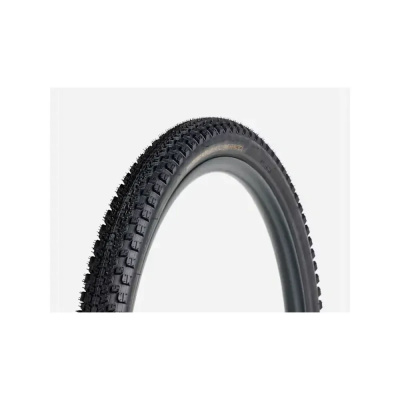
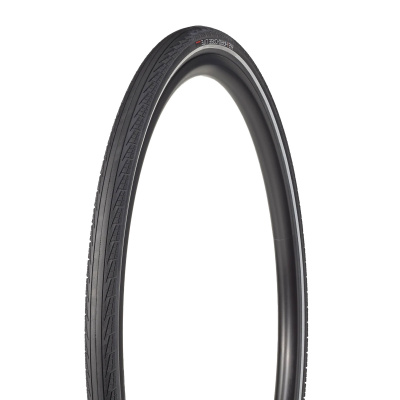
A reliable commute starts where the rubber meets the road, and Bontrager commuter and hybrid tyres are built around one core promise: getting you there without standing on a wet pavement swapping a flat. That means proprietary Hard-Case puncture protection in two distinct forms - bead-to-bead armour for urban combat, or a lighter aramid belt for riders who want speed without surrendering too much peace of mind. Underneath, TR-Endurance compound keeps the rubber going through thousands of miles of gritty British tarmac, cycle paths, and canal towpaths.
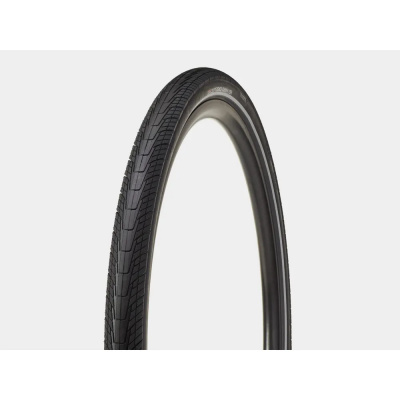
The range spans fast-rolling 700c slicks through to wider, siped all-weather treads, so whether your commute is a flat sprint across Leeds or a lumpy mixed-surface slog through the Bristol suburbs, there's a tyre width and tread pattern that fits. Reflective sidewall strips are a quiet but genuinely useful detail when you're riding home in November darkness. E-bike riders also get dedicated options carrying ECE-R75 certification, rated to handle the extra torque and load of a motor-assisted machine.
If you're after pure tarmac speed, our Bontrager inner tubes page covers supporting kit, and we have separate pages for road and MTB rubber if this category isn't quite right for your riding.
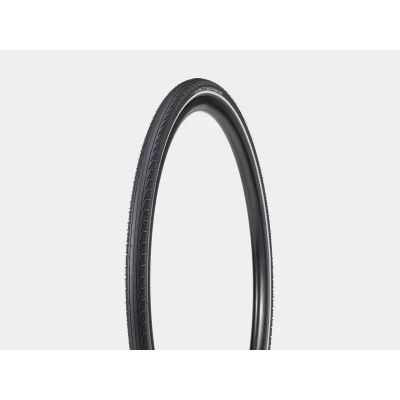
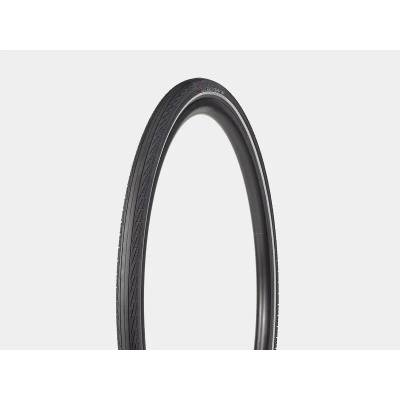
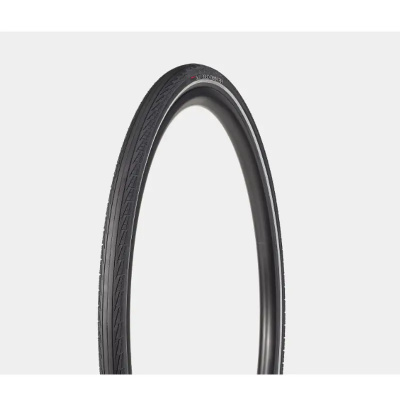
Prices and availability can change quickly. Delivery charges are not always included in listed prices.
Final price, stock status and delivery terms are set by retailer. We may receive a commission on purchases made.
Getting the Fit Right: Sizing, Clearance, and E-Bike Standards
Before anything else, check your ETRTO marking - it's the honest sizing standard that cuts through the confusion of imperial and metric labelling. A tyre marked 35-622 is what most people call a 700x35c, and that 622 figure is the bead seat diameter that actually matters when matching tyre to rim. Your internal rim width determines how wide a tyre will sit and how well the casing rolls; a 35mm tyre on a 17mm internal rim will feel noticeably narrower and harsher than the same tyre on a 21mm internal rim.
Clearance is the other thing worth sorting before you order. Running Bontrager mudguards alongside a 40mm or wider tyre on a frame with modest clearance is a recipe for a tyre rubbing in the stand, let alone in the mud. Most hybrid frames have clearance figures printed on the fork crown or dropout - add at least 6 - 8mm to your tyre width as a working clearance target with guards fitted.
If you're running a mid-drive or hub-motor e-bike, look specifically for the ECE-R75 certification. This European standard confirms the tyre casing is rated for machines up to 25 km/h with motor assistance and can handle the additional load and torque that conventional commuter tyres aren't necessarily built for. Bontrager flags ECE-R75 compliance clearly on relevant models, so it's easy to identify at the point of purchase.
Choosing Your Tyre: What the H2, H5, and AW Series Each Do Well
Bontrager's commuter range is tiered in a way that's actually logical once you know what the letters mean. The H2 is the fast-rolling end of the spectrum - smooth central tread, minimal rolling resistance, designed for tarmac. Think of it as the sensible daily-driver choice if your route is mostly road. It runs on a wire bead at the budget end, which adds a little weight but keeps cost accessible.
Step up to the H5 and you get deeper, more defined grooves and a higher TPI (threads per inch) casing. Higher TPI means a more supple casing that conforms better to surface irregularities - noticeable on rough chip-seal or packed gravel towpaths where the H2 would feel a touch wooden. The H5 is also the level at which you start seeing Hard-Case Lite as standard: a sub-tread aramid puncture belt that stops most flint and glass without adding the full weight penalty of a bead-to-bead casing. It's lighter and faster-rolling than full protection, which matters across a forty-minute commute twice a day.
Hard-Case Ultimate goes the full distance - bead-to-bead protection that covers the sidewall as well as the tread. If your route takes you through broken glass on urban back streets or you've had sidewall slashes before, the Ultimate casing is the one to go for. It's heavier, and there is a modest rolling resistance trade-off, but that's a fair deal for riding through the aftermath of a Friday night with no drama. For a comparable approach to bead-to-bead durability from another brand, Continental commuter tyres offer their own protection layers, worth comparing if budget or availability pushes you.
The AW (All-Weather) series - including the AW3 TLR at the top of the range - adds siped tread patterns specifically designed for water displacement on wet tarmac. Sipes are the small slits cut into tread blocks that allow the rubber to flex and channel water away from the contact patch. On a slick winter road in Cardiff or Edinburgh that might as well be an ice rink, sipes make a meaningful difference to how planted the tyre feels mid-corner. The AW compound is also specifically tuned for low temperatures, where standard rubber can go noticeably hard and lose grip. Specialized commuter tyres and Panaracer commuter tyres both compete in this four-season space, but Bontrager's reflective sidewall strips give the AW series a safety edge for low-light UK commuting that's genuinely worth having.
Keeping Them Rolling: Pressure, Inspection, and Winter Survival
The single most effective thing you can do to extend tyre life is run the right pressure and check the tread regularly. It takes thirty seconds. After every ride in autumn and winter, squeeze the tyre and look for anything embedded - a fragment of flint or a sliver of glass sitting just below the surface will work its way through the casing over a few days of riding until you get a slow puncture at the worst possible moment. Pick it out before it migrates deeper. Keep a Bontrager track pump near the door and make a habit of checking pressure weekly; commuter tyres lose around 5 PSI per week even without a puncture.
Pressure strategy changes with the season. In summer on smooth tarmac, running close to the tyre's maximum rated PSI reduces rolling resistance and keeps the commute efficient. In wet British winters, drop that figure by 10 - 15 PSI. A lower pressure increases the tyre's contact patch, softening the casing so it conforms to the road surface rather than skimming over it. That's especially useful on the greasy, leaf-contaminated tarmac you'll find on almost any UK cycle path between October and February.
If you're carrying regular loads - a laptop bag, pannier, or cargo - factor that weight into your pressure. Heavier loads compress the tyre more under braking and cornering, and slightly higher pressure compensates for that. A well-set-up Bontrager pannier rack distributes load evenly and reduces the asymmetric stress that can cause uneven tyre wear on heavily loaded commuters. Also worth fitting: Bontrager lights to make those reflective sidewall strips work even harder in the dark months.
On TR-Endurance compound: it's harder than a pure performance rubber, which is exactly the point. Performance compounds grip better but wear faster - fine for a Sunday ride, less sensible for a tyre doing five thousand kilometres a year through road grime and tarmac roughness. TR-Endurance is optimised for longevity, and you'll notice it most in how long the centre tread takes to square off compared to a race-oriented tyre. Worth knowing if you're comparing on feel alone at the start of a tyre's life - they're made for different jobs.
Bontrager Commuter And Hybrid Tyres FAQs
Are Bontrager Hard-Case tyres puncture proof?
No pneumatic tyre is fully puncture-proof - that's not a realistic claim for any rubber on the market. What Hard-Case Ultimate's bead-to-bead protection does is stop the vast majority of glass, flint, and sharp debris before it reaches the inner tube. Hard-Case Lite trades the sidewall coverage for lighter weight and lower rolling resistance, while still offering highly reliable sub-tread protection for most commuting conditions.
What tyre pressure should I run on a Bontrager hybrid tyre?
On a typical 700x35c hybrid tyre, 50 - 60 PSI on smooth tarmac gives good rolling efficiency without excessive harshness. In wet conditions or on rough surfaces - towpaths, chip-seal, and the like - drop to 40 - 45 PSI to widen the contact patch and improve grip. Factor in rider weight and any load carried; heavier setups need slightly more pressure to avoid pinch flats and sluggish handling.
Are Bontrager commuter tyres tubeless ready?
Most of Bontrager's H-series commuter tyres are conventional clinchers, designed to run with an inner tube. The exception is at the top of the AW range - the AW3 TLR is Tubeless Ready and can be set up without tubes using a compatible tubeless rim, valve, and sealant. Check the tyre's labelling for TLR confirmation before attempting a tubeless conversion on any other model in the range.