
Mission Workshop Frame Bags
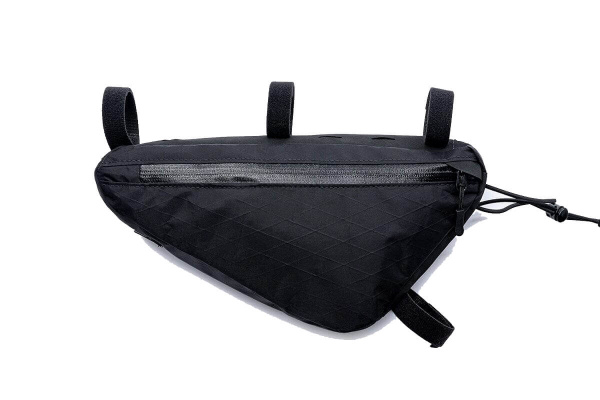
Mission Workshop Frame Bags are among the most seriously constructed bikepacking luggage you can bolt into your front triangle - engineered in San Francisco with materials that don't compromise when the weather turns. The foundation is Dimension Polyant VX-21 X-Pac, a multi-layer laminated fabric that stays rigid under load, sheds water fast, and resists the kind of abrasion that chews through cheaper nylons within a season. Pair that with YKK Aquaguard urethane-coated zippers and Hypalon-reinforced strap zones, and you've got a bag that treats a wet Welsh lane or a gritty Peak District bridleway as routine, not exceptional.
The frame bag format works hard precisely because it keeps weight central and low - no handlebar flap, no seat-post sway, just dense, accessible storage tucked inside the triangle where your bike already carries it best. Tools, a spare tube, your gilet, a mid-ride snack: it all disappears without affecting handling. Whether you're building a full bikepacking setup or just want smarter carrying capacity for longer audax days, Mission Workshop's approach to construction means these bags are bought once and used for years. Compare UK prices below and see which size fits your rig.
Prices and availability can change quickly. Delivery charges are not always included in listed prices.
Final price, stock status and delivery terms are set by retailer. We may receive a commission on purchases made.
Sizing Your Frame and Getting the Fit Right
Before you order, you need a tape measure and five minutes. Measure the inner front triangle - seat tube length from bottom bracket to top tube junction, top tube from head tube to seat tube, and the diagonal from head tube to bottom bracket. Most Mission Workshop frame bags are sized to fill the majority of that space, so a bag that's a touch too tall will foul your top tube cable runs or bite into the front derailleur band on a mechanical drivetrain. Check those clearances first, not after the bag arrives.
Cable routing is where riders get caught out. Internally routed frames give you a cleaner run, but externally routed cables - particularly those running under the top tube - restrict how far the bag's top edge can sit. The bag needs to sit below those cables without pinching them under load. Hook and loop straps with Velcro closures wrap the tubes directly, so strap placement matters: position them to avoid sitting over brake or gear cable stops. On frames with a front derailleur, the lower strap often needs to sit above the band clamp rather than over it.
Half-frame designs - bags that occupy the lower portion of the triangle only - are the practical answer for smaller frames where a full bag would block bottle cage access entirely. Even so, bottle cage clearance stays tight. A standard cage pointing straight out will usually conflict with the bag's side panel. Switching to a side-entry cage (the kind that lets you pull the bottle out horizontally) typically solves this without drama and keeps your hydration accessible on the move. Worth sorting before the first ride rather than discovering it mid-climb on the South Downs.
What X-Pac Actually Does for You
Standard nylon frame bags work until they don't. Under sustained load, softer fabrics deform - the bag belly outwards and starts brushing your knees on every pedal stroke, which goes from mildly irritating to genuinely fatiguing over a long day. Dimension Polyant VX-21 X-Pac fixes this through laminated construction: a polyester X-thread grid bonded between outer and inner film layers creates a material that holds its shape under weight rather than flexing like a bin bag. The result is a bag that keeps its profile throughout the ride, stays out of your knees, and doesn't develop that saggy droop that plagues cheaper options after a few months.
Tear resistance is the other gain. The woven X-thread layer catches any puncture before it runs - useful when a bag is wedged against chain stays or strapped close to rough welds. Hypalon reinforcements add another layer of protection specifically at the strap contact zones, where repeated fastening and movement would otherwise grind through fabric over time. Hypalon is the same material used in whitewater equipment; it's overkill in the best way.
On waterproofing: the X-Pac shell and YKK Aquaguard zippers handle British rain without fuss. The zippers carry a urethane coating that seals the teeth against water ingress - no zipper garage needed, though most Mission Workshop designs include them anyway. If you're comparing against Apidura frame bags or Ortlieb frame bags, the X-Pac construction sits closer to Apidura's race-line approach - structured and light - rather than Ortlieb's roll-top waterproof-first philosophy. A different set of trade-offs, depending on how you prioritise access speed versus submersion-proof sealing. Miss Grape frame bags offer another custom-fit alternative if you're working with an unusual geometry.
If you're planning a full setup rather than a single bag, Mission Workshop's bar bags and hip packs use the same X-Pac construction and pair naturally with the frame bag for consistent weight distribution front and rear.
Protecting Your Frame in UK Riding Conditions
UK riding has a specific problem that doesn't get talked about enough: wet grit. Winter roads and bridleways coat everything in a slurry of fine stone particles suspended in water, and when that gets trapped between a bag's Velcro strap and your frame, it acts like valve-grinding paste. Slowly. Every vibration works it back and forth. Aluminium scratches, carbon gets through to the weave if you leave it long enough. This isn't a Mission Workshop issue - it's every frame bag issue on UK roads - but it's worth treating seriously before you mount anything.
Clear helicopter tape (PPF film) applied to all contact points is the standard fix. Cover the full length of each strap run, not just the corners. Frame protection decals work too, but PPF is more durable and can be trimmed exactly to the strap width. Do this before the bag goes on for the first time. Retrofitting it after the bag has been rubbing for a few wet rides means you're protecting paint that may already be compromised.
The YKK Aquaguard zippers are tough, but mud dries into the zipper teeth and stiffens them over time. A periodic wipe-down and a light application of zipper lubricant - a dry wax type rather than anything oily, which attracts more grit - keeps them running smoothly through winter. It takes two minutes after a mucky ride and avoids the frustration of a seized zip on a cold morning when you need your tools in a hurry.
For longer multi-day setups where you're carrying more varied kit, the Mission Workshop hydration packs and outdoor equipment range extend the same durability standards to the rest of your carry system.
Mission Workshop Frame Bags FAQs
Are Mission Workshop frame bags fully waterproof?
Highly weather-resistant is the accurate description. The VX-21 X-Pac fabric and YKK Aquaguard zippers handle heavy UK rain and persistent wheel spray without issue. Seams are stitched rather than welded, though, so prolonged submersion - think flooded bridleway crossing - may allow moisture through. For everything short of that, they're more than capable.
How do I stop my frame bag from rubbing my bike frame?
Apply clear PPF (helicopter tape) or frame protection decals to every contact point before you mount the bag - strap runs, corners, anywhere the bag's edge sits against the tube. UK grit trapped under Velcro straps acts as an abrasive on both paint and carbon, and the damage accumulates faster than you'd expect. Fit the tape first; don't retrofit it after the fact.
Will a Mission Workshop frame bag fit my full suspension mountain bike?
Possibly, but you need to check carefully. Measure the usable space in your front triangle with the suspension at full compression - the bag must clear the shock body and all moving pivot points throughout the full travel range. Shock placement varies significantly between platforms, so there's no blanket answer. Some full-sus frames accommodate a half-frame design comfortably; others leave almost no usable space at all.