
Condor Gravel Wheels
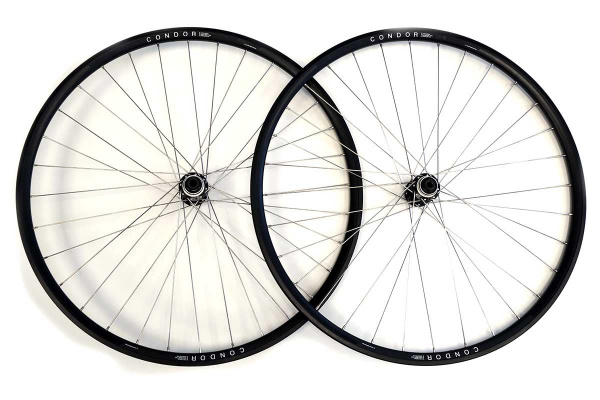
Condor gravel wheels are built around a straightforward idea: a British rider shouldn't have to choose between wheels that perform and wheels that last. Hand-built in the traditional sense, with J-bend spokes you can actually true at the roadside with a spoke key rather than hunting for proprietary parts, these wheelsets are aimed squarely at riders who'd rather be out on the bridleways than in the workshop.
The range covers both 700c and 650b formats, so whether you want rolling speed on long gravel drags or the extra tyre volume to soak up the chunk on rougher tracks, there's a fit for how you ride. Tubeless-ready construction is standard across the modern lineup, and the hubs run sealed cartridge bearings designed to keep grinding paste - mud, grit, road salt - out of the internals where it does damage. That matters in the UK, where conditions chew through poorly sealed hubs faster than you'd expect.
Fitment is covered across common axle standards, and both Centerlock and 6-bolt rotor options appear in the range. If you're comparing against wheelsets from Hope or Mavic, Condor sits in a considered spot - hand-built serviceability with specs that suit modern gravel setups.
Prices and availability can change quickly. Delivery charges are not always included in listed prices.
Final price, stock status and delivery terms are set by retailer. We may receive a commission on purchases made.
Axle Standards, Rotor Mounts, and Freehub Options
Getting the fitment right before you buy saves a lot of faff. Most Condor gravel wheels run 12x100mm at the front and 12x142mm at the rear - the current standard across virtually all modern gravel and adventure bikes with thru-axle dropouts. If you're running an older quick-release frame, check carefully; thru-axle wheels won't swap across without adapters, and it's rarely worth it.
Rotor mounting comes in two flavours depending on the specific hub spec: Centerlock and 6-bolt. Centerlock is becoming more common on newer Condor gravel disc wheels and uses a splined interface locked with a standard bottom bracket tool - quick to swap, tidy, and increasingly well-supported. Six-bolt is older but still widely used and arguably easier to work with if you're doing roadside fixes without a torque wrench. Always confirm the mounting standard on the hub before ordering replacement rotors.
Freehub body options typically cover Shimano HG (the most common for 11-speed and below), SRAM XDR for 12-speed Eagle-based drivetrains, and Campagnolo N3W for those running Ekar. Not all hub shells accept every body, so it's worth confirming compatibility with your groupset before committing. For standalone hub specs and spare parts, the Condor Hubs page goes into the detail on individual hub internals, and Condor Rims covers rim profiles and standalone hoops separately.
700c vs 650b: Picking the Right Wheel Size
The choice between 700c and 650b isn't just a numbers game - it changes how the bike feels under you and what tyres you can run. The best Condor wheels for gravel riding in a given format really comes down to what kind of riding you're doing most.
700c is the default for most gravel riders. The larger diameter rolls over surface irregularities more smoothly at speed, keeps momentum on long gravel roads, and gives you access to the widest range of tyre options. Condor's 700c gravel wheelsets comfortably accommodate tyres in the 35mm to 45mm range - enough volume for a mixed day out without the bike feeling sluggish on road sections.
650b trades some of that rolling speed for a shorter, stiffer wheel that accepts much fatter rubber - often up to 2.1 inches (around 53mm). That extra volume is transformative on rougher ground: more air, more compliance, more confidence when the surface drops off. Think Peak District packhorse routes or the looser bridleways that cut across the South Downs between the chalk sections. If you're bikepacking with a loaded frame, the cushioning 650b provides is genuinely worth the minor speed compromise on tarmac links.
Within each size, Condor offers alloy and carbon constructions. Alloy wheels are heavier but more forgiving of rim strikes - relevant on the flint paths of the South Downs where a sharp edge can ding a rim without warning. They're the sensible choice for winter training and fully loaded trips. Carbon hoops shed meaningful weight and are stiffer laterally, which sharpens the feel when you're pushing hard, but they cost more to repair if you crack them. Worth it for gravel racing; probably overkill for a regular weekend loop.
Internal rim width is worth paying attention to. Condor's optimised widths - typically in the 21mm to 25mm internal range on their gravel wheelsets - are matched to support high-volume tyres without the tyre ballooning into a lightbulb shape. A tyre mounted on a rim that's too narrow will have a rounder, less stable profile in corners; get the pairing right and the contact patch stays square and predictable. If you're running wide 650b rubber especially, check that internal rim width matches the tyre manufacturer's recommended rim range. Compared to what DT Swiss offers at the wider end of the market, Condor's alloy options hold up well on value while covering the key width specs most riders need.
Keeping Condor Gravel Wheels Running Through UK Winters
UK riding is rough on equipment in ways that don't always show up in spec sheets. Mud and grit combine into a grinding paste that works into every gap it can find, and road salt on winter mixed-surface rides attacks spoke nipples and any alloy that's not well anodised. The good news is that Condor's approach to hub sealing is more than cosmetic.
The sealed cartridge bearings in these hubs use labyrinth seal designs - essentially a maze-like path that water and contaminants have to navigate before reaching the bearing race. In practice, this means they hold up considerably longer than cup-and-cone hubs with minimal sealing. That said, they're not indestructible. Check for play in the bearings every few months - a slight rock when you grab the wheel at 3 and 9 o'clock with the bike in a stand - and replace cartridges before they get noisy, not after.
J-bend spokes are the right call for a wheel you plan to actually maintain. If you snap a spoke in a remote spot - say, deep in the Kielder Forest or halfway across Dartmoor - a J-bend replacement can be sourced from any decent bike shop and laced with standard tools. Proprietary straight-pull spokes are often faster to build but a significant headache when one goes. Check spoke tension after the first 100 miles on new wheels; they bed in and tension drops slightly, which can let the wheel go slightly out of true if you don't catch it.
On tubeless setup: reseat the tyre carefully with a proper tubeless rim tape width matched to the rim's internal width - too narrow and sealant seeps under the tape, too wide and it bubbles. Refresh your tubeless sealant every three to six months; it dries out and loses effectiveness faster in cold weather. Carry a spare Condor inner tube for sidewall tears that sealant can't plug - it's a last resort, but it's got people home. And if you're building up a full gravel setup around these wheels, the Condor Gravel Bikes page is a solid starting point for frame compatibility and complete build options.
Condor Gravel Wheels FAQs
Are Condor gravel wheels tubeless compatible?
Most modern Condor gravel wheels are tubeless-ready straight from the box. You'll need the correct width rim tape, tubeless valves, and a quality sealant - get those three things right and setup is straightforward. Check the specific rim's tape width recommendation before you start; it makes a real difference to how reliably the tyre seats.
What is the maximum tyre width for Condor gravel wheels?
It depends on the wheel's internal rim width and your frame's clearance. Most Condor 700c gravel wheels handle 35mm to 45mm tyres without issue. Their 650b wheelsets are built for wider rubber and typically accommodate tyres up to around 2.1 inches (53mm). Always cross-reference the tyre manufacturer's rim width recommendation against the wheel's internal measurement.
Do Condor gravel wheels use Centerlock or 6-bolt rotors?
Condor offers both - Centerlock is more common on newer gravel disc models, while 6-bolt appears on some alloy options. Centerlock uses a splined interface tightened with a standard BB tool; 6-bolt takes hex bolts and is easier to deal with in the field. Always check the hub spec on the wheel you're buying before ordering rotors or lockrings.