
Campagnolo 10 Speed Front Derailleurs
A Campagnolo 10 speed front derailleur is one of those components that rewards getting right. Run the correct mech and you get that crisp, mechanical clack from your Ergopower shifters - the kind of shift that feels deliberate and precise, not vague. Run the wrong one and you're chasing ghosts: chain rub, dropped chains, limit screws that never quite settle. Campagnolo's 10-speed front mechs span a solid range, from the workhorse Veloce through Centaur and up into Chorus and Record territory, and each is built around the same core principle - proprietary cable pull ratios that only behave properly when paired with matching Campagnolo Ergopower shifters.
Frames vary, so you'll find both braze-on and band-on versions in the range. Braze-on models bolt directly to your frame's tab; band-on models clamp around the seat tube, typically in 31.8mm or 34.9mm clamp sizes. Both mounting types are widely available here, so whether you're refreshing a steel Italian road bike or maintaining a mid-2000s carbon race machine, there's a mech that fits without adaptation headaches. For UK riders logging wet winter miles, durability matters as much as shift feel - and that's where Campagnolo's build quality starts to make a strong case for itself.
Prices and availability can change quickly. Delivery charges are not always included in listed prices.
Final price, stock status and delivery terms are set by retailer. We may receive a commission on purchases made.
Compatibility and Mounting: What You Need to Know Before Buying
Fitting a Campagnolo 10-speed front derailleur correctly starts with your frame. If the seat tube has a machined metal tab, you want a braze-on model - it bolts straight on, no adapter, no fuss. If the tube is a clean, round section with no tab, you're looking at a band-on mech, sized to match your seat tube diameter. Most road frames sit at 31.8mm or 34.9mm, so measure before you order. Getting this wrong is an easy mistake that wastes time and postage.
For carbon frames, Campagnolo's Even-O clamp system on band-on models is worth knowing about. Rather than concentrating clamping force at a single point, it distributes pressure evenly around the tube - which matters when you're tightening a metal clamp onto a carbon seat tube and don't want to risk crushing the fibres. It's a thoughtful piece of engineering that removes one of the legitimate worries around band-on fitment on modern frames.
Beyond mounting, crankset compatibility is where things get specific. Standard 10-speed Campagnolo groupsets typically run a 53/39 chainring combination, but compact cranksets with a 50/34 setup are well supported too - just make sure the derailleur you're buying is specced for the correct chainring size range. The cage height and trim positions are calibrated around these combinations. And on the subject of cable pull: Campagnolo uses a proprietary pull ratio across its 10-speed range. That means you must run Campagnolo 10-speed Ergopower shifters with these mechs. Swap in a Shimano or SRAM shifter and the cage won't travel far enough - or will travel too far - resulting in a front end that never indexes cleanly. It's not a workaround situation; it's a genuine incompatibility.
If you're building up or refreshing a full drivetrain, pairing the front mech with a Campagnolo 10 speed rear derailleur and a matched Campagnolo 10 speed cassette keeps everything within the same ecosystem and avoids the pull-ratio guesswork entirely.
How the Campagnolo 10-Speed Range Breaks Down
There's a clear logic to the Campagnolo 10-speed front mech hierarchy, and knowing where each tier sits helps you spend sensibly rather than over-speccing a winter training bike or under-speccing a race machine you actually care about.
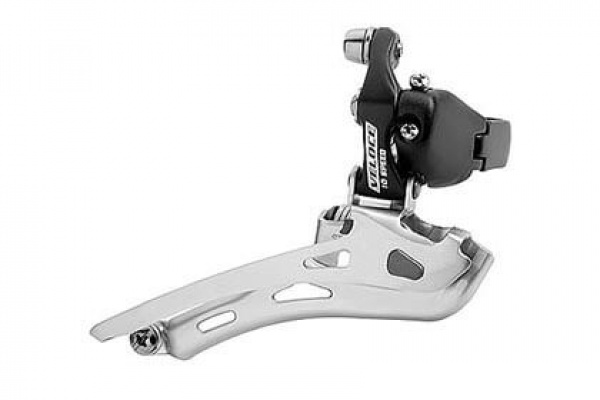
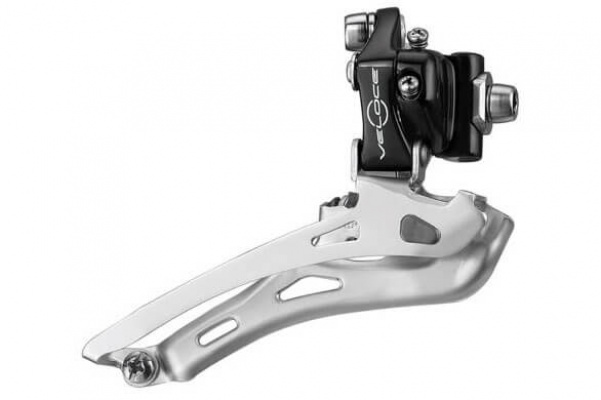
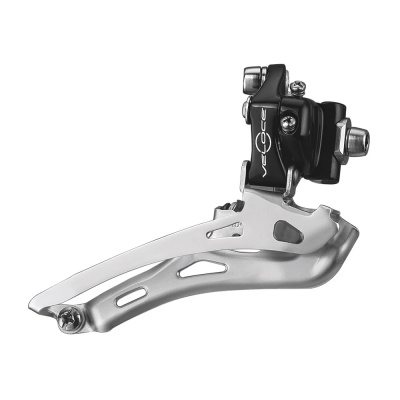
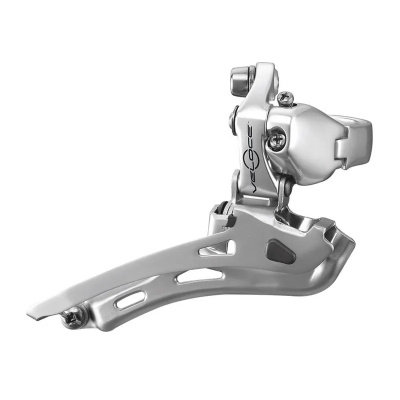
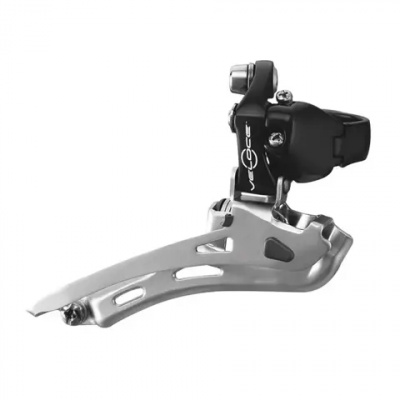
The Campagnolo Veloce 10 speed front mech sits at the entry point. The cage is stamped steel - heavier and marginally less stiff than higher-tier options, but robust and serviceable. For a commuter conversion, a winter bike, or a touring build, Veloce does the job without drama. The Campagnolo Centaur 10 speed front derailleur steps things up with a move toward alloy cage construction, which shaves weight and improves stiffness under load. Shifts feel crisper, particularly when you're pushing hard on a climb and asking the front mech to move a chain under tension.
Higher up, Chorus and Record front mechs introduce the Z-shape inner cage - a specific geometry that maximises lateral stiffness without adding bulk. Under load, a flexy cage will deflect slightly before moving the chain, which introduces lag and occasional hesitation. The Z-shape design eliminates most of that, giving upshifts a more immediate, planted feel. Record models also benefit from more refined anti-friction surface treatments on the cage itself, which reduce the friction between cage and chain over time. Less friction means less chain wear, quieter running, and marginally lighter actuation from the shifter lever. It's not a dramatic difference in day-to-day use, but over thousands of kilometres it adds up.
Weight differences between tiers are real but modest in absolute terms - the more meaningful gap is in shift feel and longevity. If you're running a road bike you take seriously, Centaur upwards is where we'd focus attention. Veloce makes sense when the budget is tight or the application is genuinely utilitarian. Worth comparing the Campagnolo options against Shimano 10 speed front derailleurs or SRAM 10 speed front derailleurs if you're open to swapping the full shifter setup - but if you're staying Campagnolo, stay committed to the ecosystem.
Keeping It Shifting Through a UK Winter
A Campagnolo front derailleur is built to last, but UK winters will test any component. Road salt and grit work into the pivot pins and the return spring over the course of a wet season, and once corrosion takes hold in those joints, the spring tension softens and shifts become sluggish. It's one of those things that creeps up gradually - you compensate without noticing, then one day the front mech just won't throw the chain onto the big ring cleanly.
The fix is straightforward and costs almost nothing in time. After wet rides, flush the pivot points with a light degreaser - a fine-tipped applicator helps - then follow with a PTFE-based or quality wet lube. Don't saturate it; a little goes a long way and excess lubricant attracts grit. Check the limit screws (H and L) for surface corrosion periodically. If they've seized slightly, a penetrating oil and patience will usually free them without damaging the thread. Stripped limit screw threads are annoying to fix and entirely avoidable.
Cable friction is another factor that's easy to overlook. As inner cables corrode and housing compresses over winter miles, shifting gets heavier - and that heavy feel is routinely blamed on the derailleur when the cable is the actual culprit. Replacing gear cables annually, ideally at the start of winter or before a big spring sportive, is one of the more cost-effective maintenance moves you can make. A fresh Campagnolo 10 speed chain at the same time keeps the drivetrain running cleanly end to end.
Mud build-up on the inner cage is a winter nuisance rather than a serious mechanical issue, but compacted grit between the cage plates will eventually affect chain guidance. A brush and a rinse after muddy rides is all it takes - don't neglect it for weeks and then wonder why there's chain slap on rough roads.
Campagnolo 10 Speed Front Derailleurs FAQs
Can I use an 11-speed Campagnolo front derailleur on a 10-speed drivetrain?
It's not a swap worth attempting. An 11-speed cage is narrower, designed around a slimmer 11-speed chain. Run it with a wider 10-speed chain and you'll get persistent chain rub on the outer cage plate. Most mechanics won't touch this combination for good reason - it simply doesn't work cleanly in practice.
Do I need a braze-on or band-on Campagnolo front derailleur?
Check your seat tube. A machined metal tab means you need a braze-on derailleur. A smooth, round tube with no tab means you need a band-on model - measure the tube diameter and match it to either 31.8mm or 34.9mm clamp sizing. Getting this wrong before ordering is the most common buying mistake with front mechs.
Will a Campagnolo 10-speed front mech work with Shimano shifters?
No. Campagnolo and Shimano use different cable pull ratios and the two systems are genuinely incompatible - not just slightly mismatched. A Campagnolo front derailleur must be paired with Campagnolo Ergopower shifters. Mix brands here and you'll never get clean indexing, regardless of how much you fiddle with limit screws and cable tension.