
Uvex Full Face Helmets
Uvex full face helmets are engineered in Germany for riders who take gravity riding seriously - from bike park laps at Fort William to full-length enduro stages in the Tweed Valley. The range spans hardshell downhill lids through to lighter, more versatile options designed for riders who pedal hard between the fast bits. What ties them together is the combination of a reinforced chin guard, double inmould technology, and high-density EPS inner shell - a construction approach that bonds the outer shell and foam liner into a single unit, cutting weight without sacrificing the structural rigidity you need when things go wrong at speed.
Ventilation is taken seriously across the range, which matters more than you might think when you're grinding up to the top of a Welsh trail centre in August humidity. Goggle compatibility is dialled in too, with wide eye-ports and minimal frame interference. Fit comes via interchangeable cheek pads, letting you tune the feel to your face shape rather than just accepting whatever a single-pad size gives you. All models meet CE/EN 1078 safety standards, so you're covered whether you're racing an official UK enduro round or just putting in a solid weekend at Ae Forest.
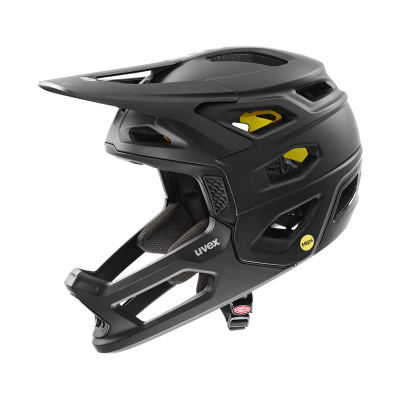
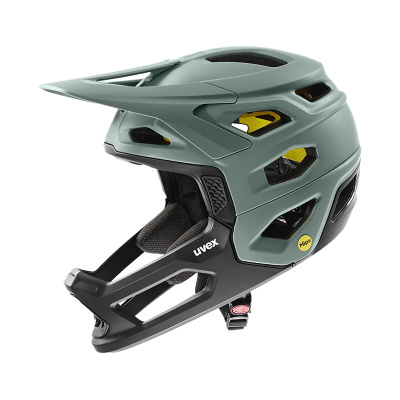
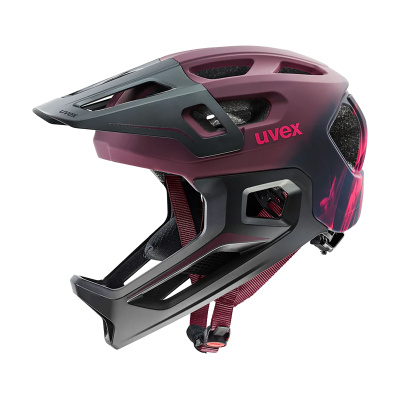
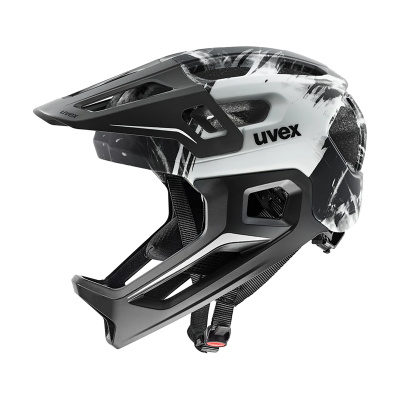
Prices and availability can change quickly. Delivery charges are not always included in listed prices.
Final price, stock status and delivery terms are set by retailer. We may receive a commission on purchases made.
Shell Construction and What It Means Under Impact
The foundation of Uvex's full face range is double inmould technology - a manufacturing process that fuses the outer polycarbonate shell directly to the EPS inner shell during production. The practical result is a helmet that's noticeably lighter than older hardshell designs, with no air gap between layers for deformation to exploit in a crash. When impact energy hits, the EPS foam compresses in a controlled way to absorb and disperse the force, rather than transmitting it straight to your skull.
The chin guard on Uvex full face helmets is structurally integrated rather than bolted on as an afterthought. That matters on steep, rooty descents where a front-end washout puts your face closest to the ground first. The chin bar is shaped to deflect and absorb rather than just block, and it's sized to work with standard MTB goggles without creating pressure points on the bridge of your nose mid-run. Compared to alternatives like Bell full face helmets or Fox full face helmets, Uvex positions itself firmly in the lightweight end of the hardshell space - not a foam-only lid, but not carrying unnecessary bulk either. The Fidlock magnetic buckle fastens with one hand in gloves, which sounds like a small detail until you're trying to get ready on a cold Pennines morning.
Getting the Fit Right Across the Range
Sizing a full face correctly isn't just about comfort - a lid that moves independently of your head in a crash is doing its job poorly regardless of what the shell is made from. Start by measuring your head circumference at the widest point, typically about 2.5cm above your eyebrows. Uvex's size guides are accurate; trust them over instinct, because full face helmets feel slightly odd in the shop compared to trail helmets and it's easy to size up unnecessarily.
Once you've found the right shell size, the removable cheek pads are your main fitting tool. Uvex supplies different thickness options, and swapping them out takes about two minutes. The goal is a snug fit across your cheeks with zero wobble when you shake your head - not painful pressure, but definite contact. If the crown sits too high or low, that's a shell size issue; cheek pads won't fix vertical fit. The removable, moisture-wicking inner lining also plays a role in fit consistency - a saturated liner compresses differently to a fresh one, so keeping it clean (more on that below) keeps your fit repeatable ride to ride.
If you're after everyday trail riding or XC protection without a chin bar, it's worth browsing the broader Uvex helmets range, which covers open-face and trail options for rides where a full face would be overkill. The full face range is aimed squarely at riders who spend meaningful time on descents where face protection is a genuine need, not a precaution.
Airflow, Goggle Compatibility, and Keeping It Clean After a UK Winter Ride
One of the fair criticisms of full face helmets has always been heat build-up on climbs. Uvex addresses this with strategic ventilation channels routed from the brow through to the rear exhaust ports, pulling air across the scalp when you're moving. In practice, these helmets are genuinely usable for pedal-heavy enduro formats - you'll notice the airflow difference between a well-designed full face and a poorly vented one on any climb longer than five minutes. That said, no full face moves air like an open-face trail helmet; the chin guard and closed lower section always restrict flow to some degree. It's a trade-off you accept for the protection level, not a flaw specific to Uvex.
Goggle compatibility is handled through a wide eye-port opening and a relatively flat brow profile, which means most standard MTB goggles sit flush without a gap at the top. If you're pairing your lid with Uvex goggles, the fit is particularly well matched - same design team, same geometry assumptions. Foam thickness at the brow can vary between goggle brands though, so if you're mixing brands, it's worth checking in person before committing. A gap at the top of your goggles in a wet Ae Forest winter sends water directly into your eyes at the worst possible moment.
After a muddy ride - and UK riding produces plenty of those - cleaning the helmet properly keeps it fresh and keeps the liner performing as intended. The outer shell and chin guard wipe down easily with a damp cloth and a small amount of mild soap; avoid solvent-based cleaners, which degrade the EPS foam over time. The removable cheek pads and inner lining come out quickly, and both can be hand-washed in cool water with a gentle detergent. Don't machine wash them - the heat and agitation break down the moisture-wicking fibres faster than necessary. Leave everything to air dry naturally before reassembling; forcing damp pads back into a helmet just accelerates bacterial build-up, and nobody wants that on a Sunday morning. Compared to brands like Giro full face helmets, Uvex's pad removal system is straightforward - no fiddly clips or hidden tabs.
Adjustable visors are standard across the range and are worth setting properly rather than leaving at the factory position. A visor angled too low catches wind on descents and creates neck fatigue over a long day; too high and it's not shielding your goggles from low branches on tight Afan singletrack. Two minutes of adjustment before your first run pays off across a full day's riding.
Uvex Full Face Helmets FAQs
How should a Uvex full face helmet fit?
It should feel snug across your crown and cheeks with no wobble when you shake your head. There should be firm contact, not painful pressure. If the helmet shifts independently of your head, either the shell is too large or you need thicker cheek pads - use the interchangeable pad system to dial it in before you ride.
Are Uvex full face helmets breathable enough for enduro?
Yes, the strategic ventilation channels pull air across the scalp well enough for pedal-heavy riding between stages. You'll feel the difference on longer transitions. A full face will always move less air than an open-face lid - that's the trade-off for chin protection - but Uvex's designs are among the more capable in the hardshell full face category.
How do I clean my Uvex helmet after a muddy ride?
Wipe the outer shell and chin guard with a damp cloth and mild soap - no harsh chemicals. Pull the cheek pads and inner liner out and hand-wash them in cool water with gentle detergent. Air dry everything completely before reassembling. Doing this regularly stops bacteria building up in the foam, especially after wet winter sessions.