
Triban Gravel Bikes
Triban gravel bikes have done something genuinely interesting: they've made capable, adventure-ready riding accessible without cutting corners where it counts. Developed by Decathlon's in-house cycling team, the GRVL range is built around the idea that you shouldn't need to spend big to get a bike that handles a muddy bridleway on Saturday and a wet commute on Monday without complaint.
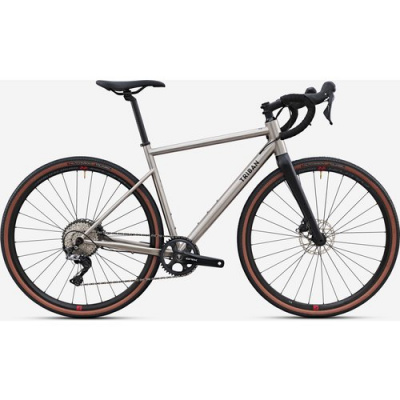
The lineup runs from the no-fuss GRVL 120 - a solid 1x workhorse for riders dipping their toes into gravel - right up to the titanium-framed GRVL 900, a bike you could realistically own for life. Across the range, you get ErgoFit geometry that keeps your back happy on long days out, tubeless-ready wheelsets that are genuinely ready to run tubeless out of the box, and tyre clearance that won't leave you stranded when the bridleway turns to soup. Flared handlebars come as standard too, which makes a real difference when you're picking a line on a loose descent.
Whether you're planning a multi-day bikepacking loop, hunting lanes in winter, or just want one bike that does the lot, the Triban GRVL range is worth a serious look. Use our price comparisons below to find your model.
Prices and availability can change quickly. Delivery charges are not always included in listed prices.
Final price, stock status and delivery terms are set by retailer. We may receive a commission on purchases made.
Decoding the Triban GRVL Family
Three bikes, three distinct riders. The GRVL 120 is where most people start, and it's a better starting point than it has any right to be at its price. You get a 1x drivetrain, mechanical disc brakes, and a frame that accommodates proper gravel tyres - it's the bike to pick if you want to find out whether gravel riding is for you without overcommitting your budget. Straightforward, solid, gets the job done.
Step up to the GRVL 520 and the bike starts feeling like a more deliberate choice. It's available in Sub-compact or SRAM Apex 1x builds depending on the variant, and you move into hydro-mechanical braking territory - a meaningful upgrade in modulation, especially when your hands are cold and wet. The frame and fork package is lighter, the spec is more considered, and it's the model that tends to stick around in riders' garages for years. If you're already convinced gravel is your thing, this is where we'd tell you to look first. Riders who prefer to stay on tarmac might also want to browse Triban Road Bikes before deciding.
At the top sits the GRVL 900, and the headline is the titanium frame. Ti isn't a marketing story here - it genuinely changes the character of the ride. The material absorbs high-frequency buzz from rough surfaces in a way aluminium can't replicate, and it doesn't corrode, so it rewards long-term ownership. If you're the type who keeps a bike for a decade rather than chasing the latest spec, the GRVL 900 makes a compelling case. Compared with the aluminium-framed options from Genesis or Cube at similar price points, the titanium frame is a significant differentiator.
What the Tech Actually Does for You
Triban's ErgoFit geometry deserves more attention than it usually gets. It's not a vague comfort claim - it's a measurably taller stack and shorter reach than you'd find on a race-oriented gravel bike. In practice, that means you're sitting more upright, your weight is better distributed, and the lower back fatigue that sets in around hour three of a long ride is less of an issue. It suits a wide range of riders, particularly those coming from a road background who aren't used to spending extended time in an aggressive position.
The 16-degree flared handlebars are worth understanding properly. Flare widens your hand position in the drops, which drops your centre of gravity and gives you more purchase on the bar when the surface gets unpredictable. On a loose chalk descent or a rutted farm track, that extra width is the difference between feeling in control and feeling like a passenger. It's not a gimmick; it's a genuine handling benefit.
Then there's the tubeless-ready wheelset. A lot of bikes claim tubeless compatibility but ship with basic rim tape and leave you to sort the rest. Triban's approach - pre-taped rims, tubeless-compatible valves included - means you're genuinely close to running tubeless from day one. Drop in some sealant, swap the valves, and you're there. Lower rolling resistance, better puncture resistance on rough surfaces, and the ability to run lower pressures for more grip. At this price point, it's a significant inclusion. Brands like Boardman and Giant offer tubeless-ready options too, but Triban's out-of-the-box readiness remains a practical advantage.
The Evo3 aluminium frame tubing used across the entry and mid-range models is formed to be both light and stiff where it needs to be - primarily around the bottom bracket and head tube - while the seat stays are left with a little more compliance to take the edge off rough surfaces. It's a sensible balance rather than a marketing claim.
Running a Triban Through a UK Winter
The UK throws a lot at a gravel bike: chalk mud in the South Downs, peat-heavy trails in the Peak District, loose slate in Wales. Tyre clearance is where a lot of budget gravel bikes quietly let you down, and it's where Triban has been thoughtful. On 700c wheels you can run up to 42mm tyres, which covers most conditions comfortably. Switch to 650b wheels and you're up to 47mm - a noticeably burlier contact patch that floats over soft ground rather than cutting through it. If you're planning on riding through the worst of a British winter, that 650b option is worth factoring in when you choose your setup.
Mudguard and pannier rack mounts are fitted as standard across the range. That sounds like a small detail, but it means these bikes function as proper winter commuters without any faff. Fit a set of guards, load up a rack, and you've got a machine that handles the school run, the commute, and a bridleway blast in the same week. Practical in a way that a lot of more performance-focused gravel bikes simply aren't.
For multi-day trips, the bikepacking mounts give you options for frame bags and top-tube packs, and the geometry means you'll still feel comfortable after several hours in the saddle. If you're building out a bikepacking setup, pairing your Triban with a decent set of bottle cages, water bottles, and comfortable shorts will make the long days significantly more manageable. It's easy to focus on the bike and forget that what you're wearing and carrying matters just as much on a 200km loop.
One honest limitation: the entry-level GRVL 120's mechanical brakes are adequate but will feel dated if you've been riding hydraulics. It's a fair trade-off at the price, and upgrading the brakes later is straightforward, but go in with eyes open. The 520's hydro-mechanical setup is a step forward, and full hydraulic Shimano GRX is the benchmark if stopping power in wet conditions is a priority for you.
Triban Gravel Bikes FAQs
Are Triban gravel bikes any good?
They're genuinely well-regarded, particularly given the price. You get reliable drivetrains, tubeless-ready wheels that actually work out of the box, and ErgoFit geometry that suits long days without punishing your back. They suit both riders new to gravel and experienced bikepackers who want dependable kit without the premium price tag.
What is the difference between the Triban GRVL 120 and 520?
The GRVL 120 runs a 1x10 Microshift drivetrain and mechanical disc brakes - solid for entry-level riding, but basic. The GRVL 520 upgrades to Shimano 105 or GRX componentry, hydro-mechanical or full hydraulic brakes, and a lighter overall build. If you're riding regularly and in mixed conditions, the 520's braking and gearing are noticeably better.
Can you put road tyres on a Triban gravel bike?
Yes, without issue. Triban's 700c wheelsets are fully compatible with slick road tyres, so you can run narrower rubber for commuting or fast road days and swap back to gravel tyres for the weekend. It makes the GRVL range a practical dual-purpose choice rather than a single-discipline bike.