
TAG Pedals
TAG pedals come out of a motocross background, and that lineage shows the moment you look at the hardware. Where plenty of MTB pedal brands iterate on the same broad template, TAG Metals engineers components that have to survive the kind of abuse that makes standard kit tap out - and they've carried that same thinking directly into their flat pedal range.
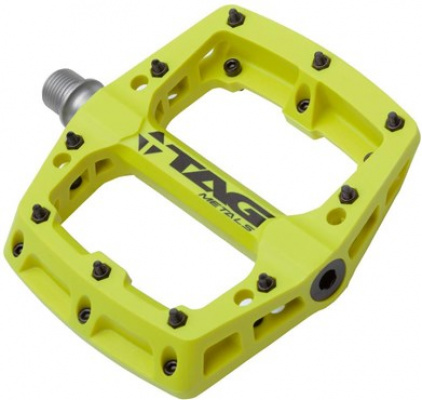
The platform design is dual-concave, which means your foot drops into a natural, cupped position rather than sitting flat on a slab. Pair that with a customisable 40-pin traction system per pair - pins available in varying heights to dial in grip to your preference - and your feet stay planted on wet-root, off-camber lines where a lesser pedal would have you dabbing. Mud clearance is generous too, with open body designs that don't pack up and turn into ice rinks halfway round a trail.
Underneath, the dual-bearing system combines sealed cartridge bearings with DU bushings to resist the grinding paste that UK grit and winter silt throw at moving parts. Bearings are a common failure point on cheaper pedals run through a British winter - TAG's approach is built to outlast that. Two main models, T1 aluminium and T3 nylon, cover most budgets and riding styles. Both share the same core engineering philosophy.
Prices and availability can change quickly. Delivery charges are not always included in listed prices.
Final price, stock status and delivery terms are set by retailer. We may receive a commission on purchases made.
Fitment and Thread Standards
TAG pedals run a standard 9/16" chromoly axle thread, so they'll fit every modern MTB crank you're likely to encounter - whether that's a mid-range alloy unit or a carbon XC item. No adapters, no drama. If you're running thick rubber crank boots for winter protection, just check there's enough clearance around the axle collar before you commit; it's a rare issue but worth a quick look.
Installation is straightforward, but two things matter. First, grease the threads before you torque them in - bare threads and an alloy crank arm is a corrosion trap after a wet season, and seized pedals are miserable to extract. Second, the left-hand pedal uses reverse threading (lefty tighty), which catches people out more often than it should. Mark them before you start, or check the L/R stamp on the axle. Snug them to around 35Nm and you're done.
T1 Aluminium vs T3 Nylon - Which One Suits You
TAG's two main flat pedal tiers solve different problems, and understanding the difference saves you buying the wrong one.
The T1 is the premium option. The body is extruded and CNC-machined from 6061 T6 aluminium - the same alloy grade used in quality stem and bar construction - which gives it a high strength-to-weight ratio and a notably thin profile underfoot. Thinner platform means more ground clearance on technical lines, and the stiff chassis transfers power cleanly without any of the flex you sometimes feel through nylon bodies on hard pedalling efforts. If you're riding enduro or bike park regularly, the T1's durability under sustained punishment justifies the step up in cost. The trade-off is that aluminium will show damage from rock strikes more visibly, and a hard enough hit can crack a platform rather than flexing through it.
The T3 uses an engineered nylon thermoplastic composite body, and that's not a budget compromise - it's a deliberate material choice. Nylon glances off rock strikes rather than gouging or cracking, which matters if your local trails involve the kind of rocky choke points where pedal strikes are inevitable. It's also lighter than a comparable alloy platform, which sounds counterintuitive given the price difference, but nylon genuinely competes on weight. The T3 is the one to reach for if you're riding aggressive trail routes on a tighter budget or you want a dedicated winter training pedal that you're not precious about. Think of it as the working tool in the range.
Both models share the dual-concave platform geometry and the 40-pin traction system, so the grip characteristic is consistent across the range. For context, DMR pedals occupy a similar bracket in terms of flat pedal pedigree, while Burgtec pedals lean more heavily into the premium alloy end. TAG sits confidently alongside both. If you want a UK-manufactured alternative, Hope pedals are worth comparing for bearing longevity specifically.
Surviving a UK Winter - Bearings, Grit, and Serviceability
British riding conditions are hard on pedal internals. Peak District grit in particular gets into bearing races and acts like lapping compound - you'll feel perfectly smooth pedals turn gritty inside a single season if the sealing isn't up to it. TAG's dual-bearing system addresses this directly. The sealed cartridge bearings handle the primary rotational load, while DU bushings at the outboard end absorb lateral force and act as a first line of defence against contamination. It's a belt-and-braces arrangement, and it holds up well through repeated wet-weather use.
The good news for maintenance is that TAG pedals are fully rebuildable. You don't need specialist tools - a hex key set and a socket to remove the chromoly axle is enough to get the internals out. Bearing replacement intervals depend heavily on how you ride and how often you clean your bike, but checking the spin and play every few months through winter is sensible practice. If you feel any roughness or lateral wobble, strip and regrease before the bearings are fully cooked - catching it early is far cheaper than a full axle replacement.
Traction pins are another maintenance point that's easy to overlook. After rock strikes, check that snapped pins are replaced promptly. Pins with mangled hex heads - where the socket can no longer get purchase - become impossible to remove cleanly, so it's worth carrying a couple of spares and swapping them before that point. Pin replacement is a two-minute job when the head is intact; it's a frustrating workshop session when it isn't.
If you're building a full TAG contact-point setup, the brand's TAG handlebars and TAG grips are worth looking at alongside the pedals - consistent platform feel from hands to feet makes a difference on technical riding.
TAG Pedals FAQs
Are TAG Metals pedals good for mountain biking?
Yes, and particularly for enduro and downhill where durability is non-negotiable. The dual-concave platform keeps your foot seated naturally, the 40-pin traction system bites hard on wet roots and loose loam, and the sealed bearing setup is engineered to handle the kind of sustained abuse that shorter-life pedals don't survive. They're a legitimate choice for serious MTB riding.
What is the difference between TAG T1 and T3 pedals?
The T1 is CNC-machined from 6061 T6 aluminium - stiffer, thinner profile, better suited to bike park and enduro where platform precision matters. The T3 uses a nylon composite body that's lighter, more affordable, and better at deflecting rock strikes without cracking. Both share the same concave geometry and pin system, so grip feel is consistent across the two.
How do you service TAG pedals?
TAG pedals are fully rebuildable with basic tools - a hex key set and the right socket to pull the chromoly axle. Once open, you can clean and regrease the sealed cartridge bearings and DU bushings, or replace them outright. Check pin condition at the same time and swap any snapped or damaged pins before the hex heads get too chewed to grip.