
Surly Touring Bikes
Surly touring bikes didn't rewrite the rulebook on long-distance riding - they just made it very hard to argue with steel done properly. Every complete bike in the range is built around proprietary 4130 CroMoly steel, obsessive braze-on counts, and geometry that stays sensible under a full load. That means comfort on a battered B-road, confidence on a muddy bridleway, and - crucially - the ability to find a replacement part in a bike shop in rural Portugal. These are bikes designed to go the distance in every sense.
The lineup splits broadly into tarmac-biased loaded touring and off-road bikepacking, so there's a meaningful choice to make before you buy. The Disc Trucker is the road-touring benchmark; the Bridge Club and Ogre push further off the beaten track. All three share the same core philosophy: carry more, go further, fix anything. If you want to start from scratch and spec your own build, our dedicated Surly frames page is the place to go. Otherwise, read on - the complete bikes are below.
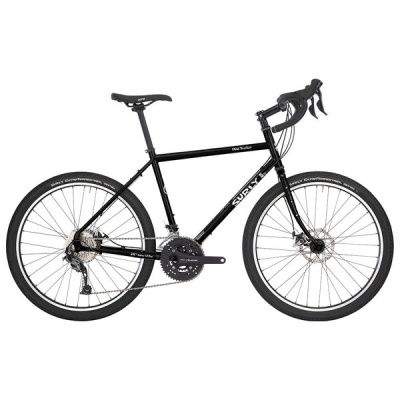
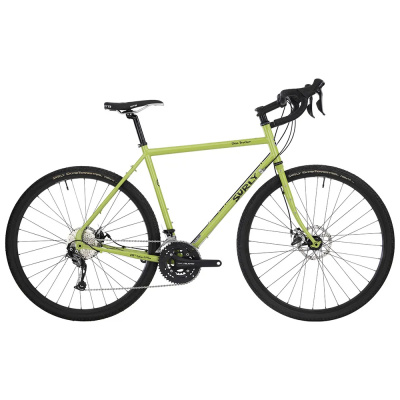
Prices and availability can change quickly. Delivery charges are not always included in listed prices.
Final price, stock status and delivery terms are set by retailer. We may receive a commission on purchases made.
Decoding the Surly Touring Lineup
Surly keeps the range focused, which makes the decision easier than it first looks. The Disc Trucker is the purist's loaded tourer - long-wheelbase, relaxed geometry, and built to swallow a full set of panniers without complaint. Think tarmac touring, coast-to-coast routes, and multi-week trips where reliability matters more than pace. It's the one you'd take across Europe. Components are spec'd for durability rather than weight savings: solid groupset choices, double-walled rims, and tyres with enough volume to take the sting out of potholed back roads.
The Bridge Club and Ogre are a different proposition. Both are geared toward mixed-surface and off-road bikepacking - the kind of riding where you're as likely to push through a flooded bridleway as roll along a canal towpath. The Bridge Club is the more accessible of the two: a versatile all-road rig with generous clearance and a broad range of gearing. The Ogre is the heavier-duty option - a 29er platform with wider tyre clearance, a more complex hub compatibility story, and a frame that genuinely doesn't care what you throw at it. If your routes include something like King Alfred's Way or the rougher sections of the Welsh National Cycle Network, the Ogre is worth the extra scrutiny. For pure off-road riding, take a look at our Surly mountain bikes page, and for gravel-specific builds, the Surly gravel bikes page covers that ground properly.
One thing consistent across the range: Surly doesn't dress these bikes up with flashy, lightweight componentry that'll need replacing after a hard season. The spec choices are deliberate - heavier, tougher, more repairable. You're not buying a race bike with mudguard eyes bolted on. That's a trade-off worth understanding before you compare gram counts with anything else in this price bracket.
The Tech That Makes a Surly a Surly
The frame is where Surly earns its reputation, and the details go deeper than "it's steel." 'Natch tubing is Surly's proprietary approach to tube selection - each frame size gets a specific blend of 4130 CroMoly with butting profiles tuned to that size. A size 46 and a size 64 don't just look different; they're engineered differently so the ride feel scales consistently across the range. That's not a given in steel frame production, and it's one reason Surly bikes don't feel wooden or sluggish at the smaller end of the size run.
Gnot-Boost rear spacing is one of those practical engineering decisions that sounds niche until you actually need it. The dropout geometry on Surly's off-road touring frames is designed to accept 135mm quick-release, 142mm thru-axle, or 148mm Boost hubs - in the same frame. That matters if you're building up a rig from parts, running mismatched wheel sets, or replacing a hub on the road with whatever's available. On a bike you might ride for a decade across multiple wheel builds, that flexibility is genuinely valuable.
Then there are the braze-ons. Surly riders tend to refer to them affectionately as barnacles, and the count is remarkable - bottle cage mounts on the fork legs, multiple top tube mounts, chainstay mounts for a third bottle or a frame bag anchor point. The point isn't to make the bike look busy; it's to give you options. You can configure a Surly to carry almost anything without resorting to cable ties and wishful thinking. Forward-facing horizontal dropouts on certain models add single-speed and fixed-gear compatibility into the mix, too.
Internally, every frame gets an ED (Electrophoretic Deposition) coating - an electrochemical primer applied inside the tubes before the paint goes on. It's genuine rust prevention from the inside out, not just a marketing footnote. For UK riding, that matters. Wet winters, damp garages, and the kind of persistent drizzle that doesn't stop for three months will find any weakness in a steel frame's internal protection over time. The ED coating buys you significant peace of mind, though we'd still suggest a shot of frame saver spray when you first get the bike - particularly if it's going to live outside or be ridden year-round.
Running a Surly in the UK
Sizing is the first thing to sort. Surly top tubes tend to run long relative to the stated frame size, which catches people out if they're used to more conservative European geometry. If you're between sizes or coming from a compact-geometry road bike, go hands-on with a size before committing - and factor in that a shorter stem is an easy, cheap fix if the reach feels stretched. A 90mm stem where the spec sheet says 110mm is not a big deal. Being uncomfortable for 600 miles is.
Tyre clearance is one of the more practical reasons to choose a Surly over the competition. The Disc Trucker runs up to 700x50c; the Bridge Club and Ogre go wider still. On the kind of B-road surfaces you'll find across much of rural England and Scotland - think cracked tarmac, loose chippings, the occasional surprise pothole that could swallow a wheel - that extra volume makes a tangible difference to comfort and confidence. You're not just absorbing bumps better; you're running lower pressures with less puncture risk. On muddier bridleways, the clearance keeps things moving rather than packing up.
Alternatives worth comparing include Genesis touring bikes and Kona touring bikes, both of which offer steel-framed options with their own takes on loaded geometry. Neither replicates the Gnot-Boost flexibility or the braze-on density of a Surly, but they're worth a look if you want a slightly more conventional build spec. The Surly difference is most apparent when you start planning for the long haul - multiple wheel builds, custom rack setups, ten-year ownership - rather than a single-season purchase.
To get your rig properly sorted for British conditions, it's worth pairing your bike with the right luggage from the start. Surly pannier racks are designed with these frames in mind, and Surly pannier bags are worth a look if you want a system that's been thought through as a whole rather than bolted together from different brands. The mounting geometry lines up, and the capacity is properly generous.
Surly Touring Bikes FAQs
Are Surly bikes good for touring?
Yes - Surly is widely regarded as a benchmark in the loaded touring and bikepacking category. The 4130 CroMoly steel frames are built to last decades, carry heavy loads without losing ride quality, and can be repaired with standard parts almost anywhere in the world. For long-distance touring, few brands match the combination of durability, practicality, and ride comfort.
What is the difference between the Surly Ogre and Bridge Club?
The Ogre is the heavier-duty off-road option - a 29er platform with wider tyre clearance, Gnot-Boost hub compatibility, and forward-facing horizontal dropouts that allow single-speed setups. The Bridge Club is more accessible and road-friendly, with a geometry better suited to mixed-surface bikepacking rather than genuinely rough trails. If your routes stay mostly on lanes and light tracks, the Bridge Club is the easier choice. If you're heading somewhere muddier and more technical, the Ogre is worth the extra consideration.
Did Surly discontinue the Long Haul Trucker?
Yes. Surly discontinued the rim-brake Long Haul Trucker in 2020. The Disc Trucker replaced it entirely, bringing disc brakes and updated geometry to the platform. For loaded touring - particularly in wet UK conditions where rim brakes struggle - the Disc Trucker is the better bike in almost every practical respect. The Long Haul Trucker's legacy is significant, but the Disc Trucker is the current standard.