
Riverside E-Bikes
Riverside E-Bikes sit at the heart of Decathlon's trekking and touring ecosystem, built for riders who need a dependable workhorse that handles the daily commute and weekend canal path adventures with equal composure. These electric hybrid bikes blend urban utility with light off-road capability, offering up to 120 km range on a single charge depending on the model and mode you choose. Removable lithium-ion battery 36V packs mean you can charge indoors without wrestling the whole bike upstairs, and integrated lighting systems keep you visible on those dark winter mornings through the Pennines or along the Taff Trail. The distinction between cadence sensor assist on entry-level models and torque sensor response on the mid-range Riverside 540 E trekking bike matters more than you'd think; the latter feels less like an on-off switch and more like a smooth amplification of your own effort. Hydraulic disc brakes and lockable suspension forks round out the package, giving you control when the towpath turns to gravel and the weather turns sour. If you're after a long range electric touring bike that won't leave you stranded halfway to the coast, Riverside delivers practical, repairable design without the boutique price tag.
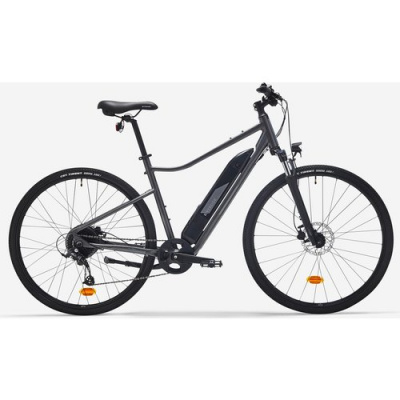
Prices and availability can change quickly. Delivery charges are not always included in listed prices.
Final price, stock status and delivery terms are set by retailer. We may receive a commission on purchases made.
Motor Efficiency & Battery Architecture
Riverside leans on brushless rear hub motors across the 500 and 540 series, tucked into the rear wheel to keep weight low and maintenance straightforward. The 36V systems typically range from 250 W nominal output - legal limit for UK e-bikes - with peak torque figures around 40 Nm on the 500 E and edging higher on the 540 E. Battery capacity sits between 418 Wh and 504 Wh depending on spec, and that translates to real-world range of roughly 90 km in Eco mode, 60 km in Normal, and 40 km when you lean on Boost. Decathlon's proprietary Battery Management System monitors cell health and temperature, extending lifespan and preventing the kind of sudden cut-outs that ruin a ride. Charge time hovers around four to five hours from flat, so an overnight top-up sorts you for the next day's commute or a Saturday loop through the New Forest.
Cadence sensors on the Riverside 500 E detect pedal rotation and trigger assist in steps; it's responsive enough for flat roads but can feel a touch binary when you're grinding up a steep bridleway. The torque sensor on the 540 E reads the pressure you apply to the cranks, modulating power delivery in real time. Feels more intuitive. You push harder, the motor pushes harder. That nuance makes a difference on mixed surfaces where you're constantly adjusting effort - think the lumpy lanes around the Cotswolds or the undulating paths of the Camel Trail. If you're considering a Carrera e-bike or a Boardman electric hybrid, compare sensor type first; it shapes the entire ride experience.
Geometry & Ergonomics for Long-Distance Trekking
Riverside frames adopt a 60-degree riding position - upright enough to scan traffic and hedgerows, forward enough to avoid wind resistance turning into a sail on exposed stretches. Trekking geometry means a longer wheelbase for stability when you're loaded with panniers, and a higher stack that keeps your wrists happy over three-hour rides. The lockable Suntour suspension fork up front offers 63 mm of travel on most models, enough to smooth out potholes and gravel chatter without the bobbing inefficiency of a full MTB fork. Lock it out on tarmac and you reclaim every watt; open it up on a rutted bridleway and your hands thank you.
Ergofit System saddles come standard, designed with a central relief channel to reduce pressure on soft tissue during long days in the saddle. Frame sizes span from small to extra-large, and the adjustable stem on some models lets you fine-tune reach without swapping parts. If you're used to a Riverside hybrid bike without electric assist, the added weight of the motor and battery - typically around 24 kg total - sits low and central, so handling stays predictable. You won't mistake it for a road bike, but it won't tip over when you lean it against a café wall either.
Load Capacity & Accessory Compatibility
Pannier rack compatibility is baked into every Riverside e-bike, with reinforced eyelets at the rear dropout and chainstay bridge rated for up to 25 kg of luggage. Front rack mounts appear on higher-spec models, opening the door to proper bikepacking setups or a week's worth of camping gear strapped across both ends. Mudguards come pre-fitted on most variants, full-length alloy jobs that keep spray off your back and your drivetrain cleaner when you're threading through November slop in the Brecon Beacons. Bottle cage mounts dot the downtube and seat tube, and some frames include a third set on the underside of the top tube for extended tours.
The structural weight limit - rider plus cargo - typically sits around 120 kg, so you've got headroom for a loaded pannier and a rucksack without stressing the frame. Cleanride anti-puncture technology appears on certain tyre specs, a 5 mm protective layer under the tread that shrugs off glass and thorns better than standard rubber. If you're planning a multi-day tour along the C2C or the Way of the Roses, this kind of utility matters more than a flashy paint job. Pair it with a Riverside touring bike for a non-electric backup, and you've got a versatile stable.
The Decathlon Trekking DNA
Riverside emerged as Decathlon's answer to riders who wanted more than a shopping bike but didn't need a full-suspension MTB. The brand leans on ISO 4210 testing standards - frame fatigue, impact resistance, brake performance - and designs for repairability rather than planned obsolescence. That means standardised components, widely available spares, and frame geometry that prioritises comfort over racing pedigree. It's not exotic, but it's honest.
Decathlon's in-house engineering runs prototypes through wet-chamber corrosion tests and vibration rigs that simulate thousands of kilometres of rough roads, so the welds and paint hold up when you're commuting year-round through Manchester drizzle or coastal salt spray. The B'Twin e-bike range shares some DNA - same parent company, similar philosophy - but Riverside skews towards longer rides and heavier loads. If you're cross-shopping against Cube e-bikes or Cannondale electric hybrids, you'll notice Riverside trades boutique cache for accessible pricing and a no-fuss parts catalogue. Hydraulic disc brakes, integrated lighting, and a two-year warranty come standard. Not glamorous, but it gets you home.