
Reserve Wheels Road Wheels
Reserve road wheels sit at a genuinely interesting crossroads: proper wind-tunnel aerodynamics, co-developed with Cervélo using real-world wind data, wrapped around a warranty that's about as close to bombproof as the industry offers. That last part matters more than it might sound on a sunny Tuesday - UK roads being what they are, a no-fault lifetime crash replacement policy is less a luxury and more a sensible insurance policy against the pothole lottery.
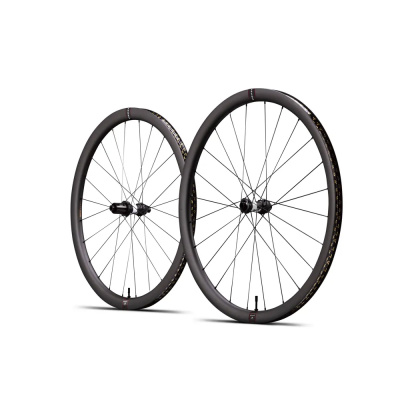
The carbon fiber rims use Reserve's proprietary Turbulent Aero Technology, which doesn't just optimise for a lab yaw angle nobody ever actually rides at. Instead, it accounts for the messy, variable wind conditions you'll find on an exposed coastal B-road or a ridge-top drag through the Dales. Pair that with a mixed-depth rim profile - shallower up front for stability, deeper at the rear for aerodynamic efficiency - and you've got a wheelset that doesn't make you fight the bike every time a lorry goes past.
Every Reserve carbon road wheelset is tubeless ready and built around DT Swiss hubs, with options spanning three hub tiers depending on your budget and how seriously you want to save grams. They're disc-brake specific across the range, so they're firmly aimed at modern builds. Fast, durable, and genuinely well thought-through - here's what you need to know before picking a pair.
Prices and availability can change quickly. Delivery charges are not always included in listed prices.
Final price, stock status and delivery terms are set by retailer. We may receive a commission on purchases made.
What Fits and What Doesn't: Standards at a Glance
Reserve carbon road wheelsets are disc-brake only - there's no rim-brake option in the current lineup, so if you're still running calipers, these aren't for you. Rotor attachment uses the Centerlock standard throughout, which is tidy, precise, and easier to torque correctly than six-bolt alternatives. Worth double-checking your rotor compatibility before you order.
Axle spacing follows modern convention: 12x100mm thru-axle up front, 12x142mm at the rear. Both are now effectively universal across road disc frames, but it's always worth confirming with your frame's dropout spec. Freehub bodies cover the two main camps - Shimano HG for 11- and 12-speed mechanical and Di2 groupsets, and SRAM XDR for 12-speed AXS. No Campagnolo option is listed in the current range, so Campy users will want to look elsewhere - DT Swiss road wheels cover that base if needed.
Rims are tubeless ready as standard, with internal widths optimised for tyre fitment in the 28c to 32c range - right in the zone most UK riders are running for a balance of rolling efficiency and compliance. Go narrower and you'll lose some of the aero benefit; go much wider and you're pushing beyond the rim's optimised profile. Stick to the 28 - 32c window and you're in good shape.
Making Sense of the Depth Numbers
Reserve names its wheelsets by rim depth - so a 34/37 has a 34mm front rim and a 37mm rear, a 40/44 goes slightly deeper, and the 52/63 is the full aero option with a meaningfully deep rear. That front/rear split is the key idea behind Reserve's mixed-depth approach: the shallower front rim keeps steering predictable when a crosswind catches you, while the deeper rear does the aerodynamic heavy lifting where it's less likely to destabilise the bike. It's a logical split, and one that ENVE and others have also leaned into - though Reserve's Turbulent Aero Technology was specifically co-developed with Cervélo to refine this balance using real-world wind data rather than purely idealised tunnel conditions.
For most UK riding - sportives, fast club runs, mixed-distance road work - the 34/37 or 40/44 profiles offer the most practical balance. The 52/63 is genuinely fast but you'll notice it on gusty days; save it for flatter, more sheltered routes or dedicated race days. If your riding takes you over exposed moorland passes, the shallower options give you more confidence without sacrificing much speed.
Hub spec is where the price tiers really separate. The entry point uses DT Swiss 350 hubs - robust, well-sealed, and about as reliable as hubs get at any price. Step up and you're into DT Swiss 240 territory, which brings the EXP Ratchet system: lighter, with a faster engagement feel that's satisfying on punchy accelerations. At the top of the range, DT Swiss 180 hubs with ceramic bearings keep rolling resistance minimal and save meaningful weight - this is the spec for riders who've already optimised everything else and want the final few watts. Compared to Cadex road wheels, Reserve's hub choice gives you a well-proven serviceability story rather than a proprietary system you'll struggle to find parts for.
Surviving UK Roads: Durability and Upkeep
British tarmac is an endurance test for any wheelset. Reserve's carbon layup is engineered for impact resistance - which helps when you clip a pothole edge on a wet descent - but the real safety net is the no-fault lifetime crash replacement warranty. That covers the original owner for the life of the wheel: crack a rim on a ride, and Reserve will replace it. No quibbling about how it happened. For UK riders who've written off expensive carbon hoops on a pothole they didn't see coming, that policy is worth factoring seriously into the value calculation.
Hub maintenance is straightforward. The DT Swiss Star Ratchet system used across the range strips down without specialist tools - you can pull the freehub, clean out winter grit and road muck, re-grease, and reassemble in under twenty minutes in your kitchen. That matters in January when your wheels are coated in whatever the roads have thrown at them. Bearing replacement is similarly accessible, with DT Swiss parts widely stocked by UK distributors. It's the kind of hub architecture you can actually maintain yourself rather than posting wheels off to a service centre every season.
If you're setting these up tubeless - and you probably should, given the puncture resistance and ride quality benefits - pair them with compatible valves. Reserve's own Fillmore high-flow valves are designed specifically for their rims and make initial tyre seating significantly less fraught. A floor pump with a high-volume blast is usually enough to seat the bead; no compressor required if the rim and tyre are reasonably well matched.
One honest trade-off: these are premium-priced carbon wheels, and the entry point reflects that. Riders who want Reserve quality but do most of their miles in winter might consider a dedicated set of alloy training wheels and keeping the Reserves for better conditions - though the lifetime warranty does reduce the anxiety of daily use. Worth also noting that the Reserve MTB wheel range follows a similar engineering philosophy if you're running two bikes.
Reserve Wheels Road Wheels FAQs
Are Reserve wheels any good?
Yes - they're consistently well-regarded for aerodynamic stability and build quality. The Turbulent Aero Technology was co-developed with Cervélo using real-world wind data, which means the profiles are tuned for actual riding conditions rather than idealised lab scenarios. Combined with DT Swiss hubs and a no-fault lifetime warranty, they represent a serious long-term investment rather than a spec-sheet gamble.
What hubs do Reserve road wheels use?
Reserve road wheels are built around DT Swiss hubs across the range. Depending on which wheelset you choose, that's either the DT Swiss 350 (reliable, robust workhorse), the DT Swiss 240 with EXP Ratchet engagement (lighter and faster-engaging), or the DT Swiss 180 with ceramic bearings at the top of the range. All are serviceable with standard tools and have excellent parts availability in the UK.
How does the Reserve wheels lifetime warranty work?
Reserve's no-fault lifetime crash replacement covers the original owner for the life of the wheel. If you crack or break a rim while riding - pothole, crash, whatever - they replace it. There's no fault assessment or excess to navigate. It's transferable context worth knowing: this covers rim damage from riding incidents, not manufacturing defects (which are handled separately).