
Redshift Sports Pedals
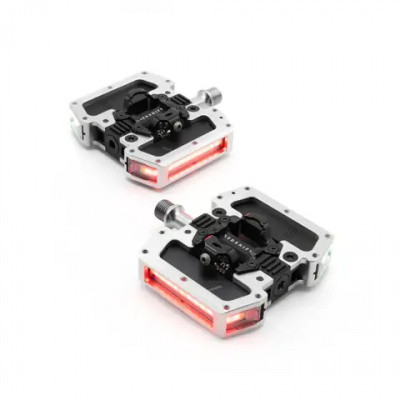
Redshift Sports pedals have done something genuinely clever: they've turned the pedal itself into a safety device. The Arclight series integrates high-output LED modules directly into the pedal body, creating a 360-degree side-on light signature that moves with your legs - that biological, strobing motion catches a driver's eye far faster than a static rear light ever will. Redshift claims up to 57% improved visibility over standard setups, and looking at how the lights sweep through the pedal stroke, it's easy to see why.
The range splits into two clear camps. The standard Arclight flat pedal suits everyday urban commuting in regular shoes - cast aluminium, grippy enough, no fuss. The Arclight PRO steps things up with a CNC aluminum body, replaceable traction pins, and your choice of flat or dual-sided SPD compatible clipless, which opens the door for gravel riders and winter training cyclists who want foot retention without sacrificing the integrated lighting. Both use standard 9/16 inch thread chromoly spindles and sealed cartridge bearings, so fitting them to any adult road, commuter, or gravel bike is straightforward. For short UK winter days when it's dark by half four, these aren't a gimmick - they're a considered answer to a real problem.
Prices and availability can change quickly. Delivery charges are not always included in listed prices.
Final price, stock status and delivery terms are set by retailer. We may receive a commission on purchases made.
Fitting Redshift Pedals: What You Need to Know Before You Buy
Every Redshift pedal uses the industry-standard 9/16 inch thread, which covers the vast majority of adult bikes - road, commuter, gravel, hybrid. If you're riding a child's bike or an older BMX with a one-piece crank, those use a 1/2 inch thread and won't accept these. Worth checking before you order.
Installation is straightforward, but there's one step worth doing properly: apply a thin smear of anti-seize compound or waterproof grease to the spindle threads before you fit them. UK winters throw road salt and standing water at your drivetrain constantly, and aluminium cranks in particular can cold-weld to a dry steel spindle over a few months of winter riding. A few seconds with a tube of copper slip now saves a lot of grief with a pedal spanner come spring. Left pedal is reverse-threaded - loosen it clockwise, tighten it anti-clockwise - which catches people out more often than it should.
For the Arclight PRO Clipless, the system uses Shimano SPD two-bolt cleats, the same standard found on the vast majority of commuter and mountain bike shoes. If your shoes already have SPD cleats fitted, you're clipping in on day one. If you're coming from Look road pedals or Crank Brothers egg-beaters, you'll need to swap shoes or cleats - SPD and those systems don't cross over.
Standard Arclight vs. Arclight PRO: Which One Is Actually for You
The standard Arclight flat pedal is the one to pick if you're riding to work in whatever shoes you happen to be wearing. Cast aluminium body, a reasonable platform size, enough grip for normal footwear on dry days. The LED modules slot in magnetically and the SmartSet Technology handles orientation automatically - white light faces forward, red light faces rearward, regardless of which way you clip the module in. That auto on/off technology detects motion too, so the lights activate when you start pedalling and switch off when you stop. No fumbling with buttons in the dark.
The Arclight PRO is a different proposition. CNC-machined from aluminium rather than cast, which means tighter tolerances, a stiffer platform, and a cleaner finish. The replaceable traction pins are the detail that matters most here - you can swap them out as they wear, or adjust pin height to tune grip to your preference. That's the kind of feature that appeals to riders doing longer miles or riding in worse conditions than a dry school run, and it's why the PRO sits comfortably alongside flat pedal options from DMR aimed at more committed riders.
The dual-sided clipless PRO version adds SPD compatible engagement on both faces, so you don't have to think about flipping the pedal to find the clip-in side - relevant when you're setting off at a junction in the dark. Gravel riders and winter commuters who already use SPD shoes will find this the most capable version in the range. If you're building out a full Redshift setup, it pairs naturally with their ShockStop stems and suspension seatposts for a comfort-focused commuter build.
One honest trade-off: the integrated LED modules add some weight compared to a bare-platform pedal of similar spec. If you're racing crits or obsessing over grams, these aren't your pedal. But for anyone whose priority is being seen on dark commutes or winter training loops, the weight consideration is beside the point.
Keeping Them Running Through a UK Winter
The magnetic USB rechargeable light modules are rated IP64, which means they handle heavy rain and road spray without complaint. Riding through a proper Welsh downpour or a grim Manchester commute - fine. Deliberately submerging them in a deep ford crossing - less fine, and not what the rating covers. For the overwhelming majority of UK road and commuter riding, the weatherproofing is genuinely adequate.
Charging is magnetic, so the modules pull cleanly off the pedal body, plug into any USB port, and are back to full in around two hours. It's a sensible system: no exposed charging ports on the pedal itself to clog with mud, and you can charge both modules simultaneously at your desk while the bike sits ready to go. Worth getting into the habit of a weekly top-up rather than waiting for them to die mid-commute.
The sealed cartridge bearings in the spindle are built for longevity, but road grit and salt will find their way in eventually - they always do. Check for play in the pedal body every couple of months by grabbing the pedal and rocking it laterally. Any looseness is a sign the bearings are ready for attention. More practically: keep the magnetic module slots clear of dried mud. Compacted grit in those slots stops the modules seating flush, which affects both the charging connection and the light output. A quick brush-out after a muddy ride takes ten seconds. The chromoly spindles are corrosion-resistant but not immune - a wipe down after salt-road exposure will keep threads in good shape for the long term.
If you want to compare the overall durability proposition against a more traditional flat pedal alternative, MKS pedals have a strong reputation for bearing longevity and repairability, though without any integrated lighting. The Redshift approach trades some of that mechanical simplicity for the safety function - a reasonable exchange for most commuters. Round out your visibility setup with appropriate Redshift grips to keep the cockpit cohesive.
Redshift Sports Pedals FAQs
How long does the battery last on Redshift Arclight pedals?
Runtime depends on the mode you use. Eco Flash stretches to 36 hours, standard Flash gives you around 11 hours, and Solid mode runs for roughly 3 hours. A full recharge via the magnetic USB connection takes about 2 hours, so topping them up overnight before a run of dark winter commutes keeps you covered.
Are Redshift Arclight pedals waterproof enough for UK winters?
The light modules carry an IP64 water and dust resistance rating, which means heavy rain, road spray, and winter grit aren't a problem. They're not rated for full submersion, so deep river crossings are best avoided. For everything a typical UK commute or training ride throws at them, they hold up well.
Do Redshift pedals come in a clipless version?
Yes. The Arclight PRO is available in a dual-sided clipless version using the Shimano SPD two-bolt cleat standard - the same system on most commuter and MTB shoes. Both faces engage, so there's no hunting for the right side at a cold junction. Flat and clipless PRO versions are available depending on your preference.