
Profile Design Saddles
Profile Design saddles are built around one specific problem: how do you stay comfortable and planted when your pelvis is tipped so far forward that a conventional saddle becomes genuinely painful? If you've ever shuffled around on the nose of a road saddle during a time trial, you'll know exactly what we mean. Profile Design's answer is a saddle shaped from the outset for the aggressive pelvic rotation demanded by TT and triathlon riding - not adapted from a road design, but purpose-built for the position.
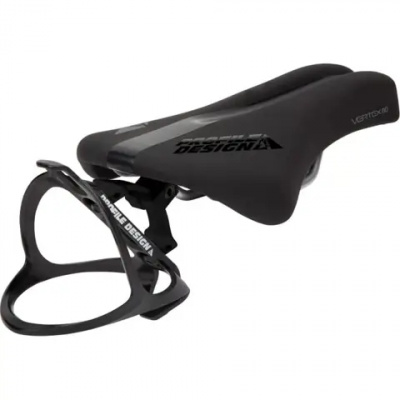
The Vertex cut-out sits at the heart of the range, relieving soft tissue pressure precisely where it builds on a steep seat tube. Anti-slip micro-fibre covers keep you in your aero tuck without requiring constant repositioning - useful when you're deep in a 40km effort and your hands are locked on the extensions. Composite shells are optimised for 78 - 80 degree seat tube angles, so the geometry of the saddle actually matches the geometry of the bike beneath you.
Whether you're targeting a club 10 on a converted road bike or racing on a full triathlon rig, getting the saddle right is foundational. Compare the Vertex lineup below to work out which model fits your setup.
Prices and availability can change quickly. Delivery charges are not always included in listed prices.
Final price, stock status and delivery terms are set by retailer. We may receive a commission on purchases made.
Rails, Clamps, and What Fits What
Profile Design saddles run on 7x7mm standard round rails, available in either CrMo or titanium depending on the model. The good news is that 7x7mm round rails fit the overwhelming majority of seatpost clamps - side-clamp, top-down, aero post cradles - so compatibility is rarely an issue if you're running a conventional setup.
The one situation worth flagging before you order: if your current saddle uses 7x9mm oval carbon rails - common on higher-end road saddles from brands like Fizik - you'll need to swap your seatpost clamp ears before fitting a Profile Design. Your local mechanic can sort this in minutes, but it's worth checking ahead rather than discovering it in the car park on race morning.
Fore-aft adjustment follows standard limits, typically around 20 - 25mm of travel depending on your post. When torquing the clamp, work to the seatpost manufacturer's spec - most aluminium and carbon posts sit in the 4 - 6Nm range for saddle clamps, and over-tightening is one of the fastest ways to crack a carbon cradle or damage rail finish. A small dab of carbon assembly paste on the rails helps prevent creep without needing excessive clamping force.
Understanding the Vertex Lineup
The core question most riders arrive with is: Vertex or Vertex 80? The answer comes down to your bike's seat tube angle. The standard Vertex is shaped for bikes running a 78-degree seat tube angle - which covers a lot of traditional TT bikes and older triathlon frames. The shell geometry positions the padding and cut-out to support pelvic rotation at that angle, so the relief lands where it needs to.
The Vertex 80 is optimised for modern triathlon frames built around an 80-degree seat tube angle. These steeper geometries have become the norm in contemporary tri bike design, and a saddle calibrated for 78 degrees will sit subtly wrong on them - rotating the pressure point forward and potentially putting you back in discomfort territory. If your bike was designed in the last four or five years, there's a reasonable chance the Vertex 80 is the correct call. Check your frame spec sheet if you're unsure; it's usually listed under geometry data.
Within each model, the rail choice shifts the character of the saddle. CrMo rails keep the cost down and are genuinely durable - they're not a compromise if you're not chasing every gram. Titanium rails save meaningful weight over CrMo and offer a small but noticeable reduction in buzz transmitted through the saddle from road surface noise. On a smooth circuit or velodrome it's barely relevant. On a rough UK B-road during a regional championship 25, that damping adds up over an hour. If you're comparing Profile Design against alternatives like ISM or Fabric at similar price points, the titanium rail versions stack up well on weight-to-durability ratio.
It's also worth pairing your saddle choice with the right cockpit - Profile Design aero bars are engineered alongside these saddles, so the stack and reach assumptions built into both tend to complement each other. Dial one in and you've got a sensible baseline for dialling in the other.
Keeping Your Saddle in Good Shape Through a UK Winter
Two things will age a TT saddle faster than race mileage: indoor trainer sweat and British road grit. Both are worth thinking about before winter, not after.
Sweat is surprisingly corrosive - more so than rain - and during heavy Zwift blocks it drips directly onto the rails and into the clamp interface. CrMo rails will surface rust if left damp; titanium rails are more resistant but not immune to pitting at contact points over time. The fix is simple: keep a small towel folded over the top tube and wipe the rails and clamp area down after every indoor session. It takes thirty seconds and meaningfully extends the life of both the rails and the clamp hardware. A light coating of Muc-Off or similar corrosion protector on CrMo rails every few weeks of heavy indoor use doesn't hurt either.
The anti-slip micro-fibre covers on Profile Design saddles do a solid job of keeping you locked into position during an aero tuck, but micro-fibre and road grit are not friends. On wet UK time trials - and there are plenty of those, from club evening 10s to open events on exposed dual carriageways - the cover picks up fine debris that acts like mild sandpaper over time. Clean it with a damp cloth and mild soap; avoid scrubbing brushes or anything abrasive. Harsh cleaners will strip the grip texture from the surface, which is the one thing you're paying for. Let it air dry rather than sitting in a damp kit bag.
If you're running Profile Design hydration on your TT setup, the same care logic applies - rinse and dry regularly, because neglect compounds fast on kit that sits in the same damp bag week after week.
Profile Design Saddles FAQs
How do I choose a triathlon saddle?
Start with <strong>sit bone width</strong> and pelvic rotation. In a TT or tri position, your pelvis tips forward significantly, shifting pressure onto soft tissue rather than sit bones. You need a saddle with a <strong>perineal relief cut-out</strong> and a profile shaped for that rotated posture - not a road saddle with a cut-out bolted on. Profile Design saddles are built specifically around <strong>78 - 80 degree seat tube angles</strong>, so the geometry actually matches where your body sits.
What is the difference between Profile Design Vertex and Vertex 80?
The <strong>Vertex</strong> suits bikes with a <strong>78-degree seat tube angle</strong> - traditional TT frames and older tri bikes. The <strong>Vertex 80</strong> is shaped for modern triathlon frames running an <strong>80-degree angle</strong>, where the steeper geometry demands a different shell profile to keep the cut-out and padding in the right place. Fit the wrong one and you'll likely feel it within the first twenty minutes.
Are Profile Design saddles compatible with standard seatposts?
Yes. Profile Design saddles use <strong>7x7mm round rails</strong> in CrMo or titanium, which fit the vast majority of standard seatpost clamps. One exception: if you're switching from a saddle with <strong>7x9mm oval carbon rails</strong>, you'll need to swap the clamp ears on your seatpost. It's a quick job for a mechanic, but worth sorting before you're standing in the car park with an incompatible clamp.