
PRO Build MTB Wheels
Pro Build MTB wheels sit at an interesting crossroads: hand-built construction and proven component pairings at a price that won't have you wincing on the drive home. If you've been running a stock wheelset that came with your bike, swapping to a properly laced set makes a more tangible difference than most riders expect - stiffer under load, more consistent through rough stuff, and far easier to keep true over a winter's worth of Peak District grit and Welsh mud.
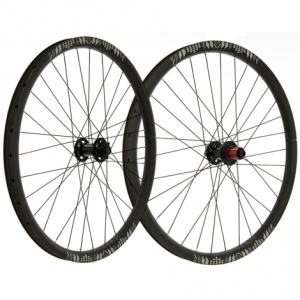
Pro Build wheelsets pair durable alloy rims - often Alexrims - with dependable hubs from the likes of Shimano or Chosen, then lace them with double-butted stainless steel spokes by hand. That process matters. Even spoke tension from the off means the wheel beds in predictably and stays true longer than a machine-built equivalent. Most modern options in the range are also tubeless ready, so you can run lower pressures on slick roots without worrying about pinch flats.
Use our filters below to match axle spacing, freehub standard, and rotor mount to your specific frame and drivetrain. Whether you need a Boost-spaced rear or a quick-release front, there's likely a Pro Build option that slots straight in.
Prices and availability can change quickly. Delivery charges are not always included in listed prices.
Final price, stock status and delivery terms are set by retailer. We may receive a commission on purchases made.
Will They Fit? Axle Standards, Spacing, and Rotor Mounts
Getting compatibility right before you buy saves a lot of faff. The most common split you'll encounter with Pro Build MTB wheels is between Boost and non-Boost spacing. Boost rear wheels run a 148x12mm thru-axle and push the flanges outward for a stiffer, more triangulated spoke angle - most trail and enduro frames from around 2016 onwards use it. Non-Boost rear spacing is 142x12mm, still common on older frames and some XC builds. At the front, Boost is 110x15mm versus the non-Boost 100x15mm. If your frame has Boost dropout spacing and you fit a non-Boost wheel, it won't seat correctly - check your frame's spec sheet if you're unsure.
Legacy quick-release options (135mm rear, 100mm front) do still appear in the Pro Build range for riders on older hardtails or budget builds that haven't moved to thru-axles. They're less stiff under braking loads, but perfectly functional for cross-country use or lighter trail riding.
Freehub body compatibility is the other thing to nail down before you order. Shimano HG freehubs cover 8- through 11-speed cassettes and a handful of 12-speed options - the most common fitment across UK trail bikes. If you're running Shimano 12-speed (think Deore or SLX M6100 and above), you'll need a Micro Spline freehub body, which has a smaller spline diameter. SRAM 11- and 12-speed cassettes use the XD driver standard instead - that's a threaded fitment, not a splined one, and the two are not interchangeable. Double-check which drivetrain you're running before selecting a Pro Build wheelset, because swapping a freehub body later is doable but adds cost and time.
Finally, sort your brake rotor mount. 6-bolt is the older standard - six small bolts clamp the rotor directly to the hub flange. Centerlock uses a splined interface and a lockring (like a cassette lockring), which is generally cleaner and quicker to swap. Most Shimano hubs use Centerlock; many budget and third-party hubs use 6-bolt. Both work well, but you'll need the right rotor to match.
Choosing the Right Pro Build Wheelset for Your Riding
Pro Build's range broadly splits into two camps, and picking the wrong one for how you ride is the most common mistake. Entry-level XC and light trail wheels typically feature narrower internal rim widths - around 25 - 28mm - which suits 2.2 - 2.4in tyres nicely and keeps the rotating weight down. These are laced with standard-gauge spokes to hubs like the Shimano HB-MT400 or similar, and they're well suited to cross-country riding, smooth flow trails, or riders who spend more time pedalling than dropping into chunkier stuff. Think a dry Sunday on the South Downs rather than a wet, rocky slog through Gisburn Forest.
The heavier-duty options - aimed at enduro and aggressive trail use - step up to 30mm or wider internal rim widths. A wider internal width supports a larger tyre carcass more squarely, improving cornering stability and allowing you to run lower tubeless pressures without the tyre folding unpredictably mid-corner. These wheels are laced with thicker-gauge spokes, often double-butted stainless steel, and paired with sealed cartridge bearing hubs that cope better with repeated immersion in mud and standing water. If you're regularly riding technical natural trails or bike park laps, this is where to look.
Internal rim width is worth understanding because it directly shapes how your tyre performs. The same 2.4in tyre mounted on a 25mm internal rim will feel rounder and narrower than on a 30mm rim, where it spreads out flatter for better traction and a lower centre of gravity. It's not a marginal difference - it changes the character of the ride noticeably. If you're comparing Pro Build options against something like Halo MTB wheels or Mavic MTB wheels, check internal widths alongside price - you'll often find Pro Build competitive on rim spec at a lower price point.
For riders after a step up in hub quality and engagement feel, Hope MTB wheels and DT Swiss MTB wheels represent the next tier - faster freehub engagement, serviceable in your garage, and made in the UK or Switzerland respectively. They cost more, but they're worth considering if longevity and hub performance are priorities over upfront value.
Keeping Pro Build Wheels Running Through a UK Winter
The Peak District throws a specific problem at hub bearings: grit suspended in water acts like grinding paste, working into races and eating through surfaces faster than pure mud ever would. Sealed cartridge bearings in the better Pro Build hubs handle this reasonably well, but they're not immortal. After a harsh winter season - roughly October to March if you're riding regularly - it's worth pressing out the old bearings and fitting new ones. Cartridge bearings are cheap, and the job takes twenty minutes with a basic bearing press or a socket set and a vice.
Cup-and-cone hubs, which appear on some lower-spec Pro Build builds using standard Shimano front hubs, are actually easier to service in the field. You can clean, re-grease, and re-adjust the cones with a cone spanner and a rag. They take slightly more attention than cartridge units, but a well-maintained cup-and-cone hub can outlast a neglected cartridge design.
New hand-built wheels always need a bedding-in period. Spoke tension settles as the lacing geometry loads up under real-world use, and most wheelbuilders will tell you the first 50 miles are critical. After that initial period, check the tension around the wheel with a spoke key - a consistent ping tone all the way round is what you're after. Any spokes that have gone slack will let the rim drift out of true. It's a five-minute job to re-tension them before they cause a problem.
If your freehub starts skipping under hard pedalling effort - that stuttering feeling when you punch out of a corner - it's usually the pawls. Clean out the freehub body with a degreaser, dry it thoroughly, and re-grease with a light oil or specific freehub grease. Heavy grease slows pawl engagement in cold weather, which is worth remembering on January morning rides. Freehub engagement is one of those things riders don't notice until it goes wrong, then it's all they can think about.
Tubeless setup on Pro Build rims is straightforward on the tubeless-ready models. Apply two layers of tubeless rim tape, fit your valves, and seat the tyre with a track pump or compressor before adding sealant. Rim bead retention on alloy rims is generally reliable, though off-camber roots at low pressures will test any setup - if you're dropping below 20psi on a 2.4in tyre, make sure your tape job is airtight and your sealant is fresh.
PRO Build MTB Wheels FAQs
Are Pro Build MTB wheels tubeless ready?
Most current Pro Build MTB wheels use tubeless-ready rims, but check the specific model's rim spec before assuming. You'll still need to add tubeless rim tape, valves, and sealant yourself - they don't come pre-set up. If the listing doesn't state tubeless-ready explicitly, it's worth confirming with the retailer.
What freehub body do I need for Pro Build mountain bike wheels?
Match the freehub to your cassette standard. Shimano HG covers 8- to 11-speed and some 12-speed cassettes. Shimano Micro Spline is required for 12-speed Shimano drivetrains (M6100 and above). SRAM XD is the standard for 11- and 12-speed SRAM cassettes. Getting this wrong means your cassette simply won't fit.
Can I convert my Pro Build wheels to Boost spacing?
It depends on the hub laced into your specific wheelset. Some hubs accept Boost end cap conversion kits, which reposition the axle contact points to 148mm rear or 110mm front spacing. Standard Shimano cup-and-cone hubs cannot be converted this way. Check the hub model first - the Pro Build listing or retailer should be able to confirm compatibility.