
Princeton Carbonworks Road Wheels
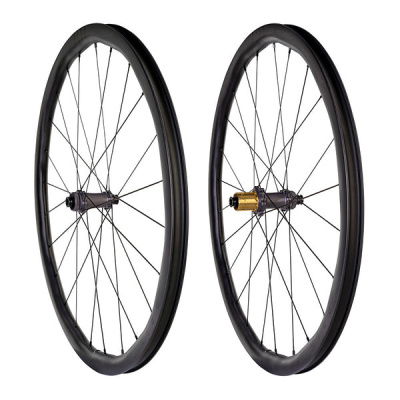
Princeton CarbonWorks road wheels are among the most technically distinctive wheelsets on the market, built around a sinusoidal rim profile that makes them instantly recognisable - and genuinely different under load. That wavy rim isn't a styling exercise. It varies in depth continuously around the hoop, giving you the aerodynamic punch of a deep-section wheel while shedding the skittish handling that catches riders out on exposed British lanes when the wind cuts sideways across an open ridge.
Every current road model uses a hole-less rim bed, which means no rim tape required for tubeless setup - just mount, inflate, and seal. The carbon layup is engineered to handle extreme spoke tension without the rim pulling out of true, which matters more than it sounds when you're pushing hard watts into a stiff rear triangle. Hub options span Tactic Racing, DT Swiss 180, and Chris King, so you're not stuck with a house-brand bearing you can't service locally.
Whether you're chasing grams on a mountain stage, drilling it in a crit, or just want a wheelset that doesn't flinch on a wet A-road in November, there's a Princeton CarbonWorks build here worth comparing.
Prices and availability can change quickly. Delivery charges are not always included in listed prices.
Final price, stock status and delivery terms are set by retailer. We may receive a commission on purchases made.
Compatibility and Standards: What Fits Where
Most Princeton CarbonWorks disc brake wheelsets run standard 12x100mm front and 12x142mm rear thru-axle spacing - the norm across modern road bikes, so fitment is rarely an issue. Where you do need to pay attention is the freehub body. Shimano HG is available in both 11- and 12-speed variants, but if you're running SRAM AXS or any 12-speed SRAM drivetrain, you'll need the XDR freehub. Campagnolo riders aren't left out either - the N3W freehub body covers their 12-speed groupsets. Getting this wrong means the wheel arrives, looks beautiful, and then sits in your hallway while you wait for a swap. Check your drivetrain before ordering.
Disc rotor mounting is almost exclusively Centerlock on current Princeton CarbonWorks disc models. That's the cleaner, more precise standard - it uses a splined interface with a lockring rather than six bolts - and it's what DT Swiss 180 and Tactic Racing hubs use natively. If your rotors are 6-bolt, a Centerlock adapter solves it for a few pounds; worth factoring in.
The hole-less rim bed is worth flagging here too. There's no drilling through the carbon structure, so there's no tape required and no gap for sealant to pool and degrade. Tubeless installation is straightforward: seat the tyre, pour in sealant, inflate. The sealed rim surface also adds a measurable degree of lateral stiffness, which you feel as directness off the bar in corners.
Wake, Peak, and Where Each One Makes Sense
Princeton CarbonWorks road wheels split broadly into two performance characters. The Peak 4550 is the climbing wheel - 45mm at its deepest, 50mm at certain points around the profile, keeping overall weight low while still delivering more aerodynamic efficiency than a traditional shallow rim. If you spend your Sundays on rolling routes through the Dales or grinding up long Welsh passes where rotating mass is the enemy, the Peak 4550 is the one to compare. It's also the more manageable wheel on tight, technical descents where rim depth starts to feel like a sail.
The Wake 6560 sits at the other end of the spectrum - 60mm minimum, 65mm at peak depth. This is the wheel for flat-road power, race circuits, and anyone whose Strava segments run across the Fens rather than up them. The sinusoidal profile does real work here: crosswind stability on a 65mm rim is noticeably better than a conventional deep-section at similar depth, which is part of what makes Princeton CarbonWorks stand out against alternatives like ENVE road wheels or Cadex road wheels at this depth. You're not fighting the bar every time a lorry passes.
The Dual 5550 sits between them - a variable 55-50mm profile that suits riders who want one wheelset across a full season rather than swapping between builds. It won't be the fastest option in a flat TT, and it won't be as light as the Peak when the road kicks up, but it's a solid all-season choice. DT Swiss road wheels and Lightweight road wheels occupy similar endurance-oriented territory if you want broader comparison points.
If you're looking at mixed-surface or off-road use rather than tarmac, these aren't the wheels for that job - have a look at our Princeton CarbonWorks gravel wheels page instead, where the build spec and tyre clearance are set up for that kind of riding.
Keeping Them Running Through a UK Winter
British riding doesn't do Princeton CarbonWorks any favours between October and March. Flint-heavy B-roads, chalk slurry, and the general grime of a wet commute or club run test bearings and rim surfaces hard. The good news is that the hole-less rim bed removes one common failure point entirely: no tape means no moisture wicking under the strip and no sealant eating through adhesive over a winter season. It's a genuine practical advantage, not just a weight saving.
Hub choice, though, is where you need to think. Tactic Racing hubs are superb for race days - low drag, high engagement, very light - but they're not what you'd spec a bike for riding through winter grit on Dartmoor week after week. For year-round UK use, DT Swiss 240 or DT Swiss 180 builds are the more sensible option. The bearing seals are excellent, the ratchet system is rebuildable at home with a basic toolkit, and replacement parts are stocked by most UK distributors. Chris King hubs take that further - their preload adjustability and seal quality are benchmark - but you pay for it. Reserve the lightest Tactic Racing builds for summer race season; use a DT Swiss-laced set for everything else.
On freehub maintenance: if you're running a high-engagement ratchet hub and notice any slipping under hard acceleration, the culprit is almost always old grease in the ratchet mechanism. A clean-out with isopropyl alcohol and a fresh application of the correct grease - light for DT Swiss EXP, heavier for older star-ratchet designs - usually resolves it immediately. It's a ten-minute job and saves you from a stripped freehub body. Worth doing at the start of each season rather than waiting for the slip.
Tubeless sealant is worth refreshing every four to six months in UK conditions - the latex breaks down faster in cold and damp. Top up through the valve core rather than breaking the bead each time; it takes two minutes and keeps the setup airtight without disturbing a well-seated tyre.
Frequently Asked Questions
Are Princeton CarbonWorks wheels tubeless compatible?
Yes. Current Princeton CarbonWorks road wheels use a proprietary hole-less rim bed, making them tubeless-ready without rim tape. The sealed surface creates a naturally airtight base - just mount your tubeless tyre, add sealant, and inflate. No tape means no tape failures, and no gap for sealant to pool and degrade over time.
What hubs do Princeton CarbonWorks wheels use?
Princeton CarbonWorks don't manufacture their own hubs. Instead, they build around premium third-party options: Tactic Racing, DT Swiss 180, DT Swiss 240, Chris King, and White Industries are all available depending on the model and build spec. That's a meaningful advantage - you're choosing a hub you can actually service and source parts for locally.
Why do Princeton CarbonWorks wheels have a wavy rim?
The sinusoidal rim profile varies in depth continuously around the circumference. Aerodynamically, this reduces the steering torque generated by crosswinds - the force that makes deep rims feel unstable in gusty conditions. Structurally, the wave geometry adds lateral stiffness to the rim without extra carbon weight, so the wheel resists distortion under high spoke tension and hard cornering loads.
Princeton Carbonworks Road Wheels FAQs
Are Princeton CarbonWorks wheels tubeless compatible?
Yes. Current Princeton CarbonWorks road wheels use a proprietary hole-less rim bed, making them tubeless-ready without rim tape. The sealed surface creates a naturally airtight base - mount your tubeless tyre, add sealant, and inflate. No tape means no tape failures and no pooling sealant degrading adhesive over time.
What hubs do Princeton CarbonWorks wheels use?
Princeton CarbonWorks build around premium third-party hubs rather than in-house designs. Options typically include Tactic Racing, DT Swiss 180, DT Swiss 240, Chris King, and White Industries depending on model and spec. That matters practically - you're choosing a hub with readily available service parts and UK distributor support.
Why do Princeton CarbonWorks wheels have a wavy rim?
The sinusoidal rim profile varies continuously in depth around the hoop. This reduces steering torque from crosswinds - the force that makes conventional deep rims feel unstable in gusts - while delivering aerodynamic efficiency across a range of yaw angles. The wave geometry also stiffens the rim laterally without adding carbon weight.