
Princeton Carbonworks Gravel Wheels
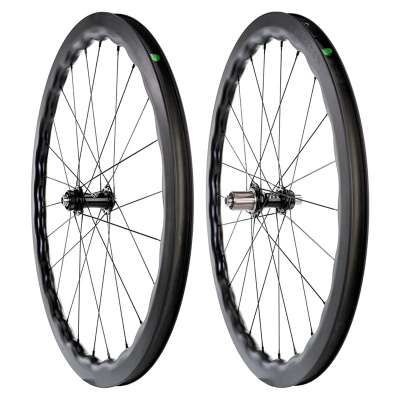
Princeton CarbonWorks gravel wheels have built a serious reputation among riders who want measurable performance gains without sacrificing stability when the wind cuts across an exposed moor. The defining feature is the sinusoidal rim profile - a variable-depth, wave-shaped cross-section that isn't just eye-catching. It actively manages aerodynamic drag while keeping steering predictable in crosswinds that would have a deep-section road wheel hunting across the lane. That matters on the kind of open, flinty bridleways and coastal tracks UK gravel riders know well.
The hole-less tire bed is equally clever. By removing the spoke holes from the rim's inner channel entirely, Princeton eliminates the need for tubeless rim tape. No tape means no tape failures, no sealant seeping into spoke nipples, and a noticeably cleaner tubeless setup. If you've ever wrestled a leaking rim tape off a carbon wheel in a cold garage, you'll appreciate exactly what that's worth.
Construction is full carbon, with layups tuned for the kind of stiffness gravel riding demands - accelerating out of a gate, holding a line over rough pack, resisting the lateral flex that robs you of power on a long drag. Hub options span from respectable entry-level builds right up to the featherweight Tactic Racing internals. There's a wheelset here for riders who want the best, and the specs to justify the spend.
Prices and availability can change quickly. Delivery charges are not always included in listed prices.
Final price, stock status and delivery terms are set by retailer. We may receive a commission on purchases made.
Compatibility and Fitting Standards
Princeton CarbonWorks gravel wheels run on 12x100mm front and 12x142mm rear thru-axle standards - the current norm across modern gravel and adventure bikes, so compatibility with recent framesets is rarely a headache. Disc braking is via Centerlock rotor mount, which suits the majority of Shimano groupsets directly and works with SRAM AXS rotors using a standard adapter. Worth double-checking that your rotor diameter matches your caliper spec before you order, particularly if you're running an older frame with limited caliper adjustment.
Freehub body options cover the main groupset families: SRAM XDR for 12-speed SRAM, Shimano HG for 11-speed Shimano, Shimano MicroSpline for 12-speed Shimano, and Campagnolo N3W. That breadth means you're not locked into a single drivetrain path, which is genuinely useful if you're speccing a new build or planning a future groupset swap.
One compatibility point that often comes up in conversation: Princeton CarbonWorks uses a traditional hooked rim design across the gravel range. That means you're not subject to the strict tyre pressure and brand restrictions that apply to hookless rims. You can run whatever tyre you like - ENVE gravel wheels moved to hookless early and some riders still find the compatibility chart restrictive. With Princeton, that's not a conversation you need to have. The internal rim width on the Grit 4540 sits at 25mm, which pairs well with 38 - 45mm tyres for the balance of rolling efficiency and compliance most UK gravel riders end up settling on.
The Model Range: Grit 4540 Versus Dual 5550
The Grit 4540 is the gravel-focused wheelset - 40mm deep front, 45mm rear, built specifically around the demands of mixed-surface riding. The asymmetric depth is deliberate: the deeper rear section aids aerodynamics on open roads and hard pack, while the shallower front keeps handling manageable when a gust comes in off the coast or across a high moorland crossing. Tyre clearance runs from 30mm up to 50mm, which makes it genuinely versatile. Packing a 40mm file tread for a fast audax one weekend and a chunkier 47mm for a wet Peaks adventure the next is entirely within its range.
The Dual 5550 sits closer to the all-road end of the spectrum - 55mm front, 50mm rear - with a bias towards faster, more road-influenced riding. If your gravel riding leans heavily towards long tarmac connectors with occasional dirt, it's worth considering. For proper mixed-surface work, the Grit 4540 is the more balanced choice and the one most UK riders in our comparisons gravitate towards. The Princeton CarbonWorks Grit 4540 review coverage across the specialist press consistently highlights its crosswind composure as a standout quality, which the sinusoidal profile deserves credit for.
Hub choice is where the pricing tiers open up. The standard build options - White Industries or DT Swiss 240 - are excellent. The DT Swiss 240 uses the Ratchet EXP engagement system, with 36 points of engagement and straightforward serviceability. Moving to DT Swiss 180 saves meaningful weight and brings ceramic bearing options into play, with the same Ratchet system underneath. The Tactic Racing hub upgrade is Princeton's proprietary option and the most interesting: conical engagement geometry, ultra-light alloy internals, and a level of refinement that's immediately apparent when you spin the wheel. The engagement is crisp and the weight penalty over even the DT 180 is minimal. If you're building a genuinely lightweight carbon gravel wheelset and weight is a priority, Tactic Racing hubs are the logical endpoint. Cadex gravel wheels offer a comparable hub quality at this level, though the rim tech differs significantly.
Surviving UK Conditions: Mud, Grit, and Maintenance
British gravel riding is hard on wheels. Flinty chalk tracks in the South Downs, deep clay on North Downs bridleways, the kind of grit that gets into everything on a winter Peak District loop - bearings feel it first, then spokes, then rims. Princeton's hole-less tire bed removes one vulnerability that often goes unnoticed until it's too late: tubeless sealant has no spoke hole channels to seep into, so your spoke nipples and rim bed stay cleaner for longer. That's not a minor point if you're riding through December and January.
Hub maintenance intervals vary by build. DT Swiss 240 and 180 hubs use the Ratchet system, which is field-serviceable with basic tools - a greased ratchet ring replacement takes minutes once you've done it once, and DT recommends servicing every 5,000km or annually for winter riders. Tactic Racing internals are slightly more involved to strip, so a workshop visit for the annual service makes more sense unless you're comfortable with precision hub work. Bearings in any hub will suffer more quickly in winter conditions; ceramic-bearing builds shed water slightly better, but no bearing is invincible against salt and silt. Rinse hubs after muddy rides, avoid pressure-washing directly at the seals, and you'll extend service intervals noticeably.
The carbon layup on Princeton's gravel range is built with durability in mind rather than being shaved to the absolute minimum. CX-Ray spokes - bladed, cold-drawn, and well-proven across cyclocross and gravel racing - handle road shock and the lateral load of cornering on loose surfaces better than round spokes of equivalent weight. That said, if you're regularly riding technical singletrack or genuinely rocky ground, a burlier all-mountain wheelset is the more honest choice. As a gravel and fast mixed-surface wheel, Princeton builds to the right spec. Compare that philosophy with DT Swiss gravel wheels or Parcours gravel wheels and you'll find Princeton sits at the performance-weight end rather than the bomb-proof-tourer end of the market.
If you're already running Princeton CarbonWorks on the road side, it's worth knowing that the same hub standards and bearing specs carry across - Princeton CarbonWorks road wheels share much of the same build logic, so your mechanic won't need a separate learning curve.
Princeton Carbonworks Gravel Wheels FAQs
Are Princeton CarbonWorks gravel wheels tubeless ready?
Yes. The Grit 4540 uses a hole-less tire bed, which means there are no spoke holes in the rim channel and no rim tape required. The tubeless setup is clean, secure, and removes the common failure point of tape degrading under sealant. It's one of the more mechanic-friendly tubeless implementations in this category.
What is the maximum tyre size for the Grit 4540?
Princeton quotes the Grit 4540 as optimised for tyres between 30mm and 50mm wide, which covers the bulk of UK gravel riding scenarios comfortably. The hard limit in practice is your frame and fork clearance - check those measurements before going above 45mm, particularly on older or tighter-fitting frames.
Do Princeton CarbonWorks wheels use hookless rims?
No. Princeton CarbonWorks runs a traditional hooked rim design across the gravel range. That means broader tyre compatibility, no strict pressure ceilings tied to specific tyre brands, and no compatibility chart to cross-reference before mounting a tyre. It's a deliberately conservative choice that keeps your options open.