
Minoura Regular Turbo Trainers
When November turns the roads into a dark, greasy mess, Minoura regular turbo trainers give you a straightforward, no-fuss way to keep the legs turning. No complicated electronics, no subscription required - just a wheel-on magnetic trainer that clamps on, powers up, and gets you working. These are the trainers you buy because they do exactly what they promise.
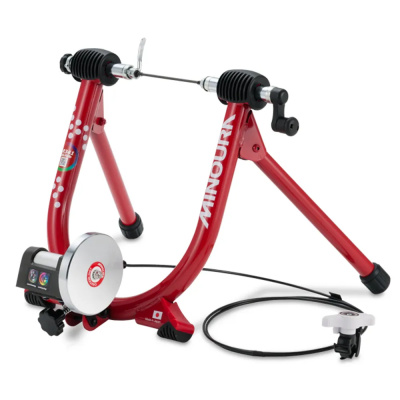
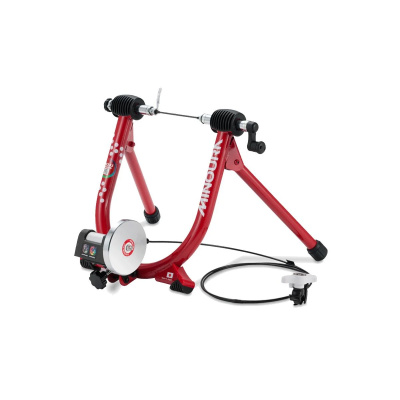
At the heart of every Minoura wheel-on unit is the Magturbo system, built around Neodymium magnets that generate smooth, progressive resistance without any moving parts wearing against each other. You shift resistance from the handlebar-mounted remote - typically a seven-level dial or lever - so you can spike the load mid-interval without taking your hands off the bars. It's a genuinely usable system, not an afterthought.
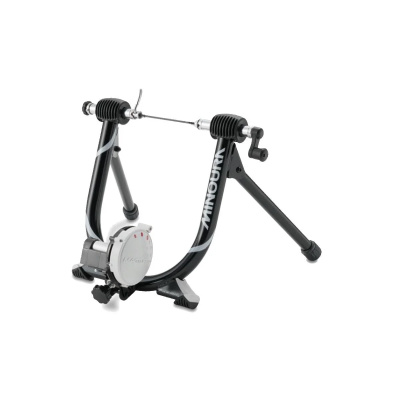
The U-shape steel frame sits rock-solid on the garage floor, and when you're done the whole thing folds flat. That matters if you're in a terraced house in Manchester or a flat with about three square metres of spare floor. Quick-release skewer compatibility is standard, with thru-axle adapters available for disc-brake bikes. Whether you're grinding through base miles in January or warming up before a club race, Minoura's magnetic trainers offer consistent, adjustable resistance without the premium cost of a direct-drive unit.
Prices and availability can change quickly. Delivery charges are not always included in listed prices.
Final price, stock status and delivery terms are set by retailer. We may receive a commission on purchases made.
Bridging Analogue Resistance to Virtual Riding
One of the most common questions we hear is whether a regular trainer can work with Zwift. It can. Minoura regular turbo trainers don't broadcast power data on their own, but pair your bike with a Bluetooth or ANT+ speed and cadence sensor and Zwift will calculate estimated virtual power - zPower - using the trainer's known resistance curve. It's not the same as a strain-gauge power meter, but for base training and structured efforts it's more than adequate. Setting up a Minoura turbo trainer for Zwift takes about ten minutes once the sensor is mounted and paired.
The experience is essentially the same on TrainerRoad or Wahoo's app: the platform reads your speed, maps it to the resistance curve, and outputs a watts figure. Gradient changes won't auto-adjust - you're shifting the remote manually - but for riders doing steady-state work or following a plan that cues resistance levels, that's a workable approach. If you want automatic gradient simulation and a built-in power meter, that's a different category entirely. Minoura smart turbo trainers handle all of that without the manual fiddling - worth a look if your training gets more structured.
Resistance, Noise, and Living With a Wheel-On Trainer
The Magturbo system uses Neodymium magnets - the same high-grade rare-earth magnets you find in quality audio equipment - to generate resistance by increasing the magnetic field around a flywheel. No friction, no pads wearing down, no fluid to leak. You get seven distinct Minoura magnetic trainer resistance levels via the handlebar remote, ranging from a light spin to something that'll have you standing on the pedals within seconds. The steps between levels are noticeable but not jarring, so mid-session adjustments feel natural.
Now, the honest bit: Minoura wheel-on trainer noise is a real consideration. Wheel-on units are louder than direct-drive trainers - there's no getting around tyre hum and the vibration transferred through the frame into your floor. In a detached garage it's irrelevant; in a first-floor flat in Bristol it's a conversation worth having with your neighbours. A good trainer mat underneath the unit absorbs a significant chunk of that vibration and protects your floor. For neighbours directly below, a foam mat plus a trainer tyre makes a meaningful difference. If you're comparing options, Elite regular turbo trainers and Tacx regular turbo trainers sit in a similar noise bracket - wheel-on is wheel-on regardless of brand. To cut the racket and protect your road rubber, browse our Minoura turbo accessories for dedicated trainer tyres and mats that make a genuine difference.
Clamping Up, Fitting Your Bike, and Storing the Thing
Setup is simpler than most people expect. Swap your rear skewer for the heavy-duty steel one supplied by Minoura - don't skip this step. Lightweight alloy or carbon skewers aren't designed for the clamping loads a trainer applies, and a slipping wheel mid-session is at best annoying and at worst a fall. Slide the rear axle into the trainer's cups, tighten them down until there's no lateral movement, then wind the roller drum forward until it presses firmly against the tyre. Too loose and the tyre spins; too tight and you'll heat the tyre faster and add unnecessary rolling resistance. A firm, even contact is what you're after.
If your bike has thru-axles - common on most disc-brake road and gravel bikes made in the last five years - you'll need a Minoura thru-axle adapter. Check your axle standard before ordering: 12x100mm, 12x142mm, and 15mm formats all exist. Minoura's adapter range covers the common sizes, but it's worth confirming compatibility rather than assuming. Riders coming from older rim-brake bikes with standard quick-release dropouts will find the standard setup completely straightforward.
The U-shape steel frame is deliberately overbuilt - it doesn't flex under hard efforts and the wide stance keeps things stable even when you're grinding out of the saddle. When you're done, the legs fold in and the whole unit slides under a bed, behind a sofa, or into the kind of narrow cupboard that UK houses specialise in. That compactness is genuinely useful. If you want somewhere to hang the bike when it's not clamped in, Minoura storage stands and hooks are worth pairing with the trainer. And if you'd rather skip the wheel-on format entirely and work on pedalling technique, Minoura rollers are worth considering alongside. For any replacement parts - roller drums, skewers, resistance knobs - the Minoura turbo spares range keeps older units running without a full replacement.
Against similarly priced wheel-on options from Saris regular turbo trainers, Minoura's Magturbo units tend to feel mechanically solid rather than clever. There's no progressive magnetic curve that simulates road feel - what you get is reliable, consistent resistance that responds to your input. For riders who want to train hard indoors without a complicated setup, that's a reasonable trade.
Minoura Regular Turbo Trainers FAQs
How do I set up a Minoura turbo trainer?
Swap your bike's standard rear skewer for the heavy-duty steel skewer Minoura supplies. Slot the axle into the trainer's locking cups, tighten until there's no lateral play, then wind the roller forward until it makes firm, even contact with the tyre. The whole process takes under five minutes once you've done it once.
Can I use a Minoura regular turbo trainer with Zwift?
Yes. Fit a Bluetooth or ANT+ speed and cadence sensor to your bike, connect it to Zwift, and the platform uses your speed data alongside Minoura's known resistance curve to calculate estimated virtual power - called zPower. It's not as precise as a dedicated power meter, but it works well for structured base training and general riding.
Do I need a special tyre for a Minoura turbo trainer?
You can use a standard road tyre, but a dedicated indoor trainer tyre is strongly recommended. Trainer tyres use a harder rubber compound that handles the heat generated by the roller contact, which reduces noise noticeably and stops your good road rubber wearing into a flat spot after a few sessions.