
Lapierre E-Bikes
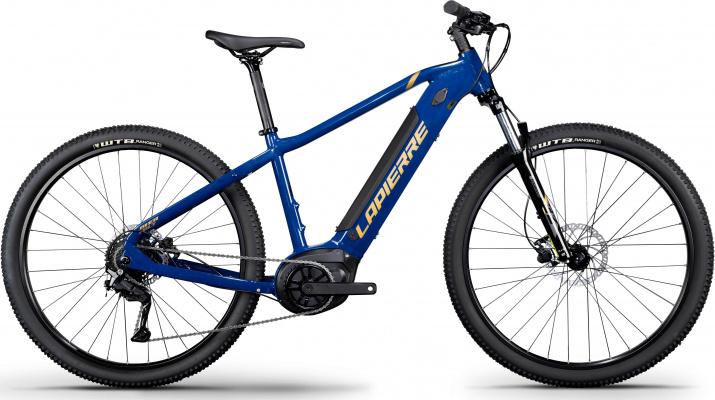
Lapierre E-Bikes sit in a distinct corner of the market - French engineering with a serious racing pedigree, shaped in part by downhill legend Nicolas Vouilloz. What sets them apart isn't just the hardware; it's how these bikes are designed to move. Their pioneering GLP (Gravity Logic Project) chassis philosophy pulls the battery mass low and tight above the motor, so the bike corners and responds more like a well-sorted acoustic trail bike than a hefty e-MTB. That counts for a lot when you're picking lines on a loose Brecon descent or threading roots in the Thetford dark.
The range splits cleanly into two camps. On one side you've got the Overvolt family - full-power e-MTBs running Bosch Performance Line CX or Yamaha motors, built for riders who want enduro-level capability with a motor doing the climbing. On the other, the E-Zesty runs a compact Fazua Ride 60 system, keeping weight down and ride feel natural. There's also the E-Sensium for drop-bar and urban riders who want battery assistance without the bulk of a trail rig.
Looking to replace or upgrade your power source? Head over to our dedicated Lapierre E-Bike Batteries page for compatible Bosch, Yamaha, and Fazua units.
Prices and availability can change quickly. Delivery charges are not always included in listed prices.
Final price, stock status and delivery terms are set by retailer. We may receive a commission on purchases made.
Making Sense of the Model Families
Lapierre keeps things structured, but the naming takes a minute to decode. The Overvolt range is the full-power e-MTB lineup, and it splits into two sub-families: AM (All-Mountain) and TR (Trail). Overvolt AM models carry more travel and are pitched at riders who spend their days on chunky enduro routes - think steep, loose, and long. The TR variants are trimmed down slightly for faster, more flowing trail riding where agility matters as much as raw capability.
Then there's the E-Zesty. This is Lapierre's lightweight e-MTB, running the Fazua Ride 60 motor system and a carbon frame. It's aimed squarely at riders who want pedal-assisted trail riding without the bike feeling like it's wearing a backpack full of bricks. If you've ever ridden a full-fat e-MTB and wished it felt 5kg lighter mid-corner, the E-Zesty is answering that exact question.
At the other end of the spectrum, the E-Sensium covers drop-bar road and flat-bar urban riding - a cleaner, more commuter-and-sportive-friendly proposition that shares the brand's attention to frame design without the aggressive MTB geometry.
Trim levels follow a numerical system: a 5.6 sits lower in the range with spec suited to riders building into the platform, while an 8.6 gets higher-tier suspension and drivetrain components. Higher number, sharper build kit. Simple enough once you know the pattern. If you're weighing up alternatives, Cube E-Bikes and Cannondale E-Bikes offer comparable range structures worth benchmarking against.
What the GLP Chassis Actually Does
The Gravity Logic Project is the piece of engineering that most Lapierre riders end up talking about, and it's worth understanding properly. Most e-MTBs integrate the battery into the downtube, which pushes mass upward and forward. Lapierre's GLP design moves the battery to sit directly above the motor unit - low in the frame, centred between the wheels. The result is a lower centre of gravity and less front-end heaviness when you're trying to steer precisely through technical sections.
It's the difference between a bike that tips into corners willingly and one that needs convincing. On something like the North York Moors, where the trail drops away fast and the berms are often loose, that responsiveness is tangible - even if you're reading about it from trusted test coverage rather than personal saddle time.
The asymmetrical carbon rear triangle is another deliberate choice. One side is shaped to maximise stiffness under power, the other gives clearance for the motor unit. It's not aesthetic; it's a packaging solution that also stiffens the chassis where it matters most during hard pedalling efforts.
For the full-power Overvolt models, Lapierre pairs GLP with the Bosch Performance Line CX - still one of the most capable motor systems available, with strong low-cadence torque for grinding out climb after climb. The E-Zesty uses the Fazua Ride 60 instead. Fazua's system is notably compact and light, which lets Lapierre build the E-Zesty into genuine lightweight territory. The trade-off is raw power output - Fazua delivers a more subtle assist that suits riders who want the bike to feel mostly like a bike, with a helpful nudge rather than a shove. Worth knowing before you spec up.
The mullet wheel setup - 29-inch front, 27.5-inch rear - on long-travel Overvolt models is another considered geometry decision. The larger front wheel rolls over obstacles more easily while the smaller rear keeps the bottom bracket height and handling balance where Lapierre's kinematics want it. It's become a standard approach in enduro e-MTBs, and Lapierre's implementation is well-dialled. Also worth exploring is their Lapierre road bike range if you're building a broader quiver.
Riding a Lapierre in British Conditions
The GLP frame design opens up the area around the motor and battery more than a traditional downtube-battery layout. That's a positive for weight distribution, but it does mean muck accumulates in places you need to flush properly after a winter session. A decent hose-down around the motor housing and battery contacts after riding somewhere like the Quantocks in November isn't optional - it's just part of the routine. Keep a brush handy for the crevices.
The asymmetrical pivot bearings on the rear triangle are doing real work in the wet. British grit - particularly the fine, silica-heavy stuff you pick up in the Peak District or around Glentress - finds its way into bearing interfaces faster than you'd expect. Keeping those pivots greased through the wet months extends service intervals considerably and stops that grinding creak developing mid-ride. Check them when you check your brake pads.
Cold-weather battery performance is worth factoring in too. Lithium cells lose capacity when temperatures drop, and the integrated battery design on Lapierre e-MTBs means you'll want to store the bike somewhere it doesn't freeze overnight before a big day out. If you're regularly riding in single-figure temperatures, pulling the battery and keeping it indoors the night before makes a noticeable difference to range.
The mullet geometry on the Overvolt pays genuine dividends on steep, rutted UK enduro tracks - the kind of greasy chutes you find at trail centres in South Wales or on natural routes in the Lakes. The shorter rear end pivots quickly, the bigger front wheel absorbs square-edged hits without deflecting, and the overall balance means you're not fighting the bike to keep it pointed where you want it. For anything outside the MTB space, it's a different conversation entirely.
Lapierre E-Bikes FAQs
Are Lapierre e-bikes any good?
They're well regarded, particularly the e-MTB range developed alongside Nicolas Vouilloz. The GLP chassis design gives Lapierre e-bikes genuinely strong handling for the category - weight distribution is more considered than most rivals, and the bikes respond predictably under load. Trusted test coverage consistently rates them among the better-handling options in both the full-power and lightweight e-MTB segments.
What motor does Lapierre use in their e-bikes?
It depends on the model. Full-power Overvolt e-MTBs run Bosch Performance Line CX or Yamaha motor systems, both tuned for strong torque output. The E-Zesty uses the compact Fazua Ride 60, which prioritises light weight and a more natural pedal feel over outright power. Check the specific model's spec sheet - the motor choice shapes the bike's character significantly.
How much does the Lapierre E-Zesty weigh?
Top-spec carbon E-Zesty models come in around 18 - 19kg, which puts them well below most full-power e-MTBs that often push past 24kg. The lighter build comes from the Fazua Ride 60 system's compact size combined with a carbon frame. That weight difference is noticeable when you're manoeuvring on technical trail sections or loading the bike into a van.