
FSA Power Meters
FSA Power Meters - specifically the Powerbox range - give you structured, data-driven training without demanding the kind of budget that makes your eyes water. The key to their credibility is under the spider: Power2Max-engineered strain gauges sitting at the heart of every unit, measuring total power output from both legs rather than estimating from one side and doubling it. That distinction matters when you're trying to pace a long drag in the Dales or hold a target watt figure through a TrainerRoad block on a January evening.
Dual ANT+ and Bluetooth Smart (BLE) broadcasting means you're not buying into a closed ecosystem. Garmin, Wahoo, Hammerhead - whatever's on your bars already pairs cleanly, no adapters, no workarounds. The system accuracy sits at plus or minus two per cent, which is tight enough for serious training load tracking and FTP testing. And the BB386EVO spindle standard means compatibility runs wide across modern road and gravel frames. If you've been putting off the jump to power-based training because the numbers felt intimidating or the kit felt fiddly, the Powerbox range is a genuinely accessible way in.
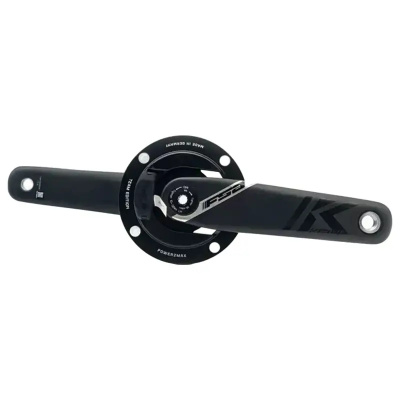
Prices and availability can change quickly. Delivery charges are not always included in listed prices.
Final price, stock status and delivery terms are set by retailer. We may receive a commission on purchases made.
Connectivity, Protocols and What Plugs In
The dual-band setup here is worth understanding properly rather than just ticking a box. ANT+ handles the reliable, low-latency broadcast your Garmin or Wahoo head unit expects - the kind of rock-solid signal that doesn't drop mid-interval when you're eight watts over threshold and your hands are shaking. Bluetooth Smart (BLE) runs simultaneously, so your phone, a Hammerhead Karoo, or a Wahoo ELEMNT can all pick up the feed without you changing any settings. You're broadcasting to both protocols at once, which means no pairing conflicts if you swap computers between bikes.
The Power2Max internals also open the door to firmware upgrades that unlock more granular metrics - left/right pedal smoothness and torque effectiveness among them - if your head unit supports the advanced data fields. Not every rider needs that level of detail, but it's there when your training evolves. Zwift and TrainerRoad read the power signal cleanly over BLE, so your indoor sessions and outdoor rides share the same data baseline. That consistency is what makes TSS and training load comparisons actually meaningful. If you're considering alternatives, Stages Power Meters offer a left-only option at a lower entry point, and Garmin Power Meters go further with advanced dynamics - but neither matches the Powerbox's combination of proven spider-based measurement and accessible price bracket.
Accuracy, Battery Life and Keeping a Spare in Your Saddlebag
Spider-based measurement captures the total power you're putting through the drivetrain - both legs, one reading, no algorithmic guesswork. The plus or minus two per cent accuracy figure is consistent with what independent testing of Power2Max-based systems has shown over the years, and it holds across a wide temperature range, which matters when you're riding in February and the thermometer is dipping toward zero on the Pennines.
Runtime sits between 300 and 400 hours on a single CR2450 coin cell. For most club riders doing eight to ten hours a week, that's roughly a month of solid riding before you need to think about a swap. The CR2450 is a standard coin cell - available in any pharmacy or supermarket - so carrying a spare in your saddlebag takes up no meaningful space and costs almost nothing. There's no proprietary charger to forget, no cable to hunt for the night before a sportive. One thing worth noting: CR2450 batteries can lose voltage faster than their spec suggests in genuinely cold conditions, so keep an eye on the battery indicator on your head unit during winter training blocks rather than waiting for it to drop out mid-ride. Your head unit will flag a low battery warning well in advance if you've set it up correctly - don't ignore it. Compared to rechargeable pedal-based options like Quarq Power Meters, the coin cell approach is simpler and more field-serviceable, even if it lacks the convenience of USB charging.
Installation, Frame Fit and Surviving a British Winter
Getting a Powerbox fitted isn't a workshop job if you're reasonably comfortable with basic drivetrain maintenance. The BB386EVO spindle standard covers a wide range of modern road and gravel frame bottom bracket shells, though it's worth double-checking your specific shell format before ordering - press-fit variants need the right FSA Bottom Bracket to seat correctly. Torque the crank bolts to spec (the documentation is clear on this), run the zero-offset calibration, and you're ready to ride.
Chainring compatibility is governed by BCD - Bolt Circle Diameter - so if you're running non-standard ring sizes or planning to change gearing, check the BCD on your specific Powerbox spider against the FSA Chainrings range before mixing and matching. Getting the BCD wrong means the rings simply won't bolt on. If you're unsure, the FSA Tools range includes what you need for a clean install.
The IPX7 waterproof rating means the unit can handle submersion to one metre for up to 30 minutes - which is substantially more than anything British weather is likely to throw at it on a wet Wednesday in the Chilterns. The battery door seal is the one component worth inspecting periodically; keep it clean and free of grit and it'll do its job without fuss. Winter road spray, standing water, and relentless drizzle are not a concern. The electronics are properly sealed, not just splash-resistant.
One honest trade-off: the Powerbox doesn't offer independent left/right power balance as a standard feature on all variants - you get total power from the spider, not a per-leg split unless the specific model and firmware support it. For most riders training to power zones, that's not a limiting factor. If bilateral analysis is central to your training plan, check the spec of the exact model you're considering.
FSA Power Meters FAQs
How do I calibrate my FSA Powerbox?
Run a zero-offset calibration through your paired head unit before every ride. Position the drive-side crank arm pointing straight down at the 6 o'clock position with no weight on the pedals, then trigger the calibration from your computer's sensor menu. It takes about five seconds and keeps your data honest.
What battery does the FSA power meter use and how long does it last?
The Powerbox runs on a standard CR2450 coin cell - the kind you'll find in any supermarket or pharmacy. Expect 300 to 400 hours of riding time before it needs replacing. In cold UK winters, keep an eye on the battery indicator on your head unit, as low temperatures can shorten runtime noticeably.
Is the FSA Powerbox compatible with Garmin and Wahoo?
Yes. The Powerbox broadcasts simultaneously over both ANT+ and Bluetooth Smart (BLE), so it pairs cleanly with Garmin, Wahoo, and Hammerhead computers, as well as indoor training apps like Zwift and TrainerRoad. No adapters needed - just search for it in your device's sensor pairing menu.