
Festka Road Bikes
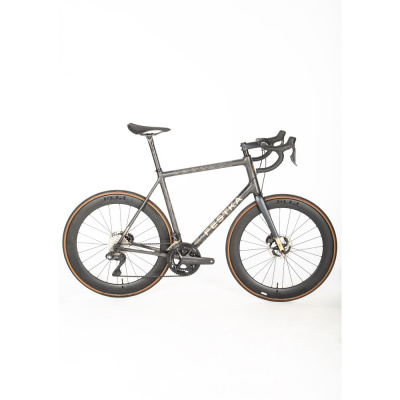
Festka road bikes occupy a rare corner of the market where aerospace composite engineering meets handbuilt craftsmanship - and the result is something mass-production simply can't touch. Every frame leaves a small workshop in Prague, built to your geometry, your riding style, and your aesthetic choices. These aren't catalogue bikes with a paint option tacked on; they're genuinely bespoke objects, each one different from the last.
The lineup covers distinct disciplines without overlap. The Scalatore is a dedicated climber - featherlight, compliant, the sort of frame that makes a long drag through the Dales feel manageable. The Spectre flips the priorities entirely: maximum stiffness, raw power transfer, built for riders who want to sprint hard and feel every watt go somewhere useful. The ONE sits between them as a balanced all-day race frame, and the Doppler blends titanium and carbon for riders after something genuinely singular. Because Festka works primarily in framesets, your groupset and wheelset choices - Shimano Dura-Ace, SRAM Red, whatever suits - define the final build as much as the frame itself. Compare UK prices on Festka framesets and full builds below.
Prices and availability can change quickly. Delivery charges are not always included in listed prices.
Final price, stock status and delivery terms are set by retailer. We may receive a commission on purchases made.
Decoding the Festka Road Lineup
Getting your head around the Festka range is straightforward once you understand that each model has a specific purpose rather than a vague marketing position. The Scalatore is the climber. It's built around low weight and a degree of vertical compliance that takes the edge off rough tarmac - useful when your favourite cols involve more patched B-road than smooth Alpine asphalt. If your Strava is full of long ascents and you're chasing every gram, this is the one to look at first.
The Spectre is a different animal. Stiffness is the priority here - laterally, torsionally, through the bottom bracket - so that when you put power down in a sprint or surge out of a corner, none of it is wasted. It's not uncomfortable, but it doesn't chase compliance the way the Scalatore does. Think of it as the frame you'd want if your riding involves fast club chains, criteriums, or you simply like the feeling of absolute connection to the road. Riders who've spent time on comparable stiff-framed machines from Factor or Cervélo will find the Spectre sits in similar philosophical territory, though the construction method is quite different.
The ONE is where most riders end up when they want a Festka but aren't committed to an extreme. It handles a day in the hills and a fast road race without feeling like a compromise in either direction. And then there's the Doppler - a titanium and carbon hybrid that's genuinely unlike anything else in the boutique frameset market. The titanium lugs bring a subtly different flex characteristic to the carbon tubes, and the aesthetic is striking in a way that polished monocoque frames rarely are. It's worth knowing about even if it's not the obvious first choice for pure performance.
Because Festka deals in framesets rather than complete bikes off a size run, the "trim levels" are whatever you build around the frame. Dura-Ace Di2 with a set of carbon deep-sections is one version; SRAM Red AXS with climbing wheels is another. That flexibility is part of the appeal, though it does mean you need a clear picture of your total budget before you start specifying.
How Festka Actually Builds Their Frames
The technical core of a Festka is its partnership with CompoTech, a Czech composite specialist whose work sits closer to aerospace and motorsport than to conventional bicycle manufacturing. Most carbon road frames - including expensive ones from well-known brands - use pre-preg carbon sheets pressed in moulds. It's a proven, efficient process, but it does constrain shapes and layup options because everything is designed around fixed tooling.
Festka's tubes use a continuous-fibre woven carbon construction rather than layered pre-preg sheets. Fibres run uninterrupted along the length of the tube, which means load paths through the material are cleaner and more predictable. The practical upshot is a frame that can be tuned with unusual precision - more compliance built into the seatstays for a climbing bike, more rigidity engineered into the bottom bracket shell for a sprint machine - without compromising overall structural integrity.
The frames are then assembled using a tube-to-tube lamination process. Rather than pressing a whole frame in a single mould, individual tubes are joined and wrapped at their junctions. It's labour-intensive, but it means custom geometry isn't a menu of small adjustments within a standard size - it's a genuinely different frame built around your stack, reach, and riding position. For riders who've never quite fitted a standard size well, or those coming from a custom steel or titanium background, this matters enormously. Boutique competitors like ENVE offer high-end carbon construction too, but the tube-to-tube approach Festka uses is notably less common at any price point.
The Doppler's titanium and carbon hybrid construction applies this same logic to a mixed-material frame, with titanium lugs bonded to carbon tubes. It's not a cost-cutting measure - titanium is expensive and difficult to work with - it's a deliberate choice that changes how the frame feels under load and gives it a visual character that's immediately distinct from anything else in a car park or a sportive start pen.
Running a Festka on UK Roads
A bike this considered deserves a straight conversation about what UK riding actually involves. Most of us aren't training on closed circuits; we're navigating potholed B-roads through the Peak District, grinding up wet Shropshire lanes, or hammering back through industrial estates after a club run. The good news is that Festka's custom geometry process lets you specify tyre clearance up to 30mm, which makes a meaningful difference on rough surfaces. If you're ordering a Scalatore for British roads, ask for that clearance - a 28mm or 30mm tyre does more for comfort and grip on chewed-up tarmac than any carbon layup tweak.
The disc brake integration on current Festka frames is clean and precise, and hydraulic discs earn their place the moment you're descending a wet Welsh valley road with grit in the air. Alignment tends to stay true on well-built bespoke frames, and the tube-to-tube construction means there are no hidden internal pockets where muck and salt water accumulate invisibly over a winter. That said, the paint on a custom Festka is genuinely beautiful - and UK roads will test it. A frame protection kit on the chainstay and downtube isn't paranoia; it's sensible if you want it to look as good in three years as it does on delivery.
For context on where Festka sits in the broader boutique market, Colnago and Basso both offer high-end Italian carbon at comparable price points, with more conventional production methods and wider dealer networks. Festka's advantage is the genuinely bespoke geometry and the CompoTech construction - you're not buying a standard frame with your name on it. Whether that's worth the longer lead time and the commitment required to specify a build properly depends entirely on what you want from the bike.
Festka Road Bikes FAQs
How much does a Festka bike cost?
Festka framesets start somewhere in the region of £4,000 - £5,000, and a full custom build with a top-tier groupset and wheelset will comfortably exceed £10,000. The final figure depends on your groupset choice, wheel specification, and how involved you go with the custom paint - which can be an artwork in itself.
Where are Festka bikes made?
Every Festka frame is hand-built in Prague, Czech Republic. Their woven carbon tubes come from CompoTech, a Czech composite specialist based nearby - so the supply chain is genuinely local, which is rarer in the bike industry than brands tend to imply.
What is the difference between the Festka Scalatore and Spectre?
The Scalatore prioritises low weight and a degree of vertical compliance - it's the climbing frame, built to feel light and manageable over long ascents and rough roads. The Spectre is about stiffness and power transfer; it's the sprinter's and racer's choice, where absolute efficiency under load matters more than compliance. Same brand, genuinely different bikes.