
Falcon Hybrid Bikes
Falcon hybrid bikes have been a fixture on British streets for decades, and the range still does exactly what it promises: get you to work, along the canal path, or round the park without fuss or financial pain. These aren't bikes trying to be something they're not. You get durable frames, proven Shimano drivetrains, and geometry that keeps you upright and comfortable rather than hunched over the bars like you're chasing a KOM.
The range splits neatly between traditional town-style models - think swept-back bars, step-through frames, and room for a basket - and more commuter-focused crossbar designs with wider gear ranges for riders covering longer distances or hillier routes. Both ends of the lineup prioritise practicality: mudguard mounts, pannier rack eyelets, and tyres wide enough to soak up the kind of potholed back streets that would rattle a narrower-tyred bike to pieces.
If you're weighing up whether a Falcon suits your riding, the honest answer is that these bikes are built for short to medium urban commutes and mixed-surface leisure rides. They're not trying to match a Carrera hybrid on fitness performance, but for accessible, low-maintenance everyday cycling, they're a solid starting point.
Prices and availability can change quickly. Delivery charges are not always included in listed prices.
Final price, stock status and delivery terms are set by retailer. We may receive a commission on purchases made.
Decoding the Falcon Hybrid Lineup
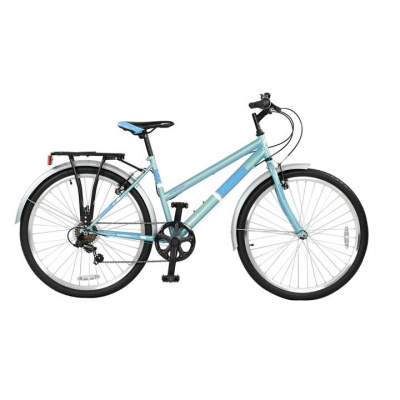
Falcon's hybrid range breaks into two distinct camps, and knowing which is which saves you buying the wrong bike. The town-and-leisure end - models like the Expression - leans heavily on comfort and ease of use. Step-through frames mean you can swing a leg over in work trousers or a skirt without a gymnastic moment, and the swept-back handlebars put you in a properly upright position. These bikes often ship with a front basket or rack mounts as standard, which tells you exactly who they're aimed at: riders doing short hops, errands, or gentle weekend outings rather than grinding out miles.
At the more active end sits the Explorer and similar crossbar-framed models. Straight bars, a slightly more forward-leaning position, and broader gear ranges make these a better fit if you're covering mixed routes - a bit of tarmac commute, a stretch of cinder towpath, the odd park cut-through. They're not performance hybrids in the way a Dawes hybrid might be, but they handle varied daily riding without complaint.
The word Superlite in a model name is worth paying attention to. It signals the shift from Hi-Tensile steel to a 6061 aluminium frame - noticeably lighter to pick up and carry up stairs or onto a train, which matters more than people think until they've lugged a steel bike up three flights. If weight is a genuine consideration for your routine, filter for Superlite models first.
The Falcon Tech Philosophy: Durability Over Frills
Falcon isn't chasing marginal gains with exotic materials. The approach is straightforward: build something that survives British conditions without demanding constant attention. That starts with the frame choice. Hi-Tensile steel tubing - used across the entry-level range - is heavier than alloy, but it absorbs road buzz in a way that alloy can't quite replicate. Hit a pothole on a steel-framed Falcon and you feel it less sharply than you might expect. It's also genuinely hard to crack or dent through everyday use, which counts for something on rough urban roads.
Step up to the Superlite 6061 alloy models and you trade some of that natural compliance for a frame that's easier to manoeuvre and carry. The ride is slightly crisper - not harsh, but you'll notice the difference. For riders who store their bike indoors and aren't bothered about extra weight, the alloy option is the more versatile long-term choice. For those keeping a bike in a damp outhouse or leaning it against railings in all weathers, steel's resilience is genuinely useful.
Double-wall alloy rims are a detail that earns its place. Single-wall rims can buckle when they drop into a deep pothole edge-on - and if you're commuting across typical UK town-centre roads, that's a real risk rather than a theoretical one. Double-wall construction adds meaningful stiffness and impact resistance without a significant weight penalty.
The drivetrains rely on Shimano Revoshift grip-shift levers paired with Shimano Tourney mechs. Tourney gets a bad reputation in performance cycling circles, but that's a category mismatch. For low-speed urban riding, it indexes reliably, rarely skips, and is straightforward to adjust when a cable stretches. Grip-shift specifically suits riders who want to change gear without lifting a finger off the bar - practical in stop-start traffic. If you're comparing Falcon to something like an Apollo hybrid at a similar price, the gearing spec is broadly comparable; the differences come down to frame quality and geometry rather than drivetrain fireworks.
V-brakes across the range are worth a mention. They're powerful, cheap to service, and compatible with standard brake pads you can pick up anywhere. The trade-off is that pad wear accelerates quickly in wet, gritty commuting conditions - think winter riding through puddles and road salt. Check the pads every few weeks if you're riding through the dark months, and you'll avoid the surprise of reduced stopping power on a wet Wednesday morning.
Tyre clearance on most models accommodates 35c to 38c rubber, which is the right spec for UK urban use. Wide enough to absorb surface imperfections, with a semi-slick tread that rolls efficiently on tarmac but won't slide out on a damp canal towpath. If you're primarily on smooth roads, running slightly higher pressure (around 60 - 65 psi) reduces rolling resistance. Drop it to 50 - 55 psi for gravel paths and the ride becomes noticeably more forgiving.
Living with a Falcon in the UK
A few things are worth knowing before the bike leaves the box. If you're on a steel-framed model and storing it outside - even in a covered shed - treat the inside of the tubes with a frame saver or similar rust inhibitor before the first wet season. Water gets in through the seat tube and sits there. It's a ten-minute job that extends the frame's life considerably.
The pannier rack mounts and mudguard eyelets that come as standard on most Falcon hybrids are genuinely useful, but fit a full-length mudguard rather than the stubby clip-on type if you're commuting. The difference between arriving at work with a damp back stripe and arriving dry is usually down to mudguard length. Most models have clearance for SKS-style full-length guards without modification.
Cable stretch on a new bike is normal - Shimano Tourney mechs are particularly sensitive to it in the first few weeks. A barrel adjuster tweak on the rear mech every few rides for the first month keeps shifting crisp. After that, the drivetrain tends to settle and needs minimal fuss. If you're not confident adjusting it yourself, any local bike shop will sort it for a few pounds. Falcon's e-bike range and mountain bikes share similar component logic, so if you already own one and know the basics of cable adjustment, the hybrid drivetrain won't surprise you.
One last thing: sizing. Falcon hybrids run in standard imperial frame sizes - typically 17, 19, and 21 inches. These correspond roughly to small, medium, and large, but inside leg measurement is more reliable than height alone when you're choosing between sizes. A 17-inch frame suits most riders between 5'4" and 5'8"; if you're above 5'9", a 19-inch or 21-inch will give you proper leg extension without stretching for the bars.
Falcon Hybrid Bikes FAQs
Are Falcon hybrid bikes good for commuting?
Yes, for short to medium urban commutes they do the job well. The upright riding position is easy on your back in traffic, and most models come with mudguard and pannier rack mounts as standard - so you can actually carry things and stay dry. They're also comfortable on canal towpaths and cinder tracks, not just tarmac.
What size Falcon hybrid bike do I need?
Falcon hybrids typically come in 17-inch, 19-inch, and 21-inch frame sizes. A 17-inch suits riders roughly 5'4" to 5'8", while 19-inch and 21-inch frames work better if you're over 5'9". That said, always cross-reference with your inside leg measurement against the specific model - height alone doesn't tell the whole story.
Are Falcon bikes made of steel or aluminium?
Both materials appear across the range. Entry-level models use Hi-Tensile steel - heavier, but resilient and naturally vibration-damping. Models in the Superlite range use 6061 aluminium, which is noticeably lighter and easier to handle day-to-day. If weight matters for your commute - carrying the bike upstairs, say - look for the Superlite name in the model title.