
Elops Hybrid Bikes
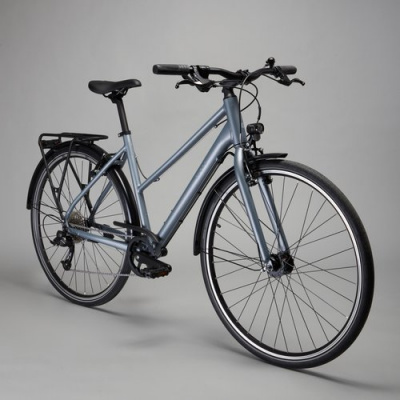
Elops hybrid bikes are Decathlon's answer to the question every commuter eventually asks: why is getting to work such hard work? The range exists to make daily urban riding genuinely practical - not aspirationally so, but actually, on a wet Tuesday in November. Every bike in the lineup ships with full-length mudguards, a dynamo lighting system, and a pannier rack already bolted on. That's the stuff most rival brands sell you separately, if they offer it at all.
The range splits broadly into two families - the comfort-focused Hoprider and the faster, more stripped-back Speed - each available in step-over and step-through frame options, across multiple trim levels. Whether you're covering four miles of potholed city streets or a longer mixed-surface run into town, there's a configuration built around what you actually need rather than what looks good in a press photo.
If you've already decided you want a motor doing some of the graft, head over to our Elops E-Bikes page. For something lighter and single-minded, the Elops Singlespeed & Fixie Bikes are worth a look. For the rest of you - gears, mudguards, rack, lights, sorted - read on.
Prices and availability can change quickly. Delivery charges are not always included in listed prices.
Final price, stock status and delivery terms are set by retailer. We may receive a commission on purchases made.
Decoding the Elops Hybrid Lineup
The naming convention is more logical than it first appears. Hoprider models are built around trekking geometry - a front suspension fork to take the sting out of broken tarmac, combined with a genuinely upright riding position that keeps your back comfortable over longer distances. Think of it as the option for riders who commute more than they sprint. Speed models, by contrast, run a rigid fork, a lighter frame profile, and a geometry that puts you in a slightly more forward, committed position - quicker handling through traffic, more responsive off the lights.
Both families come in High (standard step-over) and Low (step-through) frame variants. The step-through geometry isn't just for accessibility - plenty of city riders prefer it for mounting and dismounting in heavy traffic or when wearing work clothes. No wrong answer there.
The numbers - 500, 700, 900 - denote trim level. Lower numbers run Shimano Tourney groupsets, which are perfectly adequate for flat urban commuting. Step up to the 700 and 900 tiers and you're into Shimano Altus and Alivio territory: crisper shifts, better longevity under daily use, and components that respond more satisfyingly when you're clicking through gears on a damp morning. If your commute involves any real gradient, the jump to a higher-numbered model is worth serious consideration. Compared to something like Carrera hybrid bikes, Elops leans harder into out-of-the-box utility rather than component prestige - a deliberate trade-off, not an oversight.
The Elops Tech Philosophy: Utilitarian Integration
Most hybrid bikes at this price point make you choose: buy the bike, then budget separately for lights, a rack, and mudguards. Elops skips that conversation entirely. The integration is the point.
The Shimano Nexus dynamo hub powers integrated front and rear LED lights - no batteries, no charging, no forgetting. As long as the wheels are turning, you're lit. For dark winter evenings on UK roads, that reliability matters more than people realise until the first time a battery light dies mid-commute. The wiring runs internally on most models, keeping it tidy and protected from the worst of what British roads throw at a bike.
The rear rack is rated to 27kg. That's genuinely heavy-duty - enough to carry a child seat securely or load up with panniers without the rack flexing under the weight. If you're pairing the bike with luggage, our Elops pannier bags are designed to clip directly onto these racks without any faffing. The mounts are standardised, so aftermarket options work fine too.
The saddles and ergonomic grips are shaped for riding in everyday clothing - wider contact points, softer materials - rather than the narrow, aggressive setups that assume you're always in padded shorts. It sounds minor. After a week of daily commuting, it isn't. This is Dutch-style geometry thinking applied practically: the bike fits around your life, not the other way around.
Where brands like Boardman hybrid bikes prioritise performance efficiency and BTwin hybrid bikes sit in a similar utilitarian lane, Elops differentiates through the depth of that factory-fitted kit. The value calculation isn't just about frame price.
Living with an Elops in the UK
Let's talk weight, because it comes up. Elops hybrids typically land between 15kg and 17kg. That's heavy by any fitness-bike standard, and there's no getting around it. Steel and heavy-gauge alloy frames, plus all the integrated hardware, add up. Carrying one up three flights of stairs every evening gets old fast - worth thinking about honestly before you buy.
What that weight buys you is resilience. UK urban roads - potholes that could swallow a small dog, tram tracks, poorly patched tarmac - are genuinely rough on bikes. The Hoprider's front suspension takes the sharper edges off the worst of it, and the high-volume tyres on both families absorb more road noise than the narrower rubber you'd find on a fitness hybrid. These bikes don't get rattled apart by rough city commuting. That's the trade-off, and for most daily riders it's a sensible one.
Winter maintenance is straightforward but worth doing properly. Road salt is the main enemy of the dynamo wiring - give the cable runs a wipe-down periodically and check that the connections at the hub and light housings haven't corroded. The pre-installed mudguard stays can work loose on rougher roads; a quick check of the fixings every month or so keeps rattling at bay. Neither job takes more than a few minutes.
Tyre pressure is worth monitoring more frequently in winter - cold air contracts, and running slightly low on high-volume tyres increases the risk of pinch flats on sharp kerbs. Keep a track of it and you'll avoid most puncture frustration before it starts.
Are Elops bikes good for commuting? Straightforwardly, yes - they're designed from the ground up for exactly that, with all the daily-use accessories included rather than treated as optional extras. The question is really whether the Hoprider's comfort-first setup or the Speed's more direct ride suits your specific route and riding style.
Related searches:
Elops Hybrid Bikes FAQs
Are Elops bikes good for commuting?
Elops hybrids are built specifically for urban commuting. They come factory-fitted with full-length mudguards, a dynamo lighting system, and a heavy-duty pannier rack - accessories most bikes make you buy separately. If daily reliability and out-of-the-box readiness matter more to you than saving grams, they're a strong choice.
What is the difference between Elops Hoprider and Speed models?
The Hoprider runs a front suspension fork and a very upright riding position - it's the comfort-focused option for longer or bumpier commutes. The Speed series uses a rigid fork, a lighter frame, and a slightly more aggressive geometry for quicker, more agile city riding. Same accessories, different priorities.
Are Elops hybrid bikes heavy?
Yes - typically 15kg to 17kg, depending on the model. That's the honest trade-off for steel or heavy-gauge alloy frames paired with fully integrated racks, mudguards, and dynamo lights. They're durable rather than nimble. If you need to carry the bike regularly, factor that in before you buy.