
Domyos Regular Turbo Trainers
Domyos regular turbo trainers are about as straightforward as indoor cycling gets - and that's precisely the point. When the roads are iced over, the dark sets in by four, and you'd rather not expose a decent bike to road salt and grit, these wheel-on magnetic trainers give you a stable, no-nonsense platform to keep the legs ticking over. No firmware to update, no mains power required, no subscription needed before you can start pedalling.
The setup is genuinely quick. Swap your rear skewer for the heavy-duty one supplied, clamp your wheel into the foldable steel frame, wind the roller up against the tyre, and you're away. Resistance is adjusted manually via a handlebar-mounted dial - six to eight distinct levels covering everything from an easy recovery spin to something that'll make your legs argue with you. That simplicity is a real asset when the alternative is faffing about with Bluetooth pairing on a cold Tuesday morning.
Compact enough to fold away behind a door or slide under a bed, Domyos trainers suit the realities of smaller UK homes and narrow garages. They're a sensible, durable choice for riders who want consistent winter training without the complexity or cost of a smart system.
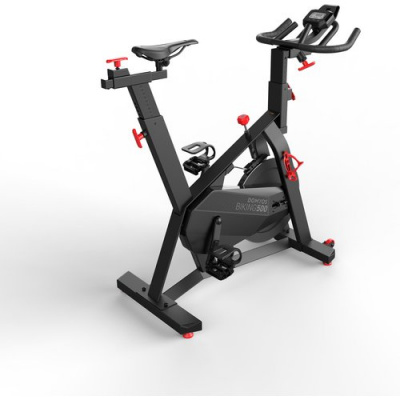
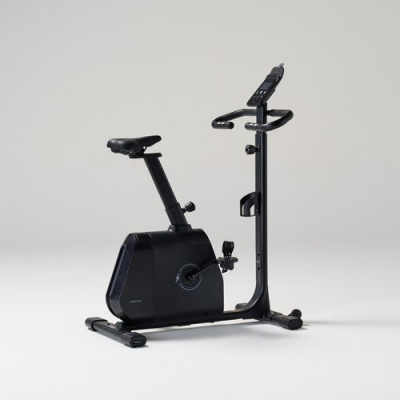
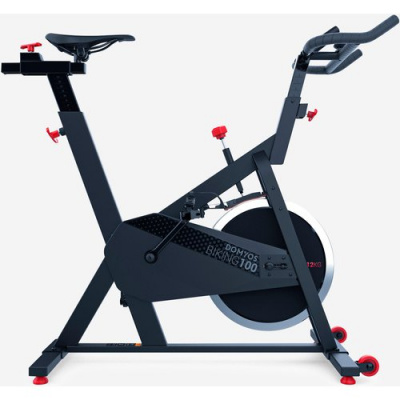
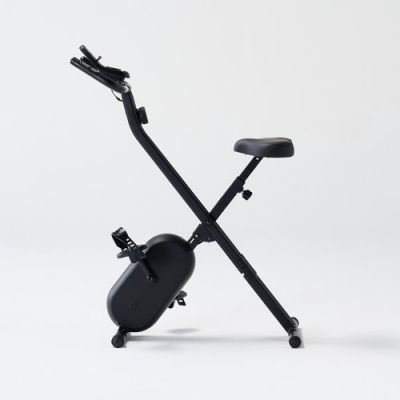
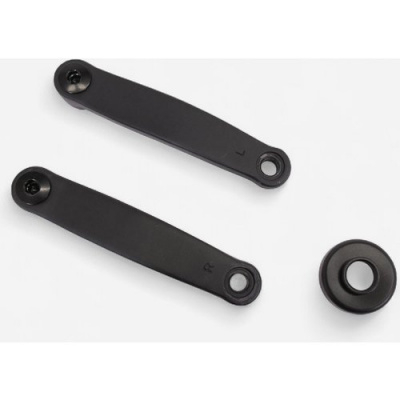
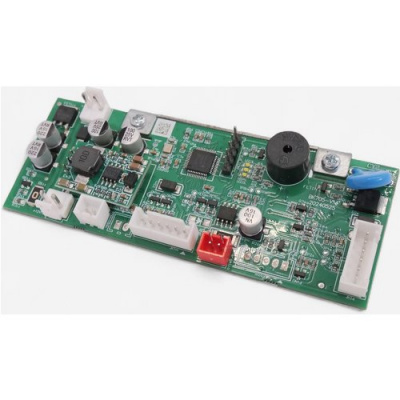
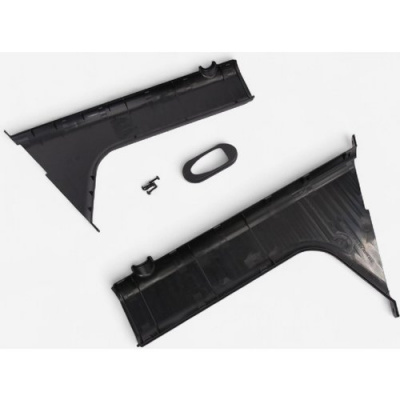
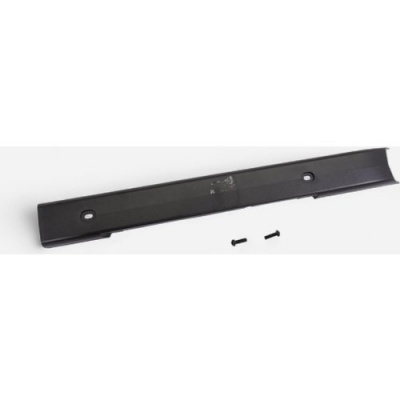
Prices and availability can change quickly. Delivery charges are not always included in listed prices.
Final price, stock status and delivery terms are set by retailer. We may receive a commission on purchases made.
Resistance Mechanics and Ride Feel
The magnetic resistance unit is the engine of a Domyos basic indoor trainer, and it works without any electronics involved. Permanent magnets create drag against a flywheel - the closer the magnets get to the flywheel, the harder you work. You control that proximity through a cable-operated dial that clamps to your handlebar, so you can shift resistance mid-session without leaving the saddle. Six to eight distinct steps give you enough range to dial in a genuine interval session or back things off for a steady aerobic hour.
The roller - the part that actually contacts your rear tyre - is typically elastomer or alloy depending on the model. Elastomer is the softer option; it's quieter and slightly more forgiving on tyre wear, though it won't replicate the progressive feel of a fluid trainer. Alloy rollers are harder and more durable but transmit a bit more road-like buzz through the drivetrain. Neither version is trying to fool you into thinking you're riding outside - this is a training tool, not a simulator.
What you get is consistent, predictable resistance that responds immediately to your input. There's no inertia-matching algorithm, no gradient simulation. If that's what you're after for virtual riding platforms, Domyos magnetic trainers aren't the right fit - riders wanting auto-adjusting resistance that responds to virtual climbs and descents should take a look at our Domyos Smart Turbo Trainers page instead.
Noise Levels and Indoor Practicality
Magnetic trainers are quieter than you might expect - but quieter than what matters here. Compared to older wind trainers, they're noticeably more subdued. Compared to a direct-drive smart trainer, they're louder, because your tyre is still spinning against a roller and that contact generates noise. Realistically, you're looking at something in the 65 - 75 dB range at moderate effort - think loud conversation rather than a vacuum cleaner, but loud enough to irritate a flatmate on the other side of a thin wall.
Two things make a real difference. First, fit a dedicated turbo trainer tyre. A standard road tyre on a roller generates more heat and more noise; a trainer-specific tyre has a harder compound that runs cooler and quieter. It also saves your good road rubber from wearing into a squared-off mess. Second, put a mat down. A proper trainer mat absorbs vibration before it travels through the floor and into the ceiling of whoever lives below you - worth doing even in a house, not just a flat.
If you're training in an unheated shed or garage through a British winter, the Domyos wheel-on turbo trainer has an advantage here that's easy to overlook: no electronics to freeze, no screen to fog, no connectivity to drop. It just works. That reliability in cold, damp conditions is something fluid and direct-drive trainers with sealed electronics can't always match.
Setup, Mounting and Storage in Tight Spaces
Getting your bike onto a Domyos wheel-on turbo trainer takes under five minutes once you've done it a couple of times. The key step that catches people out first time is the skewer swap - you need to replace your rear wheel's existing quick-release skewer with the heavier trainer skewer that comes in the box. Standard skewers aren't designed for the lateral forces a trainer frame puts through them, and using the wrong one is a safety issue, not just a minor inconvenience.
With the correct skewer fitted, slot the wheel into the trainer's dropout cups and tighten the clamping arms evenly on both sides. Then wind the roller tension adjuster until the roller just indents the tyre surface - a quarter turn past first contact is the common guidance. Too loose and the tyre slips; too tight and you're scrubbing the tyre down and creating excess heat.
One important compatibility note: Domyos turbo trainer resistance levels are designed around standard quick-release rear axles. If your bike runs a thru-axle - common on most modern gravel and mountain bikes - you'll need an adapter to make it work. Head to our Turbo Trainer Adapters section for the right solution. And if you want to complete the setup properly - a sweat net to protect your top tube, a riser block to level the front wheel, or replacement rollers down the line - our Turbo Accessories and Turbo Spares pages cover the lot.
Storage is where the foldable steel frame earns its keep. Fold it flat, lean it against a wall, or slide it into a cupboard - it takes up roughly the same footprint as a large suitcase. For anyone working with a narrow hallway, a box room, or a shared garage, that matters. Brands like Elite, Tacx, and Saris offer comparable wheel-on magnetic options at similar price points, though Domyos's no-frills approach keeps the weight and bulk to a minimum. If you're putting in longer sessions, a pair of Domyos cycling shorts will make the time on the saddle considerably more comfortable.
Domyos Regular Turbo Trainers FAQs
How do I set up my bike on a Domyos regular turbo trainer?
Swap your rear wheel's standard quick-release skewer for the heavy-duty trainer skewer supplied - using the wrong skewer is a safety risk, not just a technical flaw. Clamp the wheel into the trainer's dropout cups, tighten both clamping arms evenly, then wind the roller against the tyre until it just indents the surface. A quarter turn past first contact is the standard starting point.
Do I need a special tyre for a Domyos turbo trainer?
Not strictly, but it's strongly worth doing. A standard road tyre generates excess heat and noise on a roller and wears unevenly into a squared-off profile far faster than normal road use. A trainer-specific tyre uses a harder compound that runs cooler, lasts longer, and keeps noise down - which matters if you're training in a flat or shared house.
Can I use Zwift with a regular Domyos turbo trainer?
Yes, but you'll need to add a separate Bluetooth or ANT+ speed and cadence sensor to your bike, as the trainer doesn't transmit data itself. Once that sensor is broadcasting, Zwift reads it and tracks your ride. Automatic resistance changes in response to virtual gradients aren't possible on a manual magnetic trainer - for that, you'd need to look at a smart trainer instead.