
Cyclite Rucksacks
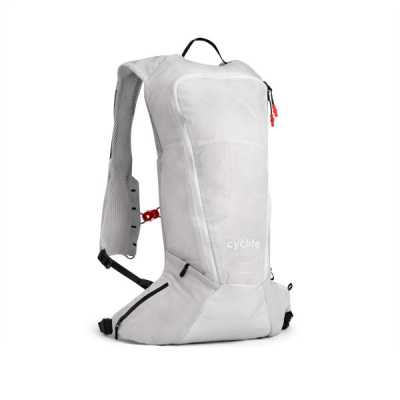
Cyclite rucksacks exist for one reason: to carry as little weight as possible, as fast as possible, without your back paying the price. Built specifically for ultra-endurance racing and fast-and-light bikepacking, Cyclite strips the brief right back - no superfluous pockets, no padding that doesn't earn its grams, nothing that creates drag when you're pushing into a headwind across an exposed Welsh ridge.
What you do get is genuinely impressive engineering. High-frequency welded seams replace stitching entirely, removing every potential entry point for water. Pair that with bespoke ultralight laminate fabrics that are tear-resistant under load, and you've got a pack that handles sustained UK downpours without the contents suffering - not a DWR coating that washes out after three wet rides, but actual 100% waterproofing built into the construction itself.
The aero-optimised profiling is the other defining feature. Cyclite shapes each pack to sit low and close behind your helmet, reducing the drag signature that a conventional rucksack creates at speed. If you've ever felt a bulky bag acting like a sail on a fast descent, you'll understand immediately why the geometry matters. These are focused tools, and that focus shows in every detail.
Prices and availability can change quickly. Delivery charges are not always included in listed prices.
Final price, stock status and delivery terms are set by retailer. We may receive a commission on purchases made.
Harness Systems and Load Stability
Fit a Cyclite pack on a mannequin and it looks almost too minimal. Put it on in an aggressive riding position - elbows bent, torso forward - and it starts to make sense. The harness system is cut for that dropped position from the outset, so the shoulder straps don't ride up and choke your neck when you're actually on the bike. That's a detail a lot of cycling-adjacent packs miss completely.
The sternum strap placement is deliberately high, which keeps the load pulled tight to your upper back rather than letting it pendulum away from your centre of mass. On a technical climb out of the saddle, that matters - a bag that sways laterally when you're rocking the bike wastes energy and upsets your balance. Cyclite's harness prevents that lateral movement without clamping your chest so hard that breathing suffers on long efforts.
Payload stability also comes down to how you pack, not just how the bag is built. Heavier items - a full hydration bladder, dense food reserves, your waterproof layer - belong at the bottom and as close to your spine as possible. Keep the top light. It sounds obvious, but a low centre of gravity transforms how even a well-engineered harness system behaves on loose or technical ground. Pack it right and the bag becomes part of you; pack it wrong and it'll remind you it's there on every switchback.
Aero Pack vs. Higher-Volume Options: What Cyclite's Range Offers
Cyclite's range splits fairly cleanly by intent. At one end sits the Aero Backpack - a genuinely race-focused piece with a capacity designed around the bare minimum needed for a fast day or shorter ultra event. Volume is intentionally restricted. Weight savings are maximised. External attachment points are kept minimal to avoid anything snagging airflow or adding grams you don't need. If you're chasing a finish line or a personal record on a long-distance route, this is the end of the range to look at.
Move up the Cyclite lineup and you gain litres and, with them, some practical additions - more considered organisation, attachment options for a helmet or extra layers, slightly more robust construction in higher-wear zones. You also gain weight and, marginally, frontal area. It's a straightforward trade-off: racing brevity versus touring practicality. Neither end of the range is wrong; they're aimed at different days out.
Compared to Apidura rucksacks, Cyclite tends to prioritise aerodynamics and outright weight savings over modular organisation. Evoc rucksacks bring more structural padding and commuter-friendly features, which tells you everything about the different audiences each brand is talking to. If you want the lightest, most aero-focused option in the bikepacking rucksack category, Cyclite is at the sharper end of that conversation. If you need integrated hydration with a broader feature set, something like CamelBak rucksacks covers different ground entirely.
For riders looking to complete the kit, pairing a Cyclite pack with a well-chosen frame bag or saddle pack keeps your overall load balanced front-to-rear - worth thinking about before you commit to a single-bag setup on longer routes.
UK Grit, Mud, and Keeping Your Pack in Good Shape
British lanes are hard on gear in a specific way. The grit that coats your bike and kit after a wet ride on country roads isn't just muck - it acts as a fine abrasive, grinding into fabric weaves and zip coils every time the bag flexes. Standard fabrics degrade faster than you'd expect. Cyclite's ultralight laminate construction and high-frequency welded seams side-step the zip-failure issue by largely eliminating exposed coil zips from waterproof zones, but the fabric surface still needs attention if you want it performing properly long-term.
Cleaning is straightforward but unforgiving if you ignore the rules. Wipe the bag down after every muddy ride using a soft sponge and warm water with a small amount of mild soap - nothing abrasive, nothing solvent-based. Work grit out of any closure systems or buckles while they're wet; it's far easier than trying to shift dried mud later. Then let the bag air dry away from direct heat sources.
On waterproofing: because Cyclite uses welded laminate construction rather than a DWR coating applied over a woven shell, you don't need to re-treat it with a spray-on product the way you would a conventional waterproof jacket. The waterproofing is structural. What you must avoid is machine washing or tumble drying - both will delaminate the fabric, destroying the waterproof membrane in a way that can't be reversed. Same goes for harsh cleaning chemicals. A soft sponge and mild soap is genuinely all it needs.
On exposed moorland rides - the kind where crosswinds are pushing you around and rain is coming in sideways - the aero profiling and true waterproofing combination earns its keep in a way that a conventionally built pack simply doesn't match. Your spare base layer stays dry. Your battery pack stays dry. And the bag isn't acting as a wind vane at the worst possible moment.
If you're considering how Cyclite fits into a broader bikepacking setup, it's also worth looking at Deuter rucksacks for comparison - they offer a very different philosophy around back ventilation and load transfer that suits touring riders with heavier loads, which helps illustrate just how focused Cyclite's approach actually is.
Cyclite Rucksacks FAQs
Are Cyclite rucksacks fully waterproof?
Yes. Cyclite uses high-frequency welded seams and coated laminate fabrics throughout, making the packs 100% waterproof rather than merely water-resistant. Your spare layers, battery packs, and food supplies stay completely dry in sustained UK rain - no DWR top-up required, because the waterproofing is built into the construction itself.
How do I clean my Cyclite bikepacking backpack?
Use a soft sponge with warm water and a small amount of mild soap. Work any grit out of buckles and closures while everything's wet, then air dry away from heat. Never machine wash or tumble dry - the heat and agitation will permanently delaminate the waterproof membrane. Avoid harsh chemicals or stiff brushes for the same reason.
Is a Cyclite rucksack suitable for daily commuting?
They work well for fast, unencumbered commutes - low weight and genuine waterproofing are obvious advantages. What they lack is the internal organisation most commuters want: no dedicated laptop sleeve, no key clip, no separated wet-gear pocket. If you're commuting light and fast, they're fine; if you're carrying a laptop and lunch, a dedicated commuter pack will serve you better.