
Condor Road Wheels
Condor road wheels come from one of London's most respected frame builders, and the wheel range carries that same hands-on precision into every spoke and rim profile. Whether you're chasing a lightweight carbon wheelset for summer sportives or need a dependable alloy pair that'll laugh off another grim January, Condor has a wheelset built for how British roads actually behave.
The range spans shallow-section alloy hoops for daily training through to deeper carbon profiles aimed squarely at aerodynamic efficiency - so there's a logical step-up path as your riding progresses. Every wheel in the line-up is hand-built with precision spoke tensioning, which matters more than it sounds when a pothole near Reigate or a flooded lane in the Fens tries to knock things out of true. High-grade sealed cartridge bearings keep the hubs rolling cleanly through the sort of road salt and standing water that accelerates wear on cheaper wheelsets. Rim profiles like the Pioggia are engineered with durability as the starting point - practical, not just pretty. Browse the full selection below and use this guide to match the right wheelset to your bike, your axle standard, and the roads you actually ride.
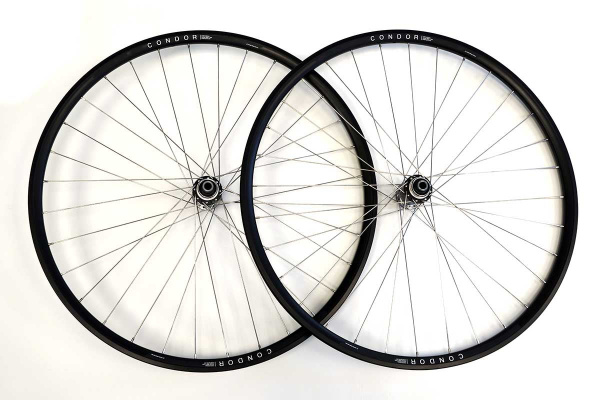
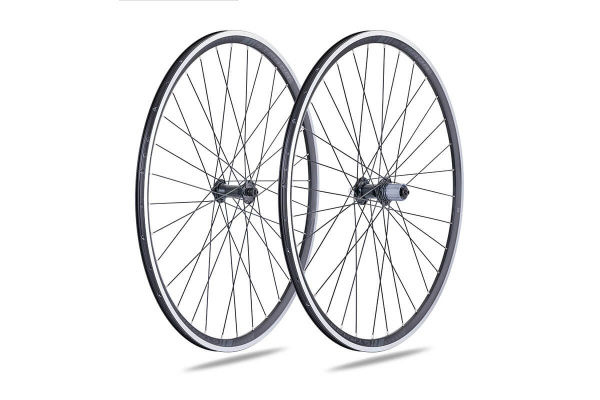
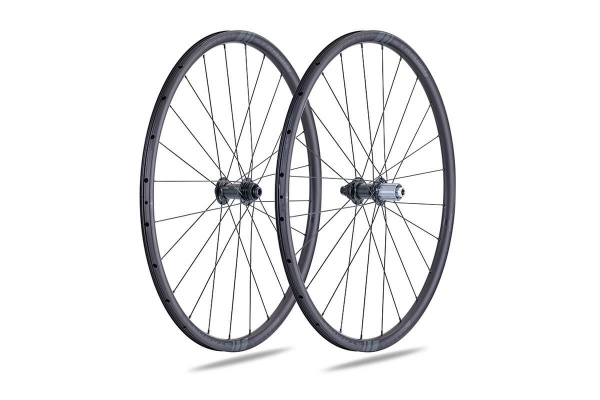
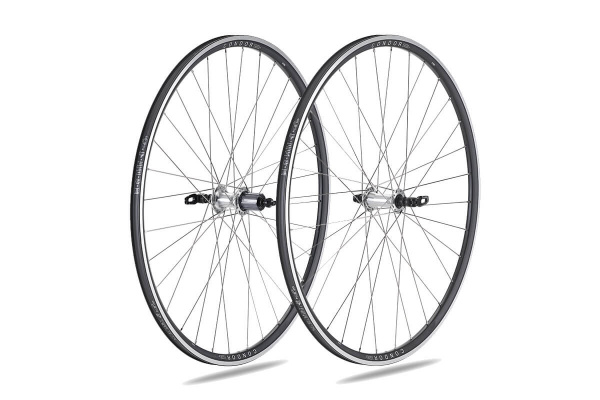
Prices and availability can change quickly. Delivery charges are not always included in listed prices.
Final price, stock status and delivery terms are set by retailer. We may receive a commission on purchases made.
Compatibility Matrix: Fitting Condor Wheels to Your Bike
Getting the right Condor wheel onto your bike means checking three things before anything else: brake standard, axle standard, and freehub spline pattern. Miss one, and you're back at the start.
On the brake side, Condor's disc brake road wheels are designed around either centerlock or 6-bolt rotor mounting - check your hub spec before ordering a rotor. Rim brake options remain available for bikes with caliper brakes; these typically use a standard 700c rim with an alloy brake track. If you're running Condor caliper brakes, it's worth confirming reach compatibility with the rim depth you choose.
Axle standards split into two camps. Thru-axle setups run 12x100mm at the front and 12x142mm at the rear - now standard on most disc road bikes produced in the last five years. Older frames and some budget builds still use quick release (QR) skewers with a 9mm front and 10mm rear dropout. Mixing these up isn't fixable on the roadside. For detailed hub mechanism specs, skewer sizing, and freehub body options across Shimano/SRAM HG, SRAM XDR, and Campagnolo spline patterns, head to the dedicated Condor hubs page - that's where the granular compatibility detail lives, and it'll save you a wasted trip to the post office.
If you're weighing Condor against other builders at this stage, DT Swiss road wheels and Hope road wheels cover similar ground on thru-axle disc compatibility and are worth a side-by-side look.
Alloy Trainers to Carbon Racers: What Each Tier Gets You
Condor's road wheel range isn't a single product - it's a hierarchy, and understanding where each wheel sits stops you overspending or underbuying.
At the practical end, shallow-section alloy wheels are the workhorses. Robust spoke lacing patterns, wide internal rim widths that suit 28c to 32c tyres, and forgiving ride characteristics make these the sensible pick for winter training, commuting, or anyone who doesn't want to fret every time a drain cover appears. The Pioggia rim profile is the clearest expression of this thinking - designed from the outset for durability and all-condition reliability rather than wind-tunnel numbers. These aren't glamorous, but they're what you reach for when the forecast is grim and the roads are filthy.
Step up to Condor's carbon wheelsets and the trade-offs shift. Rotational weight drops noticeably, which you feel most on repeated climbs rather than flat sprints. Stiffer carbon layups transfer power more directly - there's less flex between your pedal stroke and forward motion. Deeper rim sections (typically 30 - 45mm for UK roads, where crosswinds on exposed lanes make anything taller a handful) also add aerodynamic efficiency at pace. You're paying for all three of those gains simultaneously, and on a long sportive day in the Yorkshire Dales or the Chilterns, you'll feel the difference cumulatively.
The honest trade-off: carbon wheels demand more careful maintenance, cost more to repair after a serious impact, and aren't always the right call for year-round riding. Many riders keep an alloy set for winter and run carbon from April onwards. For riders on Condor road bikes, this pairing makes particular sense - the spec levels often align well. If your riding has started to drift onto gravel or mixed surfaces, don't stretch these road wheels beyond their design intent; the Condor gravel wheels page covers that brief properly. Alternatives worth comparing at the carbon end include Campagnolo road wheels and Fulcrum road wheels, both of which compete directly on stiffness-to-weight and freehub engagement.
Keeping Your Wheels True: Maintenance on UK Roads
British roads are hard on wheels. Grit, salt, standing water, and the odd unavoidable pothole are facts of life rather than exceptions - your maintenance habits need to reflect that.
Road salt is the quiet killer. It accelerates corrosion on rim brake tracks and works into hub bearing interfaces faster than most riders expect. After wet winter rides, wipe down the rim faces and flush around the hub flanges with clean water. Condor wheels use high-grade sealed cartridge bearings optimised for longevity, but sealed doesn't mean indestructible - if you feel any roughness or play in the hub, that's the bearings asking for attention, not a sign to push on for another month.
Spoke tension is the other thing to stay honest about. A solid pothole impact - the kind that sends a jolt up through the bars - can disturb spoke tension unevenly without visibly buckling the rim. Run a finger around the spokes within a day or two of a hard hit; they should feel consistent in resistance. A spoke that pings noticeably looser than its neighbours means a trip to the work stand before it compounds into a wobble. Hand-built construction with precision spoke tensioning means the factory baseline is high, but spoke tension does settle over time regardless.
On the tubeless-ready (TLR) side, check your sealant level every couple of months - it dries out, especially through summer. For the full setup - rim tape specification, tubeless valve sizing, and inner tube fallback options - the Condor rims and Condor inner tubes pages have the specifics without the guesswork.
Condor Road Wheels FAQs
Are Condor road wheels tubeless compatible?
Most current Condor road wheels are tubeless-ready (TLR), with a rim bed profile shaped to seat tubeless tyres securely. You'll still need compatible rim tape, tubeless valves, and sealant to complete the conversion - these aren't included as standard, so factor them into the setup cost.
What freehub body do I need for my Condor wheels?
It depends on your drivetrain. Condor wheels can typically be set up with a Shimano/SRAM HG freehub for standard cassettes, SRAM XDR for SRAM's 12-speed road groupsets, or a Campagnolo-pattern freehub. Check your cassette's spline pattern before ordering - getting this wrong means the cassette simply won't fit.
Can I put wider tyres on my Condor road wheels?
Yes, provided the internal rim width supports it and your frame has enough clearance. Modern Condor wheels with a 19mm or wider internal rim width handle 28c to 32c tyres comfortably, improving grip and compliance on rough roads. Fitting a tyre significantly wider than the rim's recommended range risks poor tyre shape and compromised handling.