
Cafe Du Cycliste Saddle Bags
Cafe du Cycliste saddle bags sit at an interesting crossroads: they look like they belong on a sun-drenched coastal sportive, yet they're built to handle the kind of relentless rear-wheel grit that characterises a November ride through the Chilterns or a soggy Peak District loop. That's the point. French aesthetic, proper functional thinking underneath.
The range spans compact tool rolls for riders who want just enough room for a tube and a multi-tool, through to full bikepacking seat packs with enough capacity for an extra layer and overnight kit. Whatever the bag, the construction leans on DWR-treated ripstop nylon, YKK Aquaguard zips, and Hypalon reinforcement panels at the contact points that take the most punishment - the seatpost interface and saddle rails.
Retention is taken seriously, too. Sway is one of those things that sounds minor until you've done 80 miles with a bag pendulumming off the back of your saddle. Cafe du Cycliste's strap geometry keeps bags planted, even on rough surfaces where momentum likes to throw things around.
Use the comparison grid below to find the right Cafe du Cycliste rear storage bag for your setup and check live UK prices across stockists.
Prices and availability can change quickly. Delivery charges are not always included in listed prices.
Final price, stock status and delivery terms are set by retailer. We may receive a commission on purchases made.
Will It Fit Your Bike? Clearances, Rail Spacing, and Seatpost Length
Before anything else, measure the gap between your rear tyre and the underside of your saddle. On most road bikes that's generous, but on shorter-geometry gravel bikes - particularly those running 700x45c or wider - the bag can sit closer to the tyre than you'd expect. Under compression on rough ground, even a few millimetres of clearance disappears fast. If you can hear the bag ticking against the tyre, that's tyre buzz, and it means you need either a smaller bag or a longer seatpost exposed above the collar.
Saddle rail spacing is standardised at 44mm across the vast majority of road and gravel saddles, so Cafe du Cycliste bags will thread onto most setups without drama. You do need a usable exposed seatpost length of at least 60 - 70mm for the seatpost strap to sit cleanly below the saddle clamp and above the frame collar - check this before you order, especially on compact frame sizes where stack height is limited.
Dropper posts are a different matter entirely. Standard velcro retention straps wrapped around a dropper stanchion will scratch the coating and, over time, degrade the wiper seal - that seal is what keeps grit out of the internals. The fix is a rail-only mounting bracket that clamps to the saddle rails and leaves the post completely untouched. Some riders also use a bolt-on accessory cradle. If your gravel bike runs a dropper, check the specific bag's mounting method carefully; this isn't a problem unique to Cafe du Cycliste, it applies to any bag using a post strap.
If you're finding the saddle bag isn't enough storage on its own, it pairs naturally with Cafe du Cycliste bar bags up front or a Cafe du Cycliste frame bag in the main triangle - both designed to work with the same aesthetic and attachment logic.
Tool Rolls vs. Bikepacking Seat Packs: Matching Capacity to the Ride
The Cafe du Cycliste range splits fairly cleanly into two categories, and getting this choice right makes a bigger difference than most people expect.
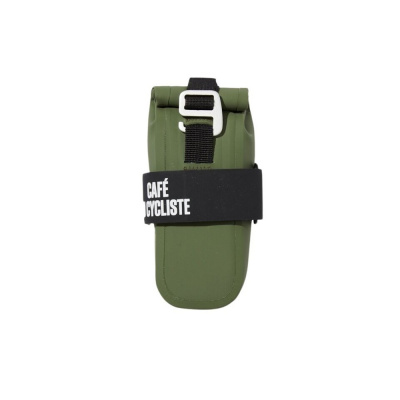
Tool rolls sit below 1 litre of capacity. Think of them as a structured pouch rather than a bag - there's room for a TPU inner tube, a pair of tyre levers, a compact multi-tool, and a CO2 inflator or small pump. That's your lot. The advantage is weight distribution: everything sits tight to the centreline of the bike, close to the saddle rails, so the rotational mass is minimal. You won't notice it on the bike. These suit riders who commute, race sportives, or simply want puncture insurance without any compromise to the bike's handling feel. If you want to keep your Cafe du Cycliste tools neatly organised rather than rattling loose, a tool roll makes sense here too.
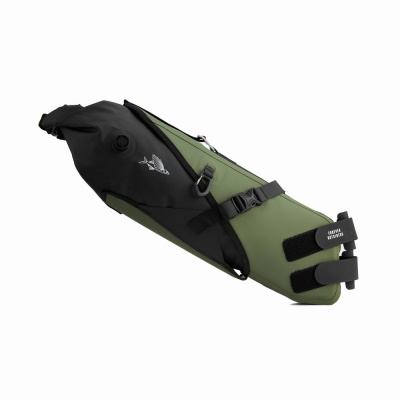
Bikepacking seat packs start around 5 litres and use a roll-top closure that lets you compress the bag when it's lightly loaded or pile in an extra layer when the forecast shifts mid-ride. Many feature bungee cord systems on the outer face for stowing a gilet or a Cafe du Cycliste jacket without opening the main compartment. At this capacity, weight distribution becomes something to think about actively. Pack heavier items - a spare jersey, food, tools - as close to the seatpost as possible. Bulkier but lighter things like a packable gilet can go further back. That keeps the centre of mass lower and reduces the pendulum effect when you're grinding up a Welsh lane out of the saddle.
If your storage needs stretch beyond what a single seat pack can carry, both Apidura and Miss Grape offer bags at higher capacities, but Cafe du Cycliste's advantage is the finish quality and the fact that the bags are designed to complement the rest of the brand's kit visually - worth something if you care about the overall setup.
UK Grit, Rear Spray, and Keeping Your Seatpost Intact
A saddle bag lives in arguably the worst position on the bike for weather exposure. Every rotation of your rear wheel throws water, road grit, and in winter, road salt directly at it. Cafe du Cycliste address this with YKK Aquaguard zips - these have an internal flap and water-resistant coating that blocks the direct spray line from the wheel. Not submersion-proof, but then you're not underwater. They handle British winter riding with room to spare.
The DWR (Durable Water Repellent) treatment on the ripstop nylon outer sheds water rather than absorbing it, keeping the bag light and the contents dry even after hours of wet riding. DWR does degrade over time with UV and washing - a light re-treatment with a spray-on product once a season keeps it performing properly.
The detail that separates the Cafe du Cycliste construction from cheaper options is the Hypalon reinforcement panels at the seatpost and rail contact zones. Hypalon is a synthetic rubber used in high-wear applications - it's what the straps press against your seatpost through, and it stops the abrasive mud that accumulates there from acting like grinding paste against your frame or carbon layup. Even so, if your seatpost is carbon, apply a strip of clear helicopter tape to the post before fitting the bag. It costs almost nothing and means you're not relying entirely on the bag's panels to protect the clearcoat. Check it periodically and replace the tape when it starts to lift.
On the zip front: UK mud gets into everything. A stiff brush along the zip teeth after a muddy ride takes thirty seconds and keeps the zip running freely. Leave it long enough and dried mud sets like concrete in the zip channel - at that point you're forcing it, and YKK or not, something gives eventually. Carradice bags dodge this with their traditional buckle-and-roll closure, but they trade zip convenience for a different attachment system. It's a genuine trade-off depending on how often you're accessing the bag mid-ride.
Cafe Du Cycliste Saddle Bags FAQs
How do you attach a saddle bag to a bike?
Most saddle bags use two attachment points: a strap that wraps around the seatpost and secondary straps that thread over the saddle rails. Thread the rail straps first to set the bag's position, then tighten the seatpost strap fully. Both need to be genuinely taut - a loose seatpost strap is the main cause of lateral sway when you're pushing hard out of the saddle.
Are saddle bags compatible with dropper posts?
Standard bags with a seatpost strap aren't recommended for dropper posts. The strap bears against the moving stanchion, which scratches the coating and wears the wiper seal over time - once that seal goes, the post internals are exposed to grit. You need either a dropper-specific bag or a rail-only mounting bracket that keeps the post completely free.
What should I pack in a cycling saddle bag?
In a tool roll or small bag: a spare inner tube (TPU saves space), tyre levers, a compact multi-tool, and a CO2 inflator. In a larger bikepacking seat pack, use compressible items like spare kit or a packable layer, and keep denser items such as tools positioned closest to the seatpost to keep the weight centred and reduce swing.