
BTWIN Folding Bikes
BTWIN folding bikes are Decathlon's answer to the daily grind of multi-modal UK commuting - practical, compact, and priced well below the boutique end of the folding bike market. The current range runs under the Fold series name (you may know these from the older Tilt branding - same thinking, refreshed lineup), and each model is built around 20-inch wheels. That's a deliberate call. Smaller-wheeled folders can feel skittish on potholed city streets; the 20-inch format gives you a noticeably more settled ride without ballooning the folded package. Whether you're squeezing onto a Thameslink service or stashing the bike under your desk, these folders are sized for real commuter life rather than theoretical minimalism.
The range splits broadly into steel-framed entry models and lighter 6061 T6 aluminium options higher up - a meaningful difference when you're hauling the thing up three flights of station stairs. Gearing spans single-speed simplicity to 9-speed Shimano drivetrain setups, so there's a spec for every commute length and gradient. If a pedal-assist option is more your speed for longer or hillier routes, head over to our BTWIN e-bikes page instead. For everyone else, read on.
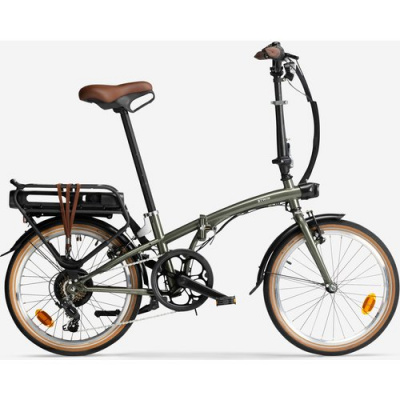
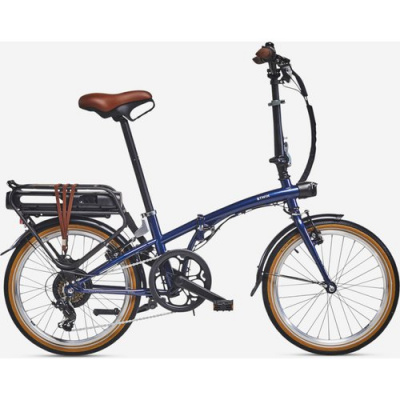
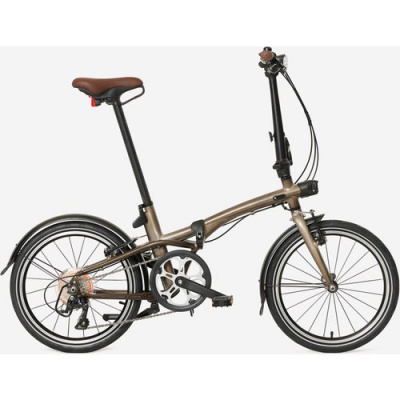
Prices and availability can change quickly. Delivery charges are not always included in listed prices.
Final price, stock status and delivery terms are set by retailer. We may receive a commission on purchases made.
Decoding the BTWIN Fold Lineup
The Fold series stacks up in a clear hierarchy once you know what to look for. At the entry level, the Fold 100 and Fold 120 use Hi-Ten steel frames - heavier than alloy, but genuinely robust for daily abuse. Expect weights in the 14 - 14.5kg region. The Fold 100 runs a single-speed setup, which suits flat urban riding and keeps maintenance near zero. The Fold 120 steps up to a basic 6-speed, adding a bit of range for routes with a bridge or an overpass in the mix. Neither model will impress on the scales, but they'll absorb years of kerb-hopping without complaint.
Move up to the Fold 500 and Fold 560 and you're into 6061 T6 aluminium frame territory. That frame swap alone drops meaningful weight - the Fold 560 comes in around 12.2kg - and shifts the carrying experience from a chore to something manageable. The Fold 500 runs a 7-speed Shimano drivetrain; the Fold 560 stretches to 9-speed, which gives you properly usable range across hillier city commutes. These are also the models where the build quality feels less purely functional and more considered. Worth knowing: the old Tilt series naming has been phased out across Decathlon's range, so if you spot Tilt 100 or Tilt 500 references on secondhand listings, they're the direct predecessors to today's Fold equivalents. Same geometry logic, updated spec. If you're weighing BTWIN against other compact commuters, Brompton folding bikes and Carrera folding bikes are the obvious comparison points - Brompton sits at a significant price premium with a smaller wheel, Carrera slots closer to BTWIN's value bracket.
How the Folding System Actually Works
BTWIN uses a lateral folding hinge at the centre of the frame - the bike folds in half widthways rather than the more complex multi-joint systems you find on some rivals. It's a simpler approach, which means fewer points of wear and a more intuitive process once you've done it a few times. Drop the saddle, release the main hinge, fold the handlebar stem down, and the bike is done. On the Fold 500 and 560, a magnetic catch clicks the folded halves together cleanly - no fiddling with straps or trying to hold the package shut while you fumble for your Oyster card. On the entry steel models, a strap or elastic does the same job less elegantly, but it works.
The 20-inch wheels are worth dwelling on. They're not the smallest option in the folding bike world, but BTWIN's geometry uses them deliberately - a larger contact patch and more gyroscopic stability than a 16-inch wheel makes the bike feel predictable on the kind of rough urban surfaces that catch smaller-wheeled bikes out mid-corner. Think of it as the difference between a nimble but jittery ride and one that just gets on with it. The anti-theft seatpost design is a clever detail that often gets overlooked: when you drop the saddle to fold, a mechanism prevents the post from being fully removed. Practically, this also means the dropped seatpost acts as a small stabilising leg when the bike is parked folded - handy on a station platform or in a café.
Living with a BTWIN Folder on a UK Commute
The honest reality of commuting on a folding bike in the UK is that the journey often involves more carrying than riding. Most major train operators allow folding bikes on services at any time, including peak hours, as long as they're folded and bagged - but check your specific operator's policy, because Southern and SWR handle it differently to, say, Northern Rail. A 12kg aluminium Fold 560 is manageable up a flight of stairs; a 14.5kg steel Fold 100 feels considerably more agricultural by the third floor. If your commute involves stairs daily, the alloy models earn their higher price in preserved back health alone.
V-brakes do a solid job in dry conditions and are simple to adjust, but wet winter commuting will chew through brake pads faster than you'd expect - budget to check them every couple of months from October onwards. Grit from salted roads works its way into the main frame hinge over a winter, causing creaking; a quick wipe-down and a drop of dry lube on the hinge pivot after particularly mucky rides keeps it quiet. Chain rust is the other seasonal reality - a wet-lube or wax treatment before winter starts pays off. Fitting BTWIN mudguards from the off cuts spray onto the drivetrain significantly, which extends both chain and cassette life. A decent lock is non-negotiable if the bike's spending any time locked up at the destination end of the commute. Pannier bags are worth considering too - carrying a loaded rucksack on a folding bike shifts your weight rearward in a way that affects handling noticeably on sharper corners. The stock tyres on the Fold 100 and 120 are functional but nothing special; swapping to a more puncture-resistant option from the BTWIN commuter tyre range is the single upgrade that delivers the most day-to-day confidence. For comparison with the broader BTWIN non-folding range, BTWIN hybrid bikes give you more speed and luggage capacity if your commute is entirely by bike without train legs.
BTWIN Folding Bikes FAQs
Are BTWIN folding bikes any good for commuting?
For multi-modal UK commuting, they make a lot of sense. The 20-inch wheels handle potholed city roads more confidently than smaller-wheeled rivals, the folded size meets standard train luggage requirements, and the pricing sits well below comparable folders from boutique brands. They're no-nonsense tools rather than objects of desire, but that's rather the point.
How much does a BTWIN folding bike weigh?
It depends which model you're looking at. The steel-framed Fold 100 comes in around 14.5kg; the aluminium Fold 560 drops to roughly 12.2kg. If you're navigating station stairs every day, that two-kilogram difference is genuinely felt by your lower back over a week of commuting - the alloy models are well worth the extra outlay.
How do you fold a BTWIN bike?
BTWIN's lateral folding mechanism keeps it straightforward: drop the saddle, release the central frame hinge to fold the bike in half, then drop the handlebar stem down. On the Fold 500 and 560, a magnetic catch locks the folded package together. On entry models, a strap secures it. With a bit of practice, the whole process takes under 15 seconds.