
BMC Mountain Bikes
BMC mountain bikes occupy a very specific corner of the market - one where Swiss engineering precision meets World Cup cross-country ambition. These aren't bikes built for the casual weekend spin. They're precision instruments, obsessively optimised for speed, climbing efficiency, and technical control, and the results speak for themselves at the highest levels of XC racing.
At the heart of the range is premium carbon construction, developed at BMC's Impec Lab in Switzerland and refined through race feedback from elite athletes. Every frame geometry decision, every layup schedule, every pivot placement is driven by performance data rather than marketing convenience. You'll find that focus in every part of the lineup, from the race-sharp Fourstroke to the trail-capable Speedfox.
These bikes reward riders who want to go fast, climb hard, and corner with confidence. If you're chasing podiums, personal bests on Strava segments, or simply want one of the most technically accomplished mountain bikes money can buy, BMC is worth serious consideration. Use the filters above to narrow by model, frame material, and build spec - and read on to understand exactly what separates each family.
Prices and availability can change quickly. Delivery charges are not always included in listed prices.
Final price, stock status and delivery terms are set by retailer. We may receive a commission on purchases made.
Decoding the BMC Mountain Bike Lineup
BMC keep the range focused. Three core mountain bike families, each with a clear purpose, and a naming system that tells you most of what you need to know before you've even looked at the spec sheet.
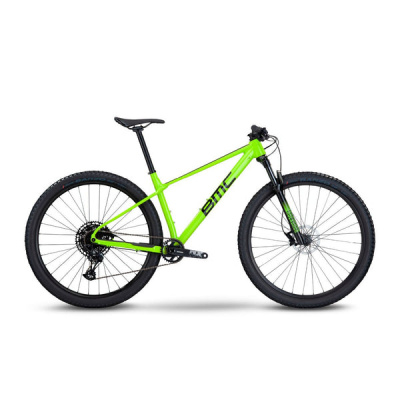
The Fourstroke is the full-suspension XC race weapon. It's where BMC's World Cup experience is most concentrated - short travel, aggressive geometry, and a frame built around pedalling efficiency above all else. This is the bike you'd reach for if cross-country racing or fast trail riding is your primary goal. The Twostroke takes that same XC race DNA and applies it to a hardtail platform. Lighter, simpler, and often sharper-feeling on smooth or hardpack surfaces, it suits riders who want a responsive race machine or a high-performance training bike without the complexity of rear suspension. Then there's the Speedfox - BMC's trail-oriented full-suspension bike. More travel, more relaxed geometry, and a broader appetite for varied riding. If the Fourstroke is a sprinter, the Speedfox is a strong all-rounder that handles a wider range of UK riding without complaint.
The numbering convention is worth understanding before you start comparing prices. The 01 suffix - as in Fourstroke 01 - denotes BMC's highest-grade carbon construction from their Impec Lab process. Models without the 01 designation use standard carbon, which is still quality material but lacks the weight and stiffness refinement of the flagship layup. AL models use aluminium frames - a more accessible entry point into the range. As for build levels, ONE, TWO, and THREE dictate component spec, with ONE being the flagship build typically carrying top-tier groupsets and suspension. Work down the numbers and you're trading component quality, not frame quality - the chassis stays consistent within each model tier.
If you're comparing options from other brands at similar price points, Cannondale mountain bikes and Giant mountain bikes both offer competitive full-suspension XC platforms worth cross-referencing.
The BMC Tech Philosophy: APS, BWC, and RAD
BMC's proprietary systems aren't marketing badges - each one solves a specific engineering problem, and understanding them helps you decide whether the approach suits how you ride.
APS (Advanced Pivot System) is BMC's dual-link rear suspension design, and it's the defining feature of the Fourstroke and Speedfox. The geometry of the linkage is tuned so that pedalling forces don't feed back into the suspension as unwanted bob, while the suspension itself stays active and responsive over rough ground. In practical terms, you get a bike that climbs like a hardtail but tracks the ground properly on rough descents - a genuinely difficult balance to strike in XC suspension design. BMC full suspension mountain bikes built around APS have been validated at World Cup level, which is about as demanding a proving ground as exists.
BWC (Big Wheel Concept) geometry is BMC's answer to the shift toward 29er-optimised trail geometry. Long reach figures, a slacker head angle than traditional XC thinking would suggest, and short chainstays work together to make large wheels handle with more agility than their size implies. The result is a 29er that doesn't feel like you're steering a canal barge through tight switchbacks - the geometry compensates for the wheel's natural tendency toward slower handling.
On the flagship Fourstroke 01 models, the RAD (Race Application Dropper) post is worth noting. It's an integrated oval dropper post - built into the frame rather than bolted in as an aftermarket part - which saves meaningful weight and eliminates the usual dropper slop. The trade-off is real, though: because it's proprietary and frame-integrated, your aftermarket replacement options are effectively zero if it develops a fault or you want a longer drop. For weight-obsessed racers that's a reasonable compromise. For everyone else, it's worth factoring in before committing.
The Impec Lab Premium Carbon layup used on 01-suffix frames is produced using processes developed for BMC's road racing programme. Fibre orientation and resin ratios are optimised zone by zone across the frame, rather than using a uniform layup throughout. That's why 01 frames feel noticeably stiffer at the bottom bracket and more compliant through the seatstays than cheaper carbon alternatives - the stiffness is placed deliberately, not applied uniformly.
If you're also running a BMC on the road or want to explore the brand's broader engineering range, their BMC time trial and triathlon bikes show the same obsessive approach applied to aerodynamics. And for the Fourstroke or Speedfox, upgrading or replacing the fork down the line is straightforward - BMC suspension forks are worth checking for compatibility.
Living with a BMC MTB in the UK
A BMC on a dry, hard-packed European race circuit and a BMC in a Welsh winter are two slightly different propositions. That's not a knock - it's just honest context that'll save you headaches.
The Fourstroke, in particular, is optimised for World Cup XC tracks: fast, often dry, with well-defined lines. The rear triangle clearances are tight by design - it keeps the back end stiff and the handling sharp. In deep, claggy winter mud of the sort that coats everything from the Brecon Beacons to the Trossachs, that tight clearance can pack out. Running a slightly narrower rear tyre in winter, rather than going for maximum volume, keeps things moving freely and saves you stopping every five minutes to clear the stays.
The APS linkage - for all its performance advantages - involves multiple pivot bearings, and those bearings don't love grit and water ingestion. Riders who spend serious time in the Peak District, the Lake District, or anywhere with a boggy fireroad between the car park and the singletrack will want to build bearing checks into their regular maintenance routine. A quick inspection every few months, more often in winter, and prompt replacement at the first sign of play or creaking will keep the suspension feeling as it should. It's not a design flaw - it's the nature of multi-link suspension - but it's worth knowing going in. Cube mountain bikes offer a useful comparison point here: their simpler single-pivot designs are marginally easier to service in dirty conditions, though they don't match APS kinematics for outright pedalling efficiency.
On the BMC hardtail MTB side, the Twostroke is a cleaner proposition for UK winter riding - fewer bearings, no linkage to worry about, and quicker to clean. If you're planning to use your BMC year-round rather than saving it for dry days, the Twostroke deserves serious consideration alongside the full-suspension options. The BMC Fourstroke vs Twostroke decision often comes down to exactly this: how much of your riding happens in conditions where rear suspension genuinely helps, versus how much you'd rather have the simplicity.
Frequently Asked Questions
Are BMC mountain bikes any good?
BMC mountain bikes are genuinely excellent for the riders they're aimed at. Swiss engineering, Impec Lab premium carbon construction, and a race-validated suspension platform make them among the most technically accomplished XC and trail bikes available. They're not built for budget buyers or casual riders - but if you're serious about cross-country performance or fast trail riding, they're hard to argue against.
What is BMC APS suspension?
APS stands for Advanced Pivot System. It's BMC's proprietary dual-link rear suspension design, engineered so that pedalling forces don't cause unwanted suspension movement, while the linkage stays sensitive to actual trail feedback. The practical result is a full-suspension bike that climbs with hardtail-like efficiency and descends with proper rear-wheel traction.
Where are BMC mountain bikes made?
BMC design, engineer, and prototype their bikes at the Impec Lab in Grenchen, Switzerland. Frame manufacturing and final assembly - for both carbon and aluminium models - takes place in Taiwan, which is standard practice across the premium end of the industry and consistent with maintaining tight quality control at scale.
BMC Mountain Bikes FAQs
Are BMC mountain bikes any good?
BMC mountain bikes are genuinely excellent for the riders they're aimed at. Swiss engineering, Impec Lab premium carbon construction, and a race-validated APS suspension platform make them among the most technically accomplished XC and trail bikes available. They're not built for budget buyers or casual riders - but if you're serious about cross-country performance or fast trail riding, they're hard to argue against.
What is BMC APS suspension?
APS stands for Advanced Pivot System. It's BMC's proprietary dual-link rear suspension design, engineered so that pedalling forces don't cause unwanted suspension movement, while the linkage stays sensitive to actual trail feedback. The practical result is a full-suspension bike that climbs with hardtail-like efficiency and descends with proper rear-wheel traction.
Where are BMC mountain bikes made?
BMC design, engineer, and prototype their bikes at the Impec Lab in Grenchen, Switzerland. Frame manufacturing and final assembly - for both carbon and aluminium models - takes place in Taiwan, which is standard practice across the premium end of the industry and consistent with maintaining tight quality control at scale.