
Bianchi E-Bikes
Bianchi E-Bikes prove that bolting on a motor doesn't have to cost a bike its character. Where a lot of electrified offerings feel like engineering exercises first and bicycles second, Bianchi's range keeps the Italian soul intact - crisp geometry, that unmistakable Celeste green, and a frame-building rigour that stretches back well over a century. What you get on top of that is a genuinely considered spread of machines: integrated pedal assist for city riders who need to arrive dry and on time, trail-focused full-suspension platforms for riders who want the Peak District or the Brecon Beacons to feel a little less punishing, and featherlight carbon road builds that barely whisper they're electric at all. Bianchi pairs Mahle ebikemotion hub motors with their drop-bar bikes to keep the pedalling feel honest, and leans on Bosch Performance Line CX mid-drives where torque and load-carrying matter most. The result is a line-up where the motor choice is deliberate, not default. If you're weighing up Bianchi electric bikes UK options against the broader market, the key difference is that these are bikes that happen to have assist - not the other way round.
Prices and availability can change quickly. Delivery charges are not always included in listed prices.
Final price, stock status and delivery terms are set by retailer. We may receive a commission on purchases made.
Decoding the Bianchi E-Bike Lineup
Bianchi organises its electric range into two main families, each split into focused sub-types. The e-Omnia platform covers the everyday end of the spectrum. The C-Type is the city variant - step-through or wave frames, integrated lighting, mudguard mounts, and a practical urban package that handles a winter commute without drama. The T-Type stretches that brief into touring, adding rack compatibility and a geometry that stays comfortable over longer distances. Push further off-road and the X-Type picks up the thread, bringing the e-Omnia DNA into trail-capable MTB territory with a more aggressive stance and chunkier rubber.
The e-Vertic range is where things get serious. The FX-Type is a full-suspension enduro machine built around Bosch power and a carbon rear end designed specifically for e-MTB stresses - more on that geometry in a moment. The T-Type within the e-Vertic family takes a hardtail approach, sitting neatly between trail explorer and loaded tourer depending on how you spec it.
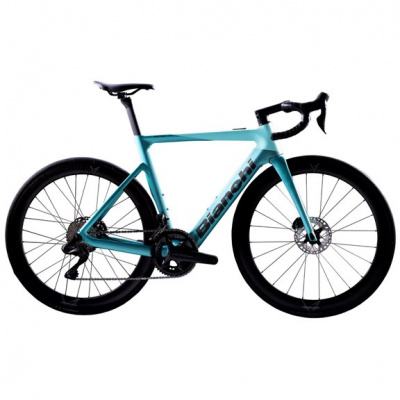
Then there are the stealth options. The Aria e-Road uses a carbon frame and a Mahle hub motor tucked into the rear wheel - barely distinguishable from a standard race bike unless you clock the subtle battery integration. The Impulso e-Gravel follows the same philosophy for mixed-surface riding. Both are covered in more depth on our Bianchi Road Bikes and Bianchi Gravel Bikes pages, where you'll also find the non-motorised drop-bar options and fuller geometry breakdowns.
How Bianchi Approaches Motor and Frame Integration
The most interesting thing about Bianchi's tech choices is what they didn't do - they didn't pick one motor system and apply it everywhere. The Mahle X35 and X20 hub units on the drop-bar bikes preserve a natural Q-factor and produce zero drag when the assist cuts out above 25km/h. That matters enormously on a road bike. A clunky mid-drive on a race-geometry frame kills the feel completely; the Mahle system largely sidesteps that problem. The Reparto Corse geometry integration - Bianchi's performance-focused design process - ensures the motor sits within the overall weight distribution rather than fighting it.
For the e-Omnia and e-Vertic, the calculus flips. Urban riders carrying bags, and trail riders hammering rooty climbs in Wales, need torque more than they need subtlety. The Bosch Performance Line CX delivers up to 85Nm at the crank, which is enough to make a fully loaded touring bike feel alive on a steep drag, or an e-MTB feel properly planted mid-climb on loose ground. On the e-Vertic FX-Type, Bianchi's proprietary asymmetric carbon swingarm is worth understanding. It's built to handle the additional torsional load that a powerful mid-drive creates through the chainstay - stiffening the rear end where it needs it, while a motor shield protects the drivetrain from trail debris. It's a genuine piece of engineering rather than a cosmetic detail.
Premium models also carry Countervail (CV) vibration-cancelling architecture within the carbon layup. It's not a separate component - it's woven into the frame material itself, damping high-frequency road buzz without adding compliance that would blunt handling precision. On a long day in the saddle, that's the difference between arriving tired and arriving wrecked. If you're comparing platforms, Cube e-Bikes and Cannondale e-Bikes both use Bosch CX systems in their trail ranges too, but neither applies the same asymmetric swingarm solution - it's a Bianchi-specific answer to an e-MTB-specific problem.
Weight is worth addressing plainly. The Aria e-Road sits around 12kg - light enough that most riders won't think twice about it. The full-suspension e-Vertic with a 750Wh Bosch PowerTube battery is a different proposition entirely, closer to 24kg. That's not a criticism; it's physics. A big battery and a full-sus frame cost weight, and the assist more than compensates on the climbs where you'd feel that mass most. Cervélo e-Bikes sit in similar weight territory on their road-oriented electric builds, for context.
Living with a Bianchi E-Bike in the UK
British winters are less a season and more a state of mind, and Bianchi's e-Omnia range has clearly been thought through with that in mind. The integrated lighting system on the C-Type and T-Type models isn't an afterthought - it's designed into the frame and fork so you're not cable-tying a commuter light to a sports bike. Combined with the ABS options available on selected models, it's a genuinely UK-ready commuter setup for dark mornings and wet tarmac.
Battery care matters more than most riders realise before their first cold snap. The Bosch PowerTube integrated into the e-Omnia and e-Vertic frames should come indoors when temperatures drop below freezing overnight. Lithium cells lose capacity in the cold, and repeated deep cold-soaks shorten the battery's long-term health. It takes thirty seconds to remove - make it a habit before the garage hits zero. Keep the charging port dry too; a quick wipe after a wet ride stops road spray from working into the terminal contacts over winter.
Mahle systems on the road and gravel bikes require slightly different attention. The charging port on the Mahle X35 and X20 units is exposed at the rear dropout area, which catches a lot of spray on UK roads. A rubber port cover - usually supplied - should stay in place whenever you're riding. Losing it means grit and water have a direct route into the electronics. Replacement covers are cheap; the alternative isn't.
Mud clearance on the e-Vertic's rear triangle is genuinely useful for British trail riding. The asymmetric swingarm design opens up space around the tyre, so when you're riding through the sort of claggy Welsh mud that sticks like wet concrete, you're less likely to pack the rear end solid. It's a small thing that becomes a big thing after two hours in the Valleys.
If you're still scoping out the broader Bianchi electric bikes UK market before committing, spending time with the e-Omnia and e-Vertic families side by side - whether in a showroom or through detailed spec sheets - makes the discipline split very clear, very quickly. These aren't the same bike with different tyres.
Bianchi E-Bikes FAQs
Are Bianchi e-bikes any good?
Genuinely, yes. Bianchi brings serious frame-building credentials to every model in the range, and the motor choices - Mahle for road, Bosch CX for trail and urban - are matched to each discipline rather than applied generically. Reliability from both drive systems is well established, and the overall build quality sits clearly above the budget end of the market.
What motor does Bianchi use in their e-bikes?
It depends on the bike. Drop-bar road and gravel models use Mahle ebikemotion hub motors - the X35 or X20 - which keep pedalling feel natural and produce no drag once assist cuts out. The e-Omnia urban range and e-Vertic MTB family use Bosch Performance Line CX mid-drives, delivering up to 85Nm of torque where you need real grunt.
How heavy is a Bianchi e-bike?
Weight varies considerably across the range. The Aria e-Road comes in around 12kg thanks to its carbon frame and compact Mahle system - close to a non-assisted road bike. At the other end, the full-suspension e-Vertic with a 750Wh Bosch PowerTube battery sits closer to 24kg. The assist more than offsets that on climbs.