
Alpinestars Trousers
Alpinestars MTB trousers bring decades of motocross crash-testing to the mountain bike world, translating that hard-won knowledge into trousers that resist rock strikes, branch snags and the inevitable tumble on a wet Welsh descent. You're looking at poly-fabric construction that balances abrasion resistance with pedal efficiency - no point armoring up if you can't move. Articulated knees carve out space for bulky pads without bunching, while ratchet waist adjustments dial in security even when you're layering impact shorts underneath. Whether you're charging downhill at Dyfi, threading enduro stages in the Peaks, or just want trousers that won't shred on your local singletrack, Alpinestars cycling pants deliver the durability credentials you'd expect from a brand that's kept motocross riders upright for half a century. The range spans gravity-focused shells with ripstop reinforcement through to lighter trail options with laser-cut ventilation - so the question isn't whether they'll survive your riding, it's which model matches how hard you push.
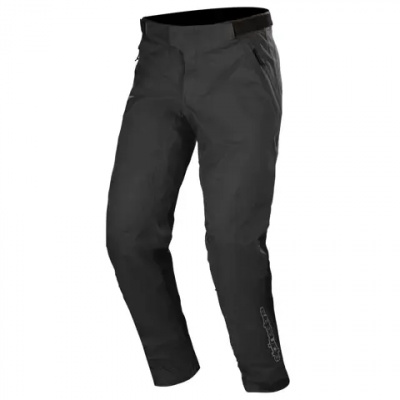
Prices and availability can change quickly. Delivery charges are not always included in listed prices.
Final price, stock status and delivery terms are set by retailer. We may receive a commission on purchases made.
Material Build & Fabric Technology
Poly-fabric multi-panel construction sits at the heart of every pair. Alpinestars map different fabric weights and weaves to match stress zones - heavier denier panels land on the knees, seat and lower leg where you'll meet rock and bark, while 4-way stretch panels slot into the crotch, behind the knee and across the lower back to keep you mobile when you're weighting the pedals or picking through technical sections. Ripstop reinforcement runs through high-wear areas, arresting tears before they propagate. It's a layered approach rather than a single-fabric compromise.
Laser-cut ventilation appears on trail-focused models, punching airflow without weakening seams - handy when you're grinding up fire roads in the Surrey Hills on a muggy June afternoon. Heavier downhill shells skip the perforations in favour of crash protection, banking on shorter run times and chairlift cooling. The fabrics shed light rain and dry quickly, though they're not fully waterproof; if you're out in proper Scottish drizzle all day, you'll want a shell over the top. Chamois liner connection points - via the Flat Snap Connection System - let you click in Alpinestars' own padded inners for longer rides without the fabric creeping or bunching mid-descent.
Fit, Protection Space & Adjustment Systems
Alpinestars trousers generally run true to size but favour an athletic, race-oriented cut - closer through the thigh and calf than baggy casual trousers. That snugness serves a purpose: less fabric flapping in the wind or snagging on the saddle. Pre-curved legs mirror the pedaling position, so the knee sits naturally bent even when you're standing. Crucially, knee pad compatibility is engineered in from the start. The articulated knee zones provide volume for bulky D3O or foam inserts without strangling your leg or riding up when you crouch into steep sections.
Ratchet waist adjustment - a motocross carryover - offers micro-adjustability and stays put under a hip pack or when you're wrestling the bike through a rock garden. Some models use hook-and-loop tabs instead, which work fine but lack the same on-the-fly precision. If you're planning to layer impact shorts or padded liners underneath, sizing up half a size and cinching the waist gives you breathing room without compromising security. The Flat Snap system clicks liner shorts into place at the waistband, preventing the chamois from migrating when you're out of the saddle. Are Alpinestars MTB pants true to size? Yes, but that race fit means riders between sizes or those stacking protection should consider the next size up and rely on the adjustment hardware to dial it in.
Model Selection: Downhill Shells vs. Trail-Ready Options
Which Alpinestars trousers are best for downhill? The Techstar and Racer lines lead here. Built with heavier denier fabrics and extensive ripstop zones, they're designed to survive repeated impacts and abrasion at speed - think Fort William rock gardens or the gnarlier lines at BikePark Wales. Pre-curved legs accommodate full knee and shin guards without restriction, and the cut assumes you're spending more time descending than climbing. Weight isn't the priority; durability is. Pair them with Alpinestars gloves and you've got a cohesive gravity kit.
For all-mountain and enduro riding - where you're pedaling as much as you're descending - the Nevada and Alps models strip weight and add breathability. Lighter poly-fabric construction and increased stretch panel coverage keep you comfortable on long climbs out of Grizedale or looping the Tweed Valley. Ventilation becomes more generous, and the fit relaxes slightly to suit knee pads rather than full leg armor. These trousers still resist trail-side scrapes, but they won't shrug off a high-speed crash the way the Techstar will. If you're comparing across brands, Fox trousers and Leatt trousers occupy similar niches, though Alpinestars' motocross pedigree often translates to tougher stitching and more robust hardware.
Do Alpinestars cycling trousers have liner shorts? Most are sold as shells only - you supply your own chamois or padded liner. The Flat Snap Connection System is there to integrate Alpinestars' own inners, but it'll work with any shorts that have snap buttons sewn in. If you prefer riding without a chamois, the trousers function perfectly well solo; just be aware that seams can chafe on longer rides without a barrier layer.
Motocross Roots Meet Mountain Bike Demands
Alpinestars spent decades refining protective gear for riders launching 40-foot tabletops and landing on hardpack at speed. That supercross DNA - articulated joints, impact-resistant panels, hardware that doesn't fail mid-moto - translates directly to mountain biking's demands. The brand didn't just rebadge moto trousers; they adapted the construction principles to suit pedaling efficiency, lighter weight and the specific abrasion patterns mountain bikers encounter. Vector Tech integrates impact protection into the garment architecture without adding bulk, while the No-Fly Zone zipper spec ensures closures won't grenade after a season of mud and grit. It's engineering informed by consequence, not just comfort.
That pedigree matters when you're committing to a steep chute in the Peaks or threading tight trees in Dalby Forest. You're not wearing trousers designed by a committee that's never seen a bike park; you're wearing gear refined by riders who understand what happens when things go sideways. Complete the kit with Alpinestars jackets or layer a technical tee underneath for temperature regulation. If you're already running Alpinestars baggy shorts in summer, the trousers are a natural extension for cooler months or rowdier riding.
Practical Considerations & Trade-Offs
Alpinestars Enduro pants and downhill trousers excel at protection and durability, but that focus brings trade-offs. The race-oriented fit won't suit riders who prefer a looser, skate-inspired silhouette - if you want room to spare, look at Endura trousers or Troy Lee Designs for a more relaxed cut. Water resistance is adequate for trail spray and brief showers, but sustained rain will eventually soak through; these aren't waterproof shells. If you're riding through a Scottish winter, a separate waterproof layer over the top is the sensible call.
Heavier downhill models can feel restrictive on long climbs - fine if you're shuttling or riding a lift, less ideal if you're self-shuttling fire roads for an hour. Trail models address that with lighter fabrics and more stretch, but you sacrifice some crash protection in return. Sizing between athletic and relaxed fits can be tricky; try them on with the pads and liners you'll actually wear, or be prepared to use the return window. The Flat Snap system only works with compatible liner shorts, so if you're committed to a different brand's chamois, you'll need to sew in your own snaps or go without the connection.
Maintenance is straightforward - cold wash, hang dry, avoid fabric softener that'll clog the stretch panels. Zippers and ratchets benefit from a quick rinse after muddy rides to prevent grit jamming the mechanism. Ripstop panels will eventually fray after repeated crashes, but that's the fabric doing its job; a patch or stitch keeps them serviceable long after lesser trousers would've torn clean through.