
Alpinestars Jackets
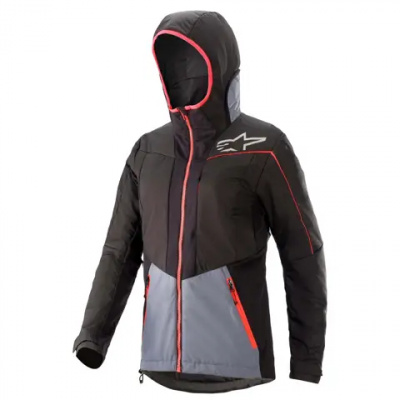
Alpinestars MTB jackets cover the full spectrum of what UK riding throws at you - from the kind of drizzle that sneaks up on you halfway up a Peak District climb to the sideways Welsh rain that makes you question your life choices. The range runs from featherlight packable windbreakers you'll forget are in your pack, all the way to bombproof winter shells that laugh at a flooded bridleway. What ties them together is a consistent focus on fit for the riding position: articulated sleeves that don't ride up when you're stretched over the bars, drop tails that keep your lower back covered when you're hunched on a descent, and helmet-compatible hoods that actually work with a lid on. Breathability is built in rather than bolted on - these aren't jackets that leave you boiling on the steep stuff. Whether you're chasing trail flow in the Surrey Hills or grinding out a soggy winter loop, Alpinestars has thought about how a jacket behaves when you're actually moving on a bike, not just standing still in a car park. That considered, functional approach is what separates this range from the more generic options crowding the market.
Prices and availability can change quickly. Delivery charges are not always included in listed prices.
Final price, stock status and delivery terms are set by retailer. We may receive a commission on purchases made.
Fabric Tech and Weather Performance
The headline technology across the Alpinestars waterproof cycling jacket range is Drystar® - their proprietary breathable membrane that blocks rain from getting in while allowing moisture vapour to escape outward. On paper that's what every brand claims; in practice, the distinction comes down to construction. The heavier-duty models use a 3-layer ripstop construction where the membrane is laminated directly to the face fabric and a protective backer, removing the loose inner lining that traps sweat and slows moisture transfer. Lighter jackets step down to a 2.5-layer build - still waterproof, but packable enough to stuff into a jersey pocket for a sudden shower on an otherwise clear day.
On top of the membrane, all Alpinestars jackets carry a DWR (Durable Water Repellent) coating on the outer face fabric. DWR makes water bead and roll off rather than saturate the material - critical on trail rides where you're moving through wet vegetation as much as riding in actual rain. Critically, taped seams on the waterproof models stop water finding its way through the needle holes at every stitch line, which is where cheaper jackets give up first.
Where Alpinestars earns points on breathability is mechanical venting. Pit zips and laser-cut ventilation panels let you manage core temperature actively - crack the underarm zips open on a steep climb, seal them back up on the descent. That toggle between effort and exposure matters more than any membrane rating when you're doing back-to-back laps and your output keeps shifting. If you're weighing this range against something like Endura jackets or Altura jackets, the mechanical venting on the Alpinestars lineup is a genuine differentiator rather than a tick-box feature.
Understanding the Alpinestars Fit and Range
Alpinestars jackets are cut for trail riding, which means a relaxed fit with room to move rather than the close, aero tuck you'd find on a road-orientated shell. The articulated sleeves are set forward at the shoulder so your arms sit naturally over the bars without the jacket pulling tight across your back - a small detail that becomes obvious after an hour on technical singletrack. The drop tail at the rear keeps coverage where you need it when you're seated and bent forward; stand up out of the saddle and it doesn't bunch or ride up.
The range breaks down into clear use cases. The Tahoe is the serious weather jacket - built for winter riding and sustained heavy rain, with full waterproofing, taped seams, and the kind of durable ripstop that'll survive repeated contact with muddy Welsh trail edges and still wash clean. The Nevada sits in the middle ground as a thermal windproof option - less focused on heavy rain, more on keeping wind and chill off during late-autumn or early-spring rides where the temperatures are low but the skies are dry. The Descender is the packable end of the range: minimal weight, compresses small, and acts as your insurance policy against the shower that wasn't in the forecast.
Are Alpinestars MTB jackets true to size? Generally, yes. The trail-oriented cut means most riders land on their usual size, but if you're planning to layer a thermal mid-layer or run body armour underneath, sizing up gives you the mobility and clearance you'll want. The helmet-compatible storm hood with shock cord adjustments fits properly over a trail helmet without ballooning or collapsing across your peripheral vision - worth checking if that's part of your riding setup.
If you're after an alternative cut or price point, 100% jackets are worth comparing - they take a similarly MTB-first approach to fit. For a complete outfit, the jackets pair naturally with Alpinestars jerseys and Alpinestars gloves if you want a matched layering system.
Layering and Care for UK Riding
Getting the layering right matters more than the jacket itself. For autumn riding - think October mornings in the Chilterns where you start cold and finish sweating - pair a lightweight Alpinestars windproof MTB jacket over a moisture-wicking jersey and nothing else. Adding a mid-layer too early in the season is how you end up soaked from the inside rather than the outside. Once you're into proper winter, a merino or synthetic thermal base layer under the jacket works well; the relaxed fit accommodates it without restricting your movement through the bars.
The one thing that kills a waterproof jacket faster than any trail abuse is washing it wrong. Use a tech-wash - products like Grangers or Nikwax Tech Wash - on a gentle, cool cycle. Avoid bio detergents entirely; the enzymes strip DWR coatings. Fabric softener is worse still, blocking the pores in the breathable membrane so moisture stops passing through. After washing, either air dry or run the jacket through a tumble dryer on a low heat setting. The gentle heat reactivates the DWR coating so water starts beading off again properly - skip this step and you'll find the jacket wetting out sooner than it should, even if the membrane underneath is still doing its job.
Abrasive, muddy winter loops - the sort you'd find on Scottish trails or the North York Moors in February - will test any jacket's outer fabric. The ripstop construction on Alpinestars' waterproof models is built for this, but it's worth rinsing mud off promptly rather than letting it dry in, which works abrasive particles into the face fabric over time. With that care routine, these jackets stay functional across multiple seasons rather than degrading after a single winter. Pair them with Alpinestars MTB baggy shorts for a system that's designed to work together at the waist and hip interface.
Alpinestars Jackets FAQs
Are Alpinestars MTB jackets true to size?
They generally run true to size with a relaxed, trail-oriented cut that gives you room to move over the bars. If you're planning to wear a chunky thermal mid-layer or body armour underneath, go a size up to keep your mobility where you need it.
How waterproof are Alpinestars cycling jackets?
It depends on the model. Three-layer Drystar® jackets with fully taped seams handle sustained heavy rain well - the kind of prolonged downpour you'd hit on a Scottish winter ride. Lighter windbreaker options use a DWR coating that fends off trail spray and brief showers but aren't designed for hours in heavy rain.
How should I wash my Alpinestars waterproof jacket?
Machine wash on a gentle, cool cycle using a dedicated tech-wash - Grangers or Nikwax are solid choices - and keep fabric softener and bio detergents well away. Finish with a low-heat tumble dry or a warm iron over a cloth to reactivate the DWR coating; it's what keeps water beading off rather than soaking in.